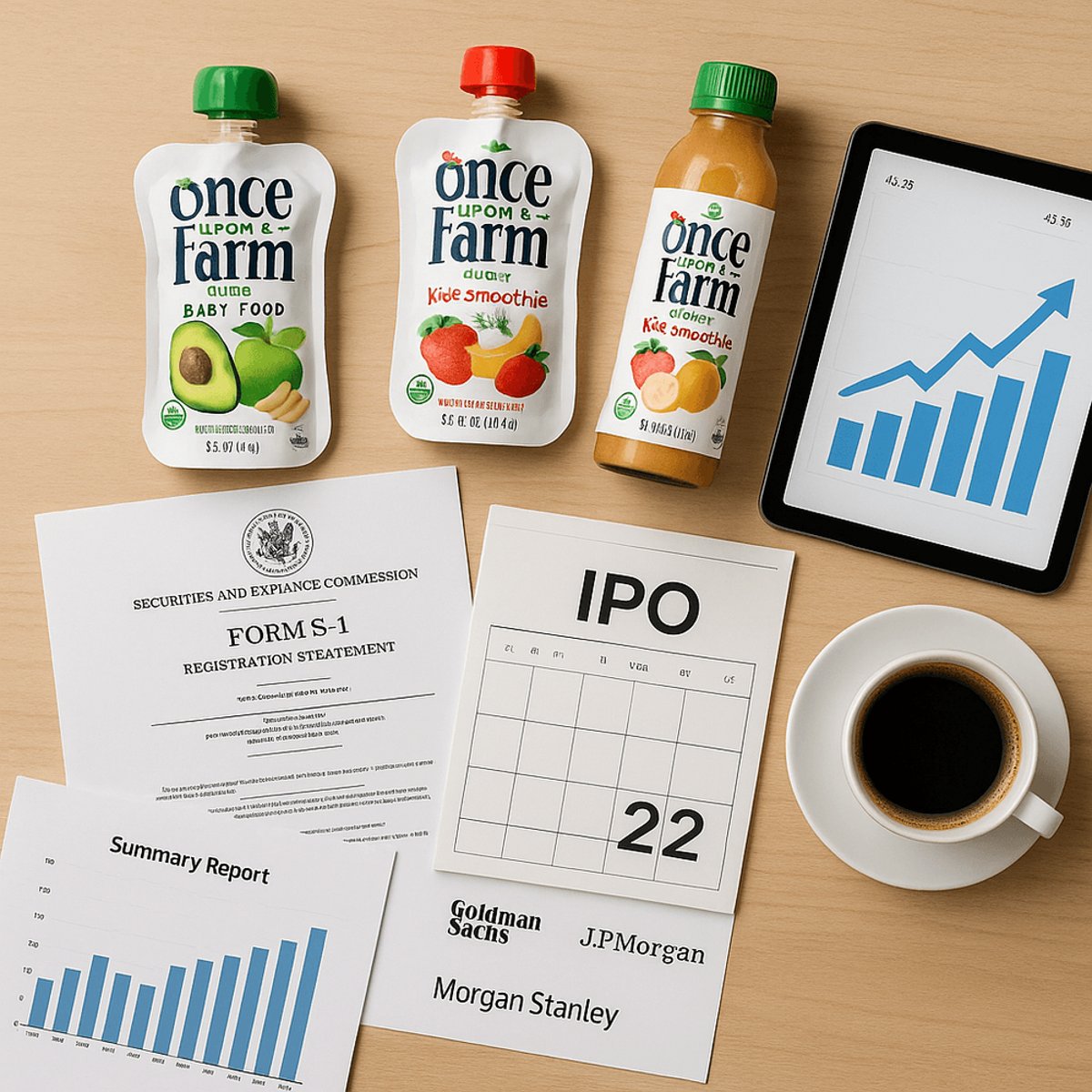
Jennifer Garner's organic kids' snack company Once Upon a Farm is back on track for its public debut after pausing plans during last year's government shutdown. The company filed an updated S-1 with the SEC on Tuesday, setting a price range of $17-$19 per share and targeting a February 6 listing. With Goldman Sachs and J.P. Morgan leading the deal, the move signals renewed momentum in a sluggish IPO market that's seen few consumer brands attempt public offerings since 2023.
Once Upon a Farm is making another run at going public, and this time the organic baby food maker thinks the market's ready. The company filed an amended S-1 with the SEC on Tuesday, setting a price range of $17 to $19 per share for what could be one of the first consumer brand IPOs of 2026. If everything goes according to plan, the company will start trading February 6, according to IPO Scoop.
The timing's notable. Once Upon a Farm had originally planned to go public last year but hit pause when the government shutdown threw a wrench into the regulatory machinery. Now the California-based company is betting that the IPO window's cracking open again - and it's bringing some serious firepower to make it happen. Goldman Sachs and J.P. Morgan are leading the offering, which aims to raise at least $208.9 million and value the company at $764.4 million, Reuters reported.
That valuation puts Once Upon a Farm in an interesting position. The company's carved out a niche in the premium organic baby food space since its 2015 launch, competing with established players while riding the wave of millennial and Gen Z parents willing to pay up for clean-label products. Co-founded by serial entrepreneurs Cassandra Curtis and Ari Raz, the company got a major boost when actress Jennifer Garner joined as a co-founder and became the face of the brand.
Garner's involvement isn't just celebrity window dressing. Her active promotion of the brand on social media and in traditional media has helped Once Upon a Farm punch above its weight in a crowded category dominated by legacy food companies. The company sells refrigerated fruit and vegetable pouches, smoothies, and snacks marketed as containing no artificial ingredients - products you'll find in the cold case at retailers rather than on shelf-stable aisles.
According to PitchBook data, Once Upon a Farm has raised close to $100 million in venture funding before this IPO attempt. Backers include S2G Ventures, a food and agriculture-focused firm, and CAVU Consumer Partners, which specializes in consumer brands. That's a relatively modest funding total for a company trying to go public at a three-quarter-billion-dollar valuation, suggesting the business has been fairly capital-efficient or that investors are betting on significant growth potential.
The broader context matters here. The IPO market's been effectively frozen for consumer brands since the tech bubble burst in 2022. Public market investors have shown little appetite for growth-stage consumer companies, especially those in competitive categories with thin margins. But there are signs things might be shifting. If Once Upon a Farm successfully prices and trades well, it could open the door for other venture-backed consumer brands that have been waiting on the sidelines.
The S-1 filing comes at a moment when the organic and natural foods category is facing headwinds. Inflation-conscious consumers have been trading down from premium brands, and the pandemic-era boom in at-home food consumption has normalized. Once Upon a Farm will need to convince public market investors it can maintain growth while achieving profitability - a tough sell in a category where even giants like Amazon-owned Whole Foods have struggled with margin pressure.
Still, the company's focus on the baby and kids' segment gives it some insulation. Parents tend to prioritize premium products for young children even when they're cutting costs elsewhere. And the refrigerated format creates a moat of sorts - it requires specific supply chain capabilities and retail relationships that not every competitor can easily replicate.
What happens next will reveal whether public markets are truly ready to embrace consumer brands again or if Once Upon a Farm's timing is still premature. The price range suggests the company and its bankers think there's demand, but the proof will come when institutional investors actually commit capital. February 6 might not just mark Once Upon a Farm's debut - it could signal whether the IPO drought for consumer startups is finally ending.
Once Upon a Farm's IPO attempt is more than just another company going public - it's a test case for whether consumer brands can still attract public market capital in 2026. With a celebrity co-founder, nearly $100 million in VC backing, and blue-chip investment banks leading the charge, the company has the ingredients for a successful debut. But the real question is whether investors believe in the long-term economics of premium organic baby food enough to support a $764 million valuation. If the February 6 debut goes well, expect other consumer startups to dust off their S-1 drafts. If it stumbles, the IPO freeze might last a while longer.