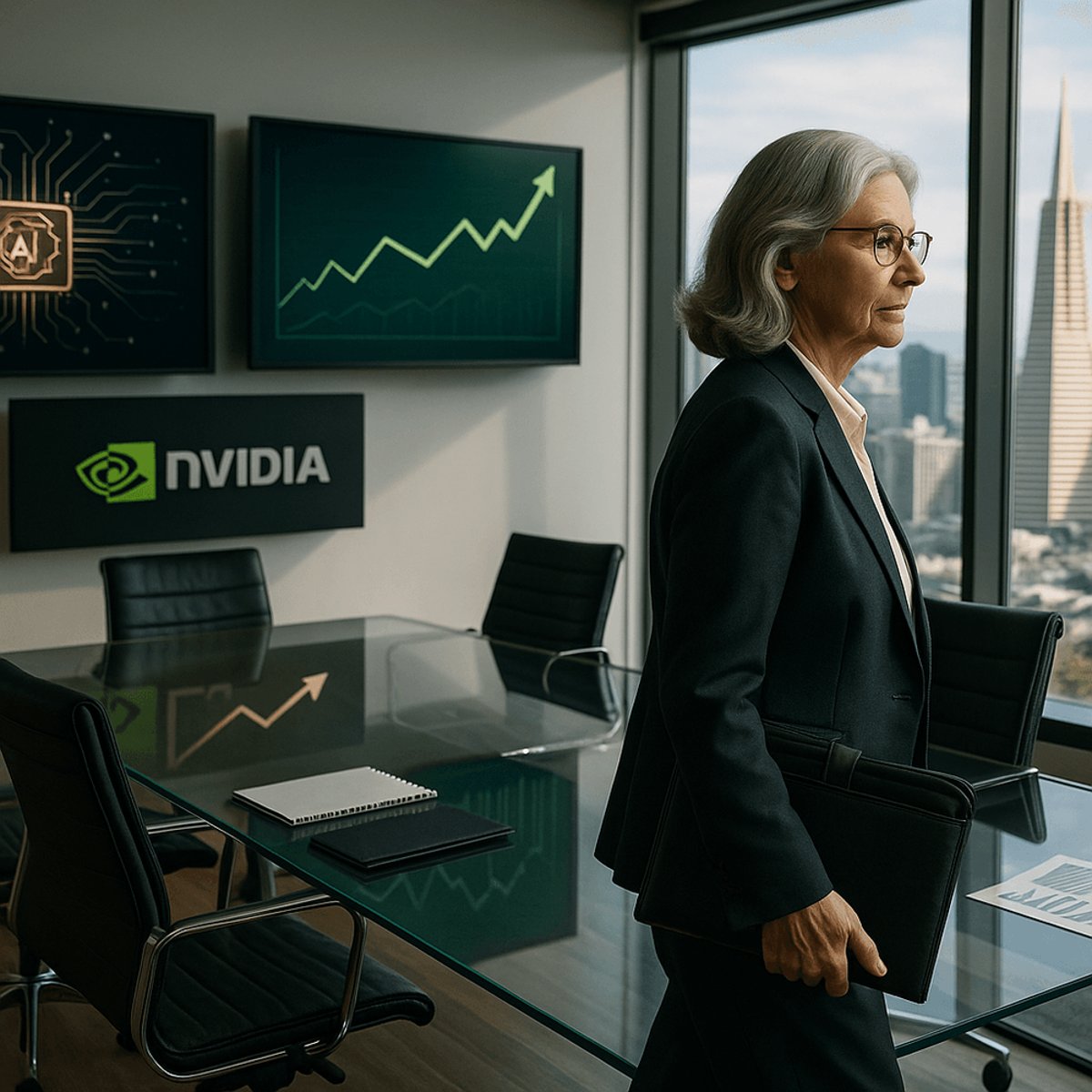
Nvidia just lost one of its longest-serving board members. Persis Drell, a Stanford engineering professor who joined the chipmaker's board in 2015, resigned Wednesday to pursue what the company calls a "new professional opportunity." She walks away with nearly 143,000 shares worth roughly $26 million - a windfall built during Nvidia's historic 22,000% stock surge since she joined. The timing raises eyebrows as Nvidia navigates heightened scrutiny over AI chip exports and competitive pressure from Chinese startups finding workarounds to U.S. restrictions.
Nvidia disclosed Persis Drell's resignation in an SEC filing late Friday, marking the end of a decade-long tenure that coincided with the company's transformation from graphics chip maker to AI infrastructure kingpin. The announcement came with the standard corporate language - she's leaving for a "new professional opportunity" with no disagreements over operations or policies - but the numbers tell a more compelling story.
Drell joined Nvidia's board in late 2015 when the stock traded around $5 per share (split-adjusted). Today it hovers near $185, delivering that eye-watering 22,000% return that's made early board members exceptionally wealthy. Her compensation package last year totaled $344,000, with nearly $259,000 coming in stock awards according to Nvidia's annual report. She also sold roughly 40,000 shares during 2025, likely for tax purposes or portfolio diversification as her Nvidia holdings ballooned.
The 69-year-old physicist brought serious technical credibility to Nvidia's governance. She's been at Stanford since 2002, rising from professor to dean of the engineering school (2014-2017) and then provost (2017-2023). Before that she ran SLAC, Stanford's particle accelerator lab, from 2007 to 2012. Her background in high-performance computing and complex systems gave her unique insight into the computational challenges Nvidia's chips aim to solve.
Drell served on the compensation committee, the group responsible for setting CEO Jensen Huang's pay package - a role that's drawn increased attention as Huang's net worth has skyrocketed past $100 billion. The committee signed off on compensation structures that heavily favor long-term stock performance, aligning executive incentives with the AI boom that's pushed Nvidia to briefly become the world's most valuable company.
Her departure shrinks the board to 10 directors, the smallest it's been in recent years. The last board member to leave was Ellen Ochoa, the former astronaut and NASA administrator who resigned in June 2025. Nvidia hasn't indicated whether it plans to fill Drell's seat or keep the board at its current size. Jensen Huang remains among the 10, alongside tech veterans and academics who've helped steer the company through rapid growth.
The timing is notable. Nvidia faces mounting pressure on multiple fronts despite its market dominance. The Biden administration's export restrictions on advanced AI chips to China have forced the company to develop watered-down versions for that crucial market, while Chinese AI startups are increasingly finding ways to train competitive models without access to Nvidia's latest hardware. CNBC reported this month that Chinese AI models are adapting techniques to work around Nvidia chip limitations.
At the same time, competition is heating up from AMD, startups like Cerebras, and even Nvidia customers like Google and Amazon who are building custom AI chips to reduce dependence on Nvidia's ecosystem. The company's stock has been volatile, swinging between $120 and $200 over the past six months as investors debate whether AI infrastructure spending can sustain its breakneck pace.
Drell's "new professional opportunity" remains unspecified in the filing. At 69, she could be transitioning to advisory roles, corporate positions, or simply focusing on academic research after decades in administrative leadership. Stanford's engineering school and SLAC continue to be at the forefront of AI research and quantum computing, areas where her expertise would be valued.
For Nvidia shareholders, board stability matters less than product roadmaps and market positioning, but governance changes can signal shifting priorities. The company has been methodically refreshing its board over the past few years, bringing in directors with AI, cybersecurity, and international business experience. Whether Nvidia seeks another academic technologist to replace Drell or pivots toward someone with different expertise will offer clues about where management sees future challenges.
The $26 million stock haul underscores how lucrative board service at high-growth tech companies has become. Directors at Apple, Microsoft, and other mega-cap tech firms routinely accumulate eight-figure equity stakes, creating potential conflicts between fiduciary duty and personal wealth preservation. Drell's decision to step down while holding such a substantial position suggests the new opportunity is compelling enough to justify giving up future board compensation and equity grants that could be worth millions more if Nvidia's AI dominance continues.
Drell's exit closes a chapter on one of Nvidia's most profitable eras for insiders, but it's unlikely to disrupt operations at a company where Jensen Huang maintains tight strategic control. The real question is what her departure signals about board composition going forward. As Nvidia navigates geopolitical chip wars, antitrust scrutiny, and the inevitable maturation of AI infrastructure spending, the expertise mix around the boardroom table could prove just as important as the silicon coming out of its fabs. Investors should watch whether the company replaces her with another technical expert or shifts toward someone with regulatory or international trade experience - a potential tell for where management sees the biggest risks ahead.