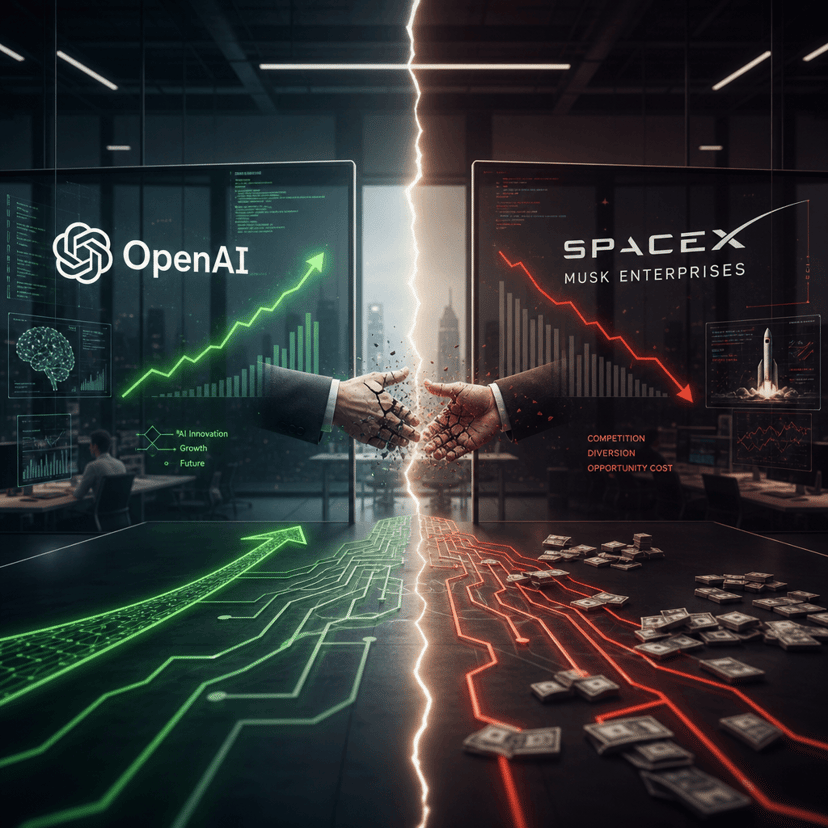
OpenAI just turned its back on more than $1 billion in annual revenue rather than stay in business with a company owned by Elon Musk. According to WIRED, OpenAI had internally projected its partnership with AI coding startup Cursor would generate over $1 billion a year, but pulled the plug the moment Musk's SpaceX acquired the company.
Sometimes the biggest business decisions aren't about the money. OpenAI just proved that by walking away from a partnership with Cursor that it had internally estimated would bring in more than $1 billion a year in revenue, according to reporting from WIRED. The reason wasn't a product dispute or a pricing disagreement. It was Elon Musk.
Cursor, the buzzy AI coding assistant that's become a favorite among developers for its ability to write and debug code using large language models, was recently acquired by Musk's SpaceX. Once that deal closed, OpenAI reportedly decided it no longer wanted to be in business with a company under Musk's umbrella, even one generating serious revenue through its API.
"OpenAI recently estimated its Cursor partnership would make more than $1 billion in revenue a year," WIRED reported. "It still walked away after Elon Musk's SpaceX acquired the AI coding startup." That's a striking admission. Companies rarely leave that kind of money on the table unless something else is driving the decision, and in this case, it's clearly personal history between OpenAI and its co-founder turned fiercest critic.
Musk helped start OpenAI back in 2015 before splitting with the company in 2018 over disagreements about its direction. Since then, he's built xAI as a direct competitor, sued OpenAI over its shift to a for-profit structure, and repeatedly criticized CEO Sam Altman in public. That rivalry has only intensified as both companies race to dominate the AI coding and agent space, a market Cursor has quickly become one of the most valuable players in.
For OpenAI, Cursor wasn't just another customer buying API access. It was one of the fastest-growing consumers of OpenAI's models, embedding them directly into a coding tool used by engineers at startups and major tech companies alike. Losing that revenue stream, even temporarily, is a real cost. But OpenAI appears to have calculated that funding a Musk-owned company, even indirectly through API fees, wasn't worth the optics or the strategic risk.
The timing matters too. AI coding tools have become one of the hottest battlegrounds in the industry, with companies like Anthropic, Google, and OpenAI itself all pushing competing coding assistants. Cursor had built its reputation partly on being model-agnostic, letting developers tap into whichever AI backend performed best. SpaceX's acquisition changes that calculus entirely, giving Musk a foothold in a market where he's been trying to catch up.
It's not clear yet who will fill the gap OpenAI left behind. Cursor could lean more heavily on Anthropic's Claude models, which it already supports, or SpaceX could push the startup toward using Musk's own xAI models instead. Either way, the split signals that Cursor's technology stack is about to look very different under its new ownership.
What's most telling here isn't the dollar figure, it's the willingness to sacrifice it. OpenAI has spent the past year locked in expensive compute deals, aggressive fundraising, and a scramble to stay ahead of rivals. Turning down guaranteed revenue in that environment is not a small thing. It suggests the rift between Altman and Musk has moved well past legal filings and Twitter jabs into the realm of actual business strategy, where OpenAI is now willing to eat losses just to avoid enriching a company Musk controls.
The bigger question going forward is whether this becomes a pattern. If OpenAI is prepared to walk from a nine-figure-plus partner over ownership ties to Musk, it raises the stakes for any other startup that might find itself acquired by xAI, SpaceX, or Musk's other ventures. For now, Cursor is left figuring out its next move, and the AI coding wars just got a lot more personal.
This isn't just a business breakup, it's a signal of how deep the rivalry between Sam Altman and Elon Musk has become. OpenAI proved it's willing to forgo real, substantial revenue rather than indirectly fund a Musk-owned venture, and that decision could ripple through the AI coding market as Cursor figures out its next steps under SpaceX. Anyone tracking the AI arms race should watch closely for who Cursor partners with next, and whether OpenAI's move becomes a one-off or the start of a broader pattern of avoiding anything tied to Musk.