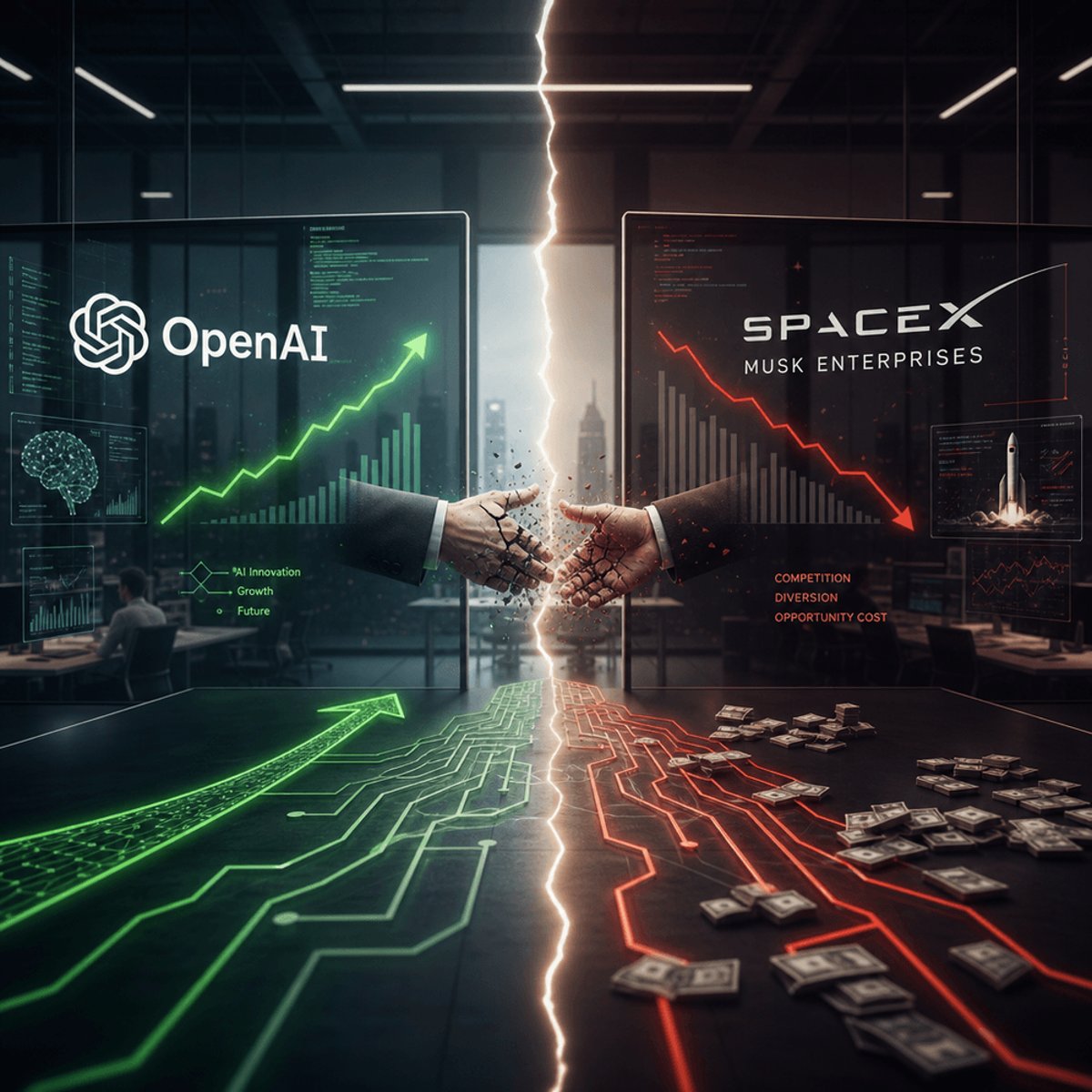
OpenAI just turned its back on more than $1 billion in annual revenue rather than stay in business with a company owned by Elon Musk. According to a new report from Wired, OpenAI walked away from its lucrative partnership with AI coding startup Cursor almost immediately after Musk's SpaceX acquired the company, a decision that underscores just how personal the rivalry between Sam Altman and Musk has become.
OpenAI just walked away from more than a billion dollars a year in projected revenue, and it did so on purpose. According to Wired, the company had internally estimated that its partnership with Cursor, the fast-growing AI coding assistant, would generate over $1 billion annually. Then Elon Musk's SpaceX acquired Cursor, and OpenAI cut ties almost immediately.
That's a stunning number to leave on the table, especially for a company that's been burning cash at an eye-watering pace to train and run its models. But sources familiar with the matter told Wired that OpenAI's leadership decided the revenue wasn't worth the optics, or the reality, of funneling money into a business now controlled by Musk, OpenAI's co-founder turned fiercest critic and legal adversary.
The two men have been at war for years. Musk sued OpenAI and Sam Altman last year, alleging the company abandoned its founding nonprofit mission in favor of profit-driven deals with Microsoft, a case that's still winding through the courts. He's also used X and his own AI venture, xAI, to needle OpenAI at nearly every turn. Against that backdrop, a nine or ten-figure revenue stream flowing indirectly into a Musk-owned company was apparently a bridge too far.
Cursor, made by Anysphere, had built its reputation as one of the buzziest names in AI-assisted coding, competing directly with tools like GitHub Copilot and Amazon's CodeWhisperer for a developer base hungry for faster, smarter code generation. Its integration with OpenAI's models had reportedly been a major driver of usage and revenue on both sides, making the split a real loss for OpenAI's enterprise business, not just a symbolic one.
Neither OpenAI nor SpaceX has publicly detailed the terms of the original deal or confirmed the exact revenue figures cited in Wired's reporting. OpenAI did not immediately respond to a request for comment on the decision, and SpaceX has not commented on how it plans to integrate or run Cursor going forward. That silence leaves plenty of open questions about what happens next to the product itself, and whether Cursor's engineering team will pivot toward xAI's Grok models as a replacement for OpenAI's technology.
This isn't the first time business decisions in the AI industry have been shaped as much by personal rivalries as by pure economics. Musk has previously pulled back advertising and partnership commitments tied to companies he's feuded with, and Altman has been just as willing to draw hard lines when Musk is on the other side of the table. The Cursor episode fits a pattern where the two men's public feud increasingly spills into concrete business decisions worth real money.
For OpenAI, the calculus seems to be that protecting its narrative, and avoiding any appearance of funding a Musk enterprise, is worth more than the revenue itself. That's a notable stance for a company that's reportedly been under pressure to justify its valuation and spending through actual commercial traction, not just user growth. Turning down nine figures in annual revenue is the kind of move that only makes sense if the strategic cost of staying in the deal outweighs the financial upside.
What happens to Cursor's roughly however-many enterprise and individual users now sits in limbo. If SpaceX folds Cursor's technology into its own internal tooling, or spins it out with a different AI backend, the coding assistant market could see a meaningful shakeup. Rivals like GitHub Copilot, Replit's Ghostwriter, and newer entrants will be watching closely to see if OpenAI's exit creates an opening to poach Cursor's user base.
The bigger story here is what it says about how deeply the Musk-Altman rivalry now shapes decisions across the AI industry. Billion-dollar revenue lines are being redrawn not just by market forces, but by who owns what and who's feuding with whom. As this saga continues, expect more scrutiny on OpenAI's other partnerships for similar entanglements, and don't be surprised if Musk responds publicly, given his track record of doing exactly that whenever OpenAI makes a move he can spin into a headline.
Whatever the exact numbers turn out to be, the message from OpenAI is clear: it's willing to give up serious money to keep any distance from Elon Musk's business empire. For an industry that likes to talk about rational, data-driven decision-making, this is a reminder that personal history and rivalry still drive some of the biggest calls in AI. Readers should keep an eye on where Cursor's technology and user base land next, and whether this is the last time OpenAI walks away from a deal simply because of who's on the other side of it.