Nvidia just dropped a free tool that could change how people run AI at home. Called Personal AI Router, or PAIR, the open-source software links up every compatible computer on your home network, turning a spare gaming PC or an old laptop into extra horsepower for running large language models locally, no cloud subscription required.
Nvidia is done waiting for consumers to buy into the idea that AI has to live in someone else's data center. The company just announced its new Personal AI Router, or PAIR, a free tool that syncs up the computers already sitting around your house so they can tackle AI inference tasks together, no cloud bill attached.
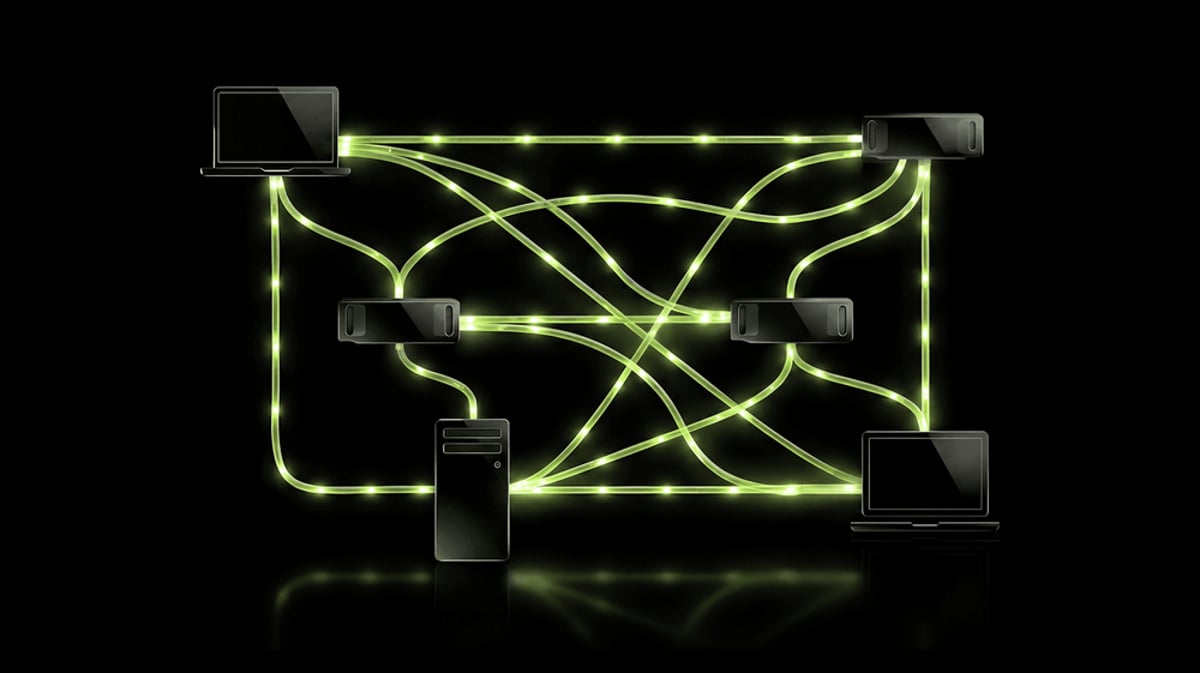
Let's clear up the obvious confusion first. Despite the name, PAIR isn't a piece of hardware you plug in. It's open-source software built by Nvidia that scans your home network, finds compatible machines, links them together, and preps them to share the load on agentic AI workflows, the kind of multi-step tasks where an AI model plans, reasons, and executes rather than just spitting out a single response.
Most of the compatible hardware is unsurprisingly Nvidia's own. PAIR runs on GeForce GPUs going back to the RTX 20-series, plus the newer RTX Pro lineup and Nvidia's DGX Spark systems, according to details shared with The Verge. But here's the twist that caught people's attention: Apple silicon gets a seat at the table too. Macs running M4 chips or newer are also supported, a rare bit of cross-platform cooperation for a company that typically keeps its AI tooling tightly wrapped around its own GPUs.
The timing isn't random. Local AI inference, running models directly on your own hardware instead of routing every query through a company's cloud servers, has been gaining traction among privacy-conscious users and hobbyists tired of subscription fatigue. Tools like Ollama and LM Studio have already made it possible to download and run open models like Llama or Mistral on a single machine. What PAIR adds is the ability to pool multiple machines together, so instead of being limited by whatever GPU memory sits in one box, a household could theoretically combine the compute of a gaming rig, a workstation, and a MacBook into something closer to a mini AI cluster.
That's a meaningful shift for anyone who's hit the wall of running larger models locally. Big language models are memory-hungry, and consumer GPUs, even high-end ones, often can't hold an entire model in memory on their own. By distributing that load across several machines on a home network, PAIR is essentially offering a DIY version of the distributed computing tricks that data centers have used for years, just scaled down for a living room setup.
It also fits into Nvidia's broader strategy of making sure its hardware stays relevant no matter where AI workloads end up running. The company has spent the last few years dominating the data center GPU market, but as more AI processing moves to the edge, onto phones, laptops, and home PCs, Nvidia wants its chips baked into that shift too. Giving away free software that makes older RTX cards more useful for AI tasks is a clever way to extend the lifespan and relevance of GPUs that might otherwise be gathering dust, while nudging future GPU purchases toward the RTX ecosystem.
The Apple compatibility angle raises its own questions. Nvidia and Apple aren't exactly known for deep collaboration, so supporting M4 chips suggests Nvidia sees enough demand among Mac users running local AI tools that it's worth building bridges rather than walls. It's a small but telling sign that the local AI inference space is becoming crowded and competitive enough that hardware vendors are willing to play nice across ecosystems if it means more people using their tools.
What happens next probably depends on adoption. If PAIR catches on with the hobbyist and prosumer crowd already running Ollama or LM Studio setups, it could push more people toward multi-device local AI rigs instead of cloud subscriptions. That's a slow-moving trend, but one that chips away at the recurring-revenue model cloud AI providers have leaned on. For now, PAIR is free, open-source, and available for anyone with the right hardware to try, which is about as low-friction a launch as Nvidia could manage.
For everyday users, PAIR is a glimpse at where personal AI compute might be headed: less reliance on cloud subscriptions, more use of the hardware already sitting in your house. It won't replace big cloud models overnight, but it's a low-cost experiment that could reshape how hobbyists and prosumers think about running AI locally, and it's worth watching whether Ollama, LM Studio, and other local AI tools build deeper integrations around it in the coming months.