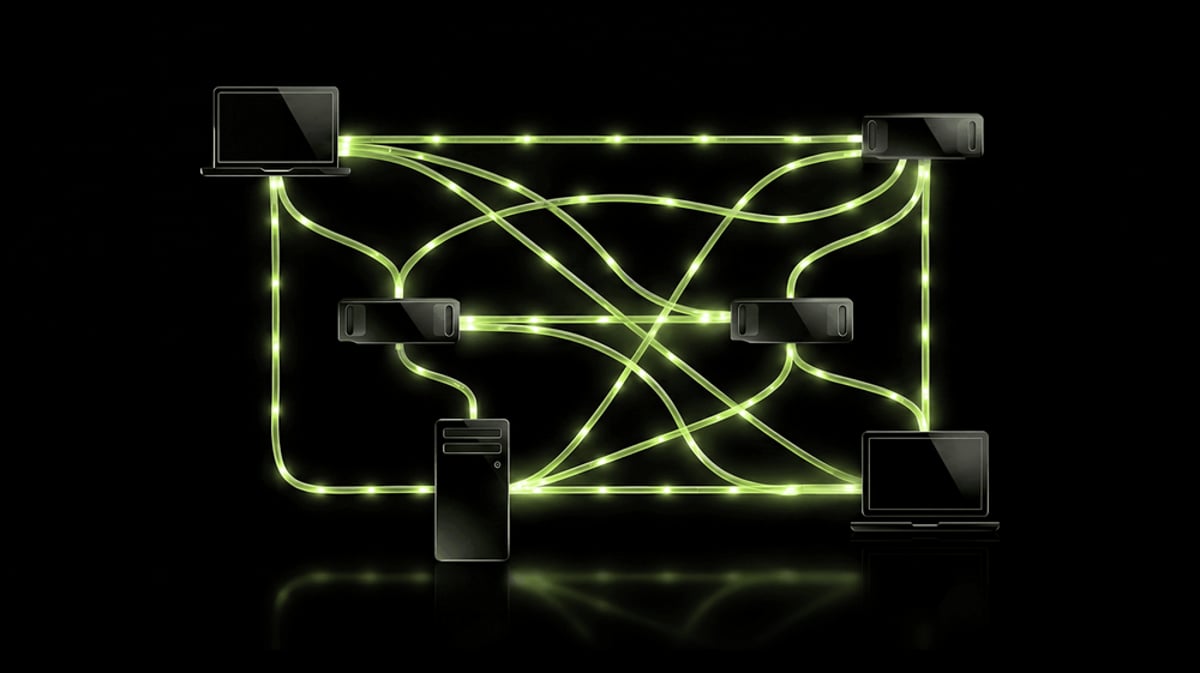
Nvidia just dropped a free, open-source tool that turns your scattered home computers into a makeshift AI data center. The Personal AI Router (PAIR) discovers compatible machines on your network, links them together, and pools their compute power for local AI inference. It's a clever move that could reshape how enthusiasts and small teams run large language models without cloud bills.
Nvidia just made a quiet but potentially significant move in the local AI space. The company announced its new Personal AI Router, or PAIR, a free tool designed to sync up multiple home computers so they can work together on AI inference tasks. Think of it less as networking hardware and more as software glue that turns a pile of separate machines into something resembling a tiny personal data center.
And yes, despite the name, PAIR is not a router you plug into your wall. It's open-source software that Nvidia built to automatically discover compatible PCs sitting on the same network. Once it finds them, PAIR connects those machines and preps them to handle number-crunching for agentic AI workflows, the kind of multi-step, autonomous tasks that are becoming increasingly common as AI models take on more complex jobs.
The compatibility list is where things get interesting. PAIR works with Nvidia's own GeForce RTX 20-series GPUs and anything newer, along with the company's RTX Pro lineup and its DGX Spark systems. But Nvidia didn't stop at its own hardware. The tool also supports Apple's M4 chips or newer, a notable nod toward cross-platform flexibility that you don't always see from a chipmaker this deep into its own ecosystem.
This push toward local, distributed AI computing isn't happening in a vacuum. Over the past year, tools like Ollama and LM Studio have exploded in popularity among developers and AI hobbyists who want to run large language models on their own hardware instead of paying for cloud API calls. PAIR plugs directly into that ecosystem, letting users combine the power of several machines rather than being limited by whatever GPU sits in a single box.
For Nvidia, this fits into a broader strategy of keeping its hardware relevant even as the AI conversation shifts from massive cloud training runs to more distributed, on-device inference. The company has spent years dominating the data center GPU market, and moves like PAIR suggest it's also angling to own the software layer that makes consumer and prosumer AI setups more capable. If you already own a couple of RTX cards scattered across different machines, or a DGX Spark plus a Mac, PAIR gives you a reason to actually use them together instead of running AI models in isolation.
The open-source nature of the release matters too. By putting the code on GitHub rather than locking it behind a proprietary app, Nvidia is inviting the developer community to poke at it, extend it, and presumably find bugs faster than an internal team could alone. That's a common playbook lately for AI infrastructure tools, and it tends to accelerate adoption among the exact power users Nvidia wants buying more GPUs down the line.
There's also a quieter signal here about where local AI is headed. As models get more capable and agentic tasks require sustained compute rather than a single quick response, having the option to pool several consumer-grade machines could matter more for hobbyists and small businesses that can't justify enterprise-grade infrastructure. It's not going to replace a proper data center, but for someone experimenting with multi-step AI agents at home, stitching together three or four machines suddenly becomes a lot more practical.
What happens next is worth watching closely. Nvidia including Apple silicon support is a small but telling detail, since it suggests the company sees value in supporting mixed hardware environments rather than pushing an all-Nvidia setup. Whether PAIR becomes a staple tool in the growing local AI toolkit alongside Ollama and LM Studio, or fades as a niche experiment, will depend heavily on how smoothly it performs once actual users start throwing real workloads at it.
PAIR might sound like a niche release buried in Nvidia's usual flood of AI announcements, but it points at something bigger: the slow shift of serious AI compute away from cloud-only setups and into home networks stitched together by clever software. For anyone tired of cloud inference bills or curious about running agentic AI workflows locally, this is a tool worth keeping an eye on as it matures.