Qualcomm just delivered a stark warning that's rattling the smartphone industry: memory shortages are now defining the size of the entire mobile market. Despite beating fiscal Q1 earnings expectations with $12.25 billion in revenue, the chipmaker's shares tumbled in after-hours trading after CEO Cristiano Amon told investors that data center demand for AI memory is starving smartphone makers of critical components. The guidance miss signals a supply crunch that could reshape handset pricing and availability throughout 2026.
Qualcomm delivered a reality check on Wednesday that sent shockwaves through the smartphone industry. The chipmaker beat fiscal first-quarter earnings expectations with adjusted EPS of $3.50 versus $3.41 expected and revenue hitting $12.25 billion. But none of that mattered once investors saw the guidance.
For the current quarter, Qualcomm expects revenue between $10.2 billion and $11 billion - well short of the $11.11 billion analysts had penciled in, according to LSEG consensus data via CNBC. Adjusted earnings per share are forecast at $2.45 to $2.65, missing the $2.89 consensus. Shares tumbled in after-hours trading.
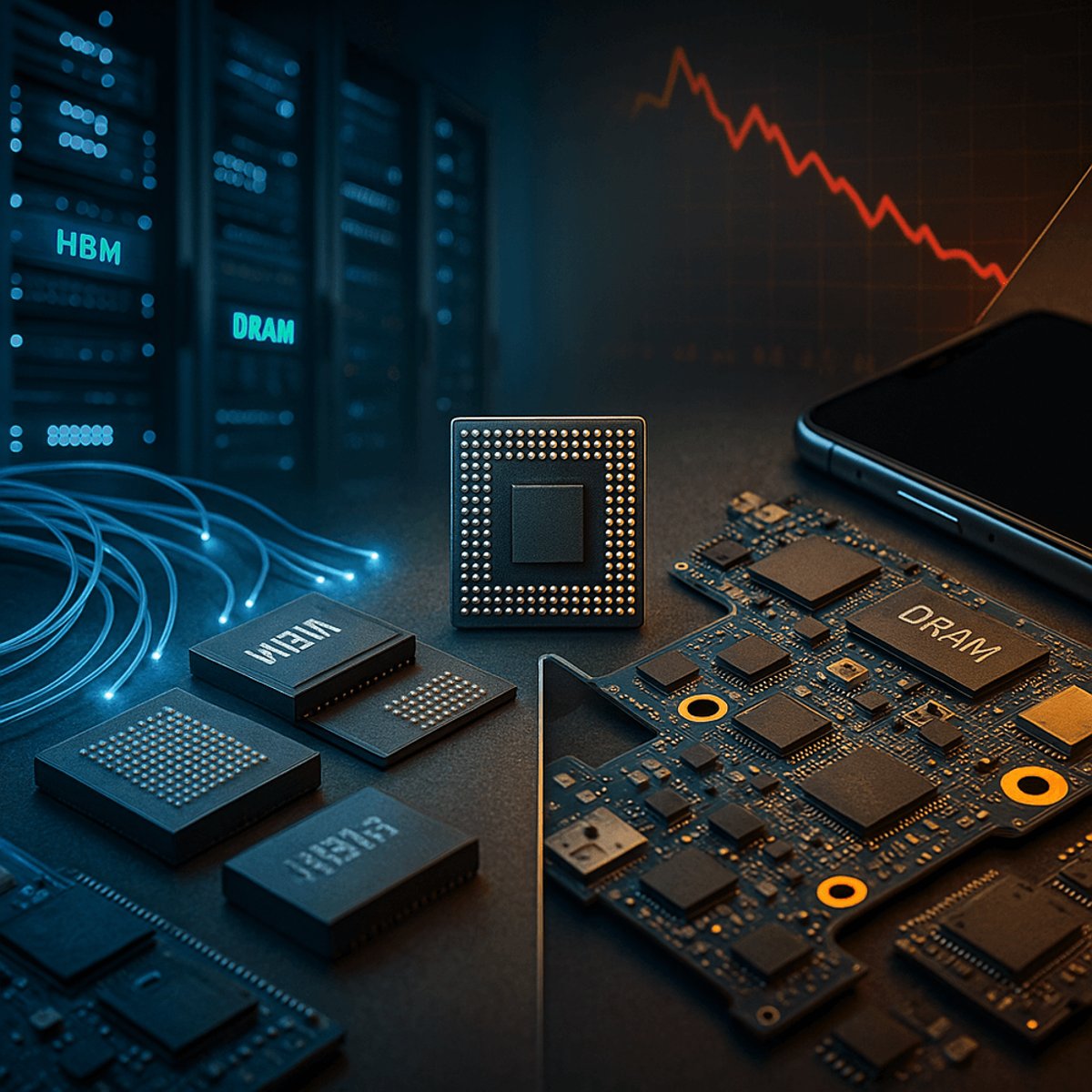
The culprit? A global memory shortage that's pitting AI data centers against smartphone makers in a battle for DRAM and NAND supply. "We're starting to see that memory is going to define the size of the mobile market," CEO Cristiano Amon told CNBC in an interview following the results.
Qualcomm CFO Akash Palkhiwala was even more direct, saying the guidance gap versus Wall Street estimates was driven entirely by the memory issue. Big orders for high-bandwidth memory (HBM) used in AI accelerators are consuming production capacity that would normally go to consumer electronics, creating a ripple effect across the smartphone supply chain.
Here's where it gets complicated for Qualcomm's business model. The company sells processors and modems to handset makers like Samsung and Xiaomi, but those customers source their own memory separately and pair it with Qualcomm's chips. Now those smartphone makers are watching memory availability like hawks and adjusting their production plans and inventories accordingly. When memory supplies tighten, they can't build phones - which means they don't need Qualcomm's chips.
Amon emphasized that underlying handset demand remains strong and the smartphone market is going through an upgrade cycle. But he warned that supply constraints will limit what customers can actually buy. "We see this as an industry issue affecting everything in consumer electronics," he said.
The memory crunch could reshape the smartphone market in unexpected ways. Amon told investors he expects Qualcomm's customers to shift focus toward higher-tier premium devices, which have better profit margins to absorb rising memory costs. Budget handsets with thinner margins may get squeezed out as memory prices climb. Whether smartphone makers will pass those costs to consumers through price increases remains unclear.
Despite the guidance disappointment, Qualcomm's core handset business showed resilience during the December quarter. The company reported $7.82 billion in handset chip sales, up 3% year-over-year. Overall revenue grew 5%, with smaller divisions posting stronger growth rates.
Qualcomm's internet of things segment - which includes industrial chips and the processors powering Meta's Ray-Ban smart glasses - jumped 9% to $1.69 billion in sales. The automotive and robotics division, which supplies chips to carmakers including Toyota, surged 15% to $1.1 billion. These newer business lines are helping diversify Qualcomm beyond its smartphone dependence, though handsets still account for the bulk of revenue.
Net income slipped slightly to $3 billion, or $2.78 per diluted share, compared to $2.18 billion or $2.83 per share in the year-ago period. Qualcomm's highly profitable patent licensing business, reported as QTL revenue, brought in $1.59 billion during the quarter. That licensing arm collects royalties from device makers using Qualcomm's 5G and wireless technology patents, generating margins far higher than chip sales.
The memory shortage storyline is becoming a defining narrative for the semiconductor industry in 2026. Memory makers like Micron are prioritizing lucrative AI data center contracts over consumer electronics orders, creating bottlenecks throughout the supply chain. Qualcomm's warning suggests this isn't a short-term blip but a structural shift that could constrain smartphone production for quarters to come.
Investors are now left weighing Qualcomm's strong current results against a murky outlook shaped by factors largely outside the company's control. The chipmaker can't manufacture more memory or force suppliers to prioritize mobile over AI data centers. All it can do is navigate the constraints and hope its customers find creative ways to keep building phones.
Qualcomm's earnings reveal a semiconductor industry at an inflection point where AI's voracious appetite for memory is directly constraining the smartphone market. While the chipmaker posted solid quarterly results, the guidance miss underscores how supply chain dynamics beyond any single company's control are reshaping consumer electronics. Investors should watch memory pricing trends and smartphone maker production plans in coming quarters - those will determine whether this shortage forces a painful industry adjustment or resolves as capacity expands. For now, premium handsets look positioned to weather the storm better than budget devices, potentially accelerating the market's shift upmarket.