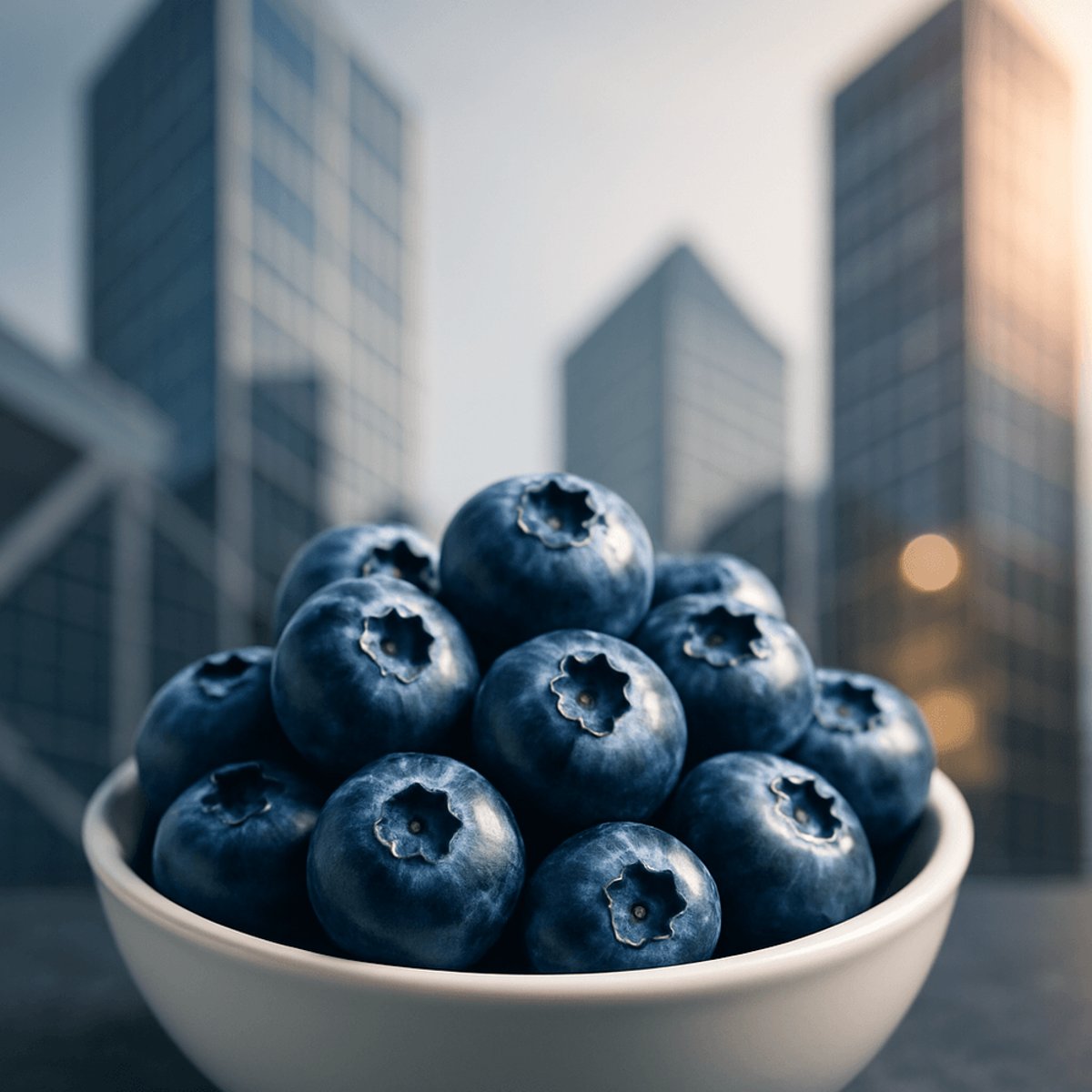
The billion-dollar berry wars just got serious. Fruitist, the premium blueberry startup known for its jumbo berries, closed a $150 million funding round led by JPMorgan Asset Management with billionaire investor Ray Dalio's family office doubling down. The deal positions the company to capture more of the $800 billion global snacking market as consumers increasingly pay premium prices for healthier options.
Fruitist just proved that premium produce can command serious investor attention. The berry startup's latest $150 million equity round, led by JPMorgan Asset Management, signals growing confidence in the healthy snacking revolution that's reshaping how consumers think about food.
The funding comes as billionaire Ray Dalio's family office doubles down on its existing investment, joining new backers Aliment Capital and Oaktree Capital's Steve Kaplan. With over $1 billion in valuation and $443 million in total equity raised, Fruitist has become the poster child for premium agricultural brands disrupting traditional commodity markets.
"Demand is far greater than we can supply," CEO and co-founder Steve Magami told CNBC. The company's annual sales have surpassed $400 million, with blueberry sales tripling as consumers gravitate toward what Magami calls "snacking berries to replace a meal."
The numbers behind Fruitist's growth tell a compelling story about changing consumer behavior. The company's Snack Cups - single-serve, grab-and-go packs - exploded from 30 stores in Spain in April to 750 locations, with plans to hit 1,000 stores and expand into U.S. markets. It's the kind of rapid scaling that catches institutional investors' attention.
JPMorgan's Brad Demong sees the investment through the lens of supply chain control and market positioning. "We believe that Fruitist, with control of its value chain, significant organic growth opportunity ahead, and positioning as a driving force of premiumization of berries and the better-for-you category, will realize durable expansion," he said in announcing the deal.
The funding arrives as the "better for you" snacking segment drives growth in an otherwise flat market. Sally Lyons Wyatt from consulting firm Circana notes that healthy options are "keeping the core snacking category going," with berries particularly well-positioned as "full of antioxidants and one of healthiest fruits in this snacking story."
Fruitist's distribution footprint reads like a who's who of major retailers - Costco, Giant, Publix, ShopRite, Sprouts, Trader Joe's, Wakefern, Walmart, and Whole Foods. The company operates agricultural facilities across eight countries, giving it unusual control over quality and supply in a traditionally fragmented industry.
What sets Fruitist apart isn't just size - it's positioning. Magami dismisses traditional berry players like Driscoll's as "more of a commodity," arguing his company occupies "the far right of the upper right quadrant" in terms of premium positioning. At around $6 per clamshell, Fruitist's berries command premium pricing that reflects their positioning as snacks rather than ingredients.
The timing couldn't be better for food-tech IPOs. [Jennifer Garner](https://www.onceupona farm.com)'s Once Upon a Farm recently filed to go public, and Fruitist ranked No. 18 on CNBC's 2025 Disruptor 50 list. While Magami declined to comment on IPO timing, he confirmed the company is "closely monitoring" Once Upon a Farm's public debut.
Matthew Kennedy from Renaissance Capital points to growth metrics as the key differentiator. "It's especially impressive if a company is able to sell a premium product and take market share while the rest of the industry is under pressure," he noted, though he warned that "the biggest risk for investors is when that growth is unsustainable."
For Fruitist, sustainability seems built into the business model. The new funding will primarily support agricultural expansion - more planting, cold storage facilities, and automation infrastructure. It's the kind of capital-intensive scaling that commodity players struggle to justify but premium brands can leverage for competitive advantage.
Fruitist's $150 million raise represents more than just another food-tech funding round - it's validation that premium positioning can reshape commodity markets. With institutional backing from JPMorgan and continued confidence from Ray Dalio, the company is positioned to define what "healthy snacking" means for the next generation of consumers. As the broader snacking market stagnates, Fruitist's ability to command premium pricing while scaling globally suggests the future belongs to brands that can elevate everyday products into lifestyle choices. The question isn't whether consumers will pay more for better food - it's which companies can deliver the quality and experience to justify those prices at scale.