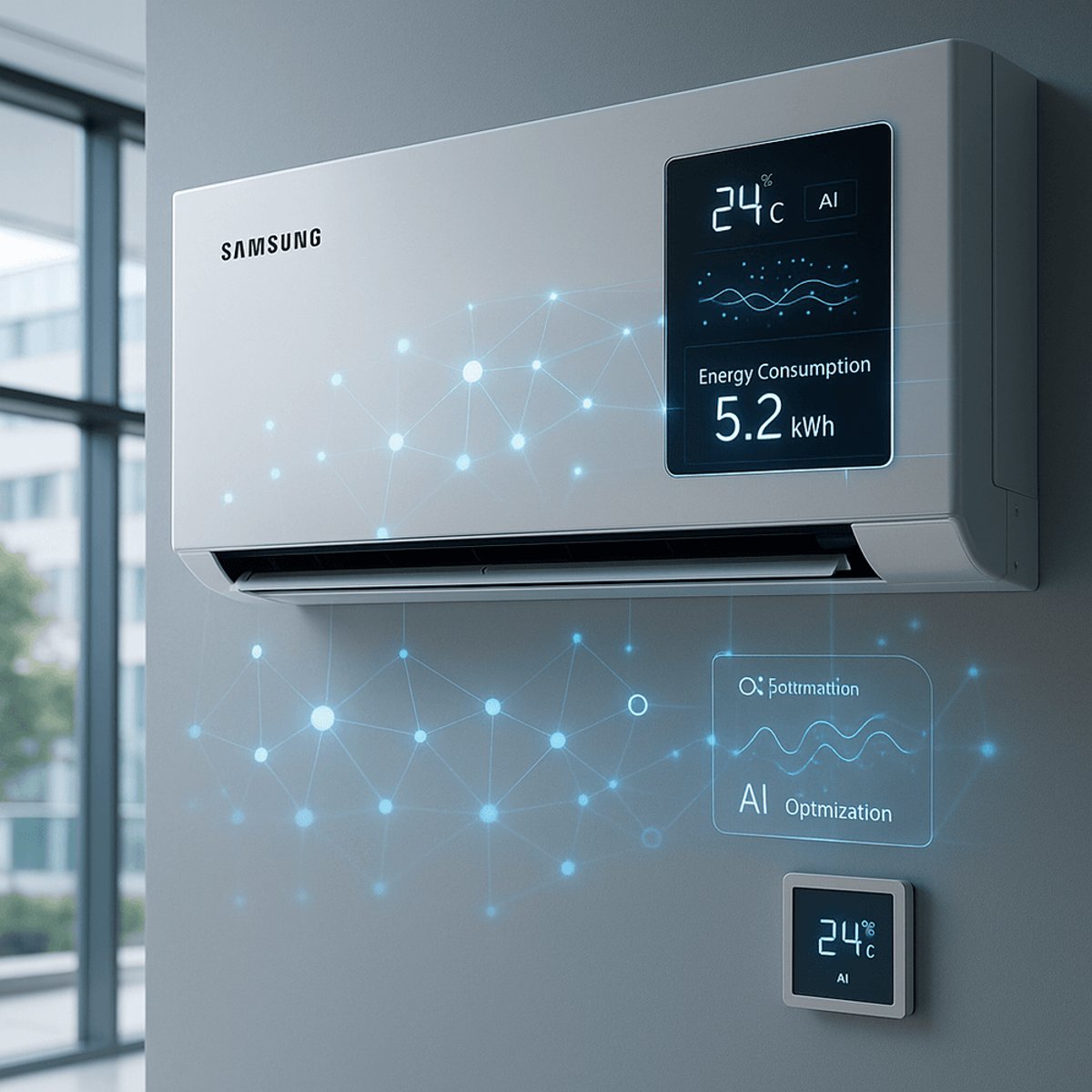
Samsung is making a serious play for the North American HVAC market, positioning climate control as its next growth driver. At the AHR Expo in Las Vegas this week, the company unveiled its DVM S2+ commercial air-conditioning system, powered by on-device AI that learns environmental patterns in real time to cut energy consumption. It's part of a broader push to connect heating and cooling systems to SmartThings, turning climate control into another node in Samsung's smart home ecosystem - and a new revenue stream as the company eyes a market it expects to grow 5% annually.
Samsung just made it official: HVAC isn't a side project anymore. Speaking at the AHR Expo this week, Hye-seong Baek, VP of Digital Appliances, laid out the company's ambitions in North America's heating and cooling market - and they're not small. The centerpiece is the DVM S2+, a commercial air-conditioning system that uses on-device AI to learn building patterns and adjust output in real time, promising to cut energy costs without sacrificing comfort.
It's a calculated bet. Samsung sees HVAC as the next frontier for its SmartThings platform, which already connects home appliances, security systems, and lighting. By embedding AI into climate control hardware, the company's positioning itself to capture recurring revenue from energy management services - a model that worked for Nest before Google acquired it. "We're focusing on scaling HVAC services in connection with smart homes and smart cities," Baek told Samsung Newsroom, pointing to synergies in remote maintenance and energy optimization.
The timing reflects shifting market dynamics. U.S. environmental regulations are forcing the industry away from high-GWP refrigerants, and new efficiency standards are pushing residential and commercial buyers toward inverter-based heat pumps. Samsung's responding with Hylex, an inverter outdoor unit using R454B refrigerant that it's pitching to North American homeowners through Samsung Lennox HVAC North America, its joint venture with Lennox. The residential segment represents 70% of the North American HVAC market, according to Baek's interview, making it the obvious beachhead.
But Samsung's also hedging with commercial plays. The company recently acquired FläktGroup, Europe's largest HVAC provider, and it's now pairing FläktGroup's modular chillers with Samsung's cooling tech for data center applications. That's a smart move - AI data centers and high-performance computing facilities are driving demand for precision cooling systems, and Samsung's betting that hyperconnectivity through SmartThings Pro will give it an edge in building-wide energy optimization.
The DVM S2+ sits at the intersection of these trends. Its on-device AI processes environmental data locally, adjusting cooling output without relying on cloud connectivity - a selling point for enterprise customers wary of latency or security risks. Samsung's also rolling out its EHS lineup of air-to-water heat pumps, positioning them as fossil-fuel boiler replacements that maximize hot-water supply and heating efficiency.
Still, Samsung's entering a crowded field. Carrier, Trane, and Daikin dominate North American HVAC, and they've spent decades building distributor relationships and service networks. Samsung's response is to lean on brand recognition and its existing appliance channels, but it'll need to prove its systems can match incumbents on reliability and service - two areas where HVAC buyers don't compromise.
The market's there, though. Baek cited 5% annual growth projections, driven by climate regulations and energy-efficiency mandates. Heating and cooling account for a massive share of residential electricity consumption in North America, and Samsung's pitching integrated energy management as the solution. The company's also targeting the shift from fixed-speed air conditioners to inverter systems, which are more efficient but require different installation expertise.
Samsung's not disclosing revenue targets, but the company's clearly treating HVAC as a long-term investment. It's been exhibiting at AHR Expo since 2015, gradually expanding its product lineup and partner network. The FläktGroup acquisition signals it's serious about commercial applications, while the Lennox joint venture gives it residential distribution without building infrastructure from scratch.
What's less clear is how quickly Samsung can scale. HVAC installation and maintenance require local service networks, and Samsung's still building those relationships. The company's betting that SmartThings integration and AI-driven predictive maintenance will reduce service costs over time, but that's a future promise, not a current advantage. For now, Samsung's playing catch-up with established players who've spent decades refining their systems.
The DVM S2+ launch is Samsung's signal that it's moving beyond appliances into building infrastructure. If SmartThings becomes the connective tissue for residential and commercial climate control, Samsung could capture recurring revenue from energy management subscriptions. But it'll need to prove its systems can compete on performance, reliability, and service - the unglamorous but essential factors that drive HVAC purchasing decisions.
Samsung's HVAC push is a long game. The company's betting that AI-powered climate control, integrated through SmartThings, will differentiate it in a market dominated by entrenched players. The DVM S2+ and Hylex launches show Samsung's committing resources to both commercial and residential segments, but success will depend on execution - building service networks, proving reliability, and convincing buyers that connected HVAC systems justify the investment. If Samsung can deliver on energy savings and predictive maintenance, it's got a shot at capturing share in a market that's growing steadily as regulations tighten and efficiency becomes non-negotiable. But HVAC buyers are conservative, and Samsung's still the new player proving itself.