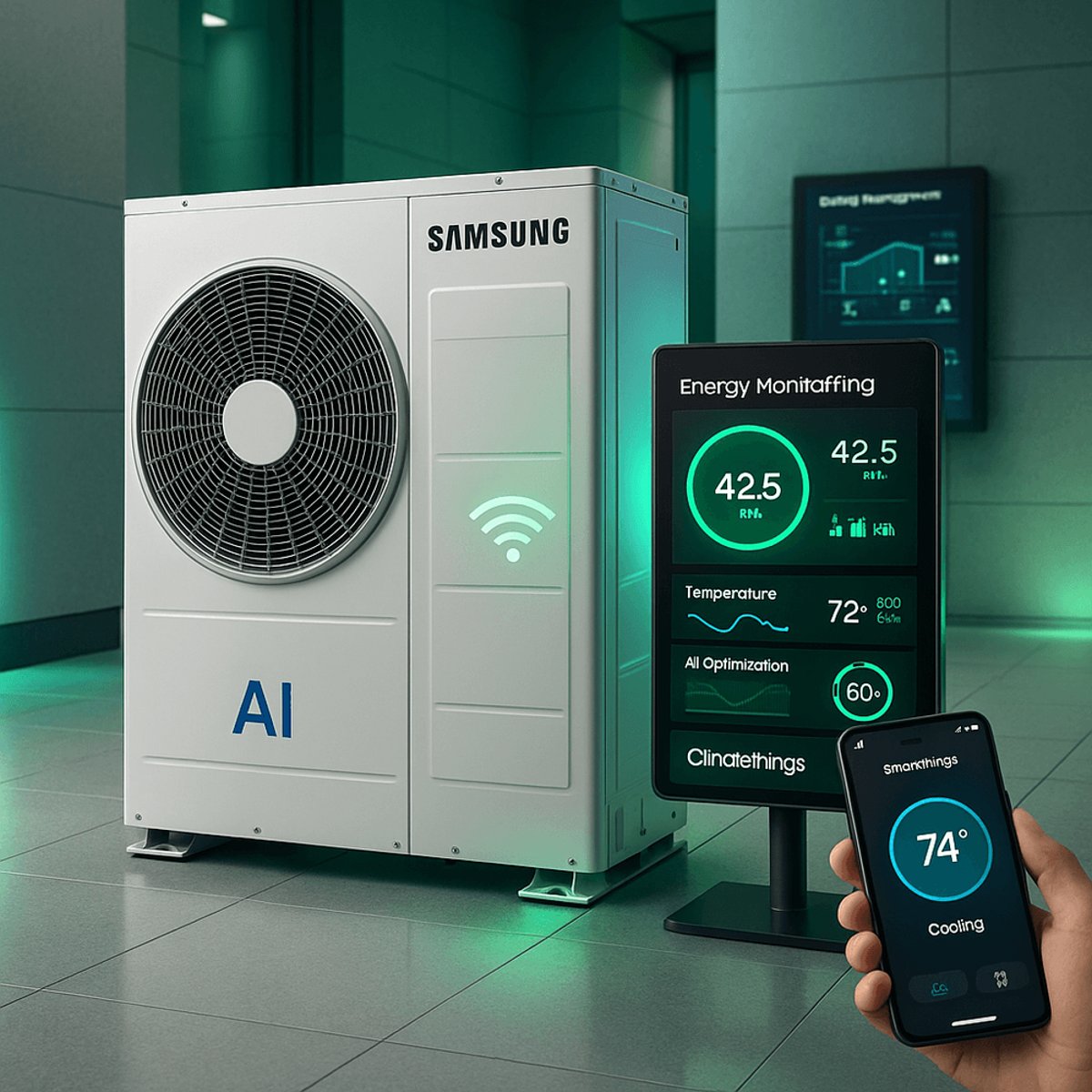
Samsung is betting big on HVAC as its next revenue driver, unveiling AI-powered climate control systems at North America's largest trade show. At the AHR Expo in Las Vegas, the tech giant showcased the DVM S2+, a commercial air-conditioning unit with on-device AI that adapts in real time to cut energy use while maintaining comfort. The move signals Samsung's ambition to become a top-tier player in the $70 billion North American HVAC market, which the company expects to grow 5% annually as sustainability regulations tighten.
Samsung just made its clearest play yet for the climate control market, and it's banking on AI to win. At the International Air-Conditioning, Heating, Refrigerating Exposition (AHR Expo) in Las Vegas last week, the company rolled out its most advanced HVAC lineup to date, headlined by the DVM S2+ commercial system that learns from its surroundings to slash energy bills. It's a strategic pivot for a company better known for smartphones and semiconductors, but one that could unlock serious revenue as buildings worldwide race to meet decarbonization targets.
The numbers tell the story. North America represents the world's second-largest HVAC market, with residential accounting for 70% and commercial taking 30%, according to Hye-seong Baek, Vice President of Samsung's Digital Appliances Business, in an interview with Samsung Newsroom. Samsung's projecting steady 5% annual growth as environmental regulations force the industry away from high-GWP refrigerants and fixed-speed compressors toward efficient inverter heat pumps.
The DVM S2+ sits at the heart of Samsung's commercial strategy. Unlike traditional systems that react to thermostat commands, this one deploys on-device AI that continuously monitors temperature, humidity and occupancy patterns to predict optimal settings before conditions shift. The result is what Samsung calls "minimal energy consumption while delivering optimal indoor comfort" - corporate speak for lower utility bills without sacrificing performance. The system learns building-specific usage patterns over weeks and months, getting smarter the longer it runs.
On the residential side, Samsung's targeting sustainability-conscious homeowners with Hylex, an inverter-based outdoor unit using R454B refrigerant with low global warming potential. The company's also expanding its EHS air-to-water heat pump lineup, positioning these as fossil-fuel boiler replacements that deliver heating and hot water more efficiently. It's a direct response to tightening environmental standards that are phasing out high-GWP refrigerants across North America.
But Samsung's real differentiator isn't hardware - it's connectivity. The company's weaving SmartThings and SmartThings Pro throughout its HVAC portfolio, creating what Baek calls "hyperconnectivity" that links climate systems to broader building management platforms. In homes, that means residents can monitor and adjust heating and cooling from their phones. In commercial buildings, facility managers gain real-time diagnostics, predictive maintenance alerts and building-wide energy optimization. According to Baek, this integration creates "meaningful synergies ranging from remote maintenance to energy cost optimization."
The strategy extends beyond products to partnerships. Samsung's joint venture with Lennox, called Samsung Lennox HVAC North America, handles residential distribution and taps Lennox's established contractor network. For commercial applications, Samsung's leaning on FläktGroup, Europe's largest HVAC equipment provider, which it recently acquired. Together, they're developing modular chiller systems tailored for high-demand environments like data centers and cleanrooms - a growing segment as AI infrastructure buildout accelerates.
That data center angle is no accident. Rising demand for AI computing and high-performance systems is fueling "the growth of precision cooling systems as an increasingly important market segment," Baek noted. Samsung's combining its chiller tech with FläktGroup's cooling solutions to deliver what it calls "optimized solutions for data center applications." As hyperscalers race to build GPU clusters for training large language models, keeping those chips cool becomes mission-critical.
The timing aligns with broader HVAC industry shifts. Environmental regulations are expanding into commercial sectors, bringing new design and installation standards that favor inverter-based systems over energy-hungry fixed-speed units. Variable Refrigerant Flow (VRF) systems are gaining traction in commercial buildings, while residential buyers increasingly opt for eco-conscious heat pumps. Meanwhile, IoT sensors and AI-based predictive maintenance are becoming table stakes, with "improvements in energy and operational efficiency emerging as a key industry trend," according to Samsung's market assessment.
Samsung's been participating in AHR Expo annually since 2015, but this year's push felt more aggressive. The company operated a 350-square-meter booth under the theme "Enabling Better Living," showcasing everything from residential units to commercial systems and maintenance software. More than 1,800 companies exhibited at the Las Vegas event, hosted by the American Society of Heating, Refrigerating and Air-Conditioning Engineers (ASHRAE), making it a critical venue for Samsung to signal its HVAC ambitions to distributors, contractors and facility managers.
The challenge ahead is execution. Samsung's entering a mature market dominated by entrenched players like Carrier, Trane and Daikin, all with decades-long contractor relationships and service networks. But the company's betting its consumer electronics pedigree - particularly around AI, IoT and user experience - can carve out differentiation. Heating and cooling account for a significant chunk of residential electricity consumption in North America, giving Samsung an opening to pitch integrated energy management that connects HVAC to solar, batteries and smart appliances through SmartThings.
"The goal is clear: to leap forward as a top-tier HVAC player in the North American market by leveraging advanced technologies and a diverse product portfolio," Baek said. Samsung's planning to expand from its ductless stronghold into ducted systems - where centralized HVAC dominates in North America - through synergies with FläktGroup. The company's also accelerating low-GWP product rollouts and strengthening AI-powered energy-saving features to deliver what it calls "a differentiated, integrated energy management experience."
Samsung's HVAC offensive represents more than product launches - it's a strategic bet that climate control becomes the next frontier for AI-driven building automation. By embedding on-device intelligence and SmartThings connectivity across residential and commercial systems, the company's positioning itself as buildings transition from dumb infrastructure to smart, energy-optimized environments. The question isn't whether HVAC becomes a growth engine for Samsung, but how quickly the company can scale distribution, build contractor trust and prove its AI systems deliver measurable savings. With environmental regulations tightening and data center cooling demands exploding, Samsung's timing looks solid. Now it needs to execute.