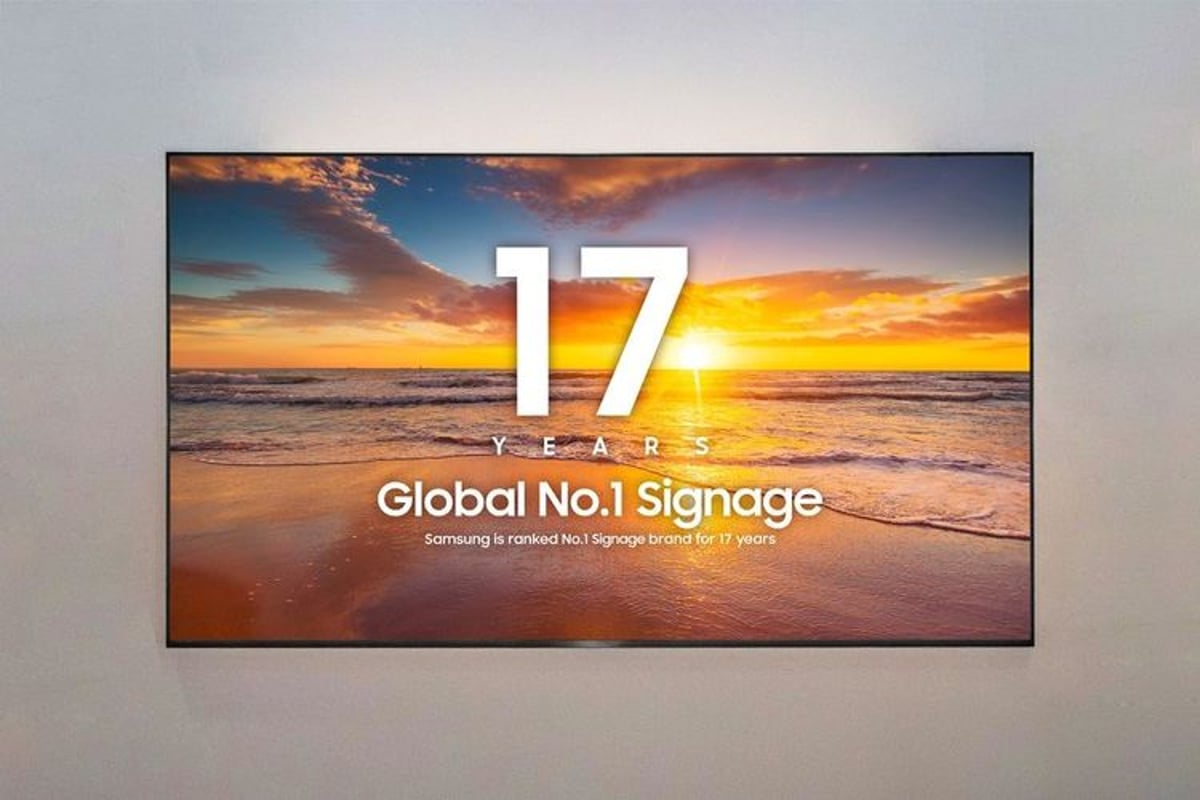
Samsung just locked down its 17th consecutive year as the world's top commercial display vendor, claiming 35.2% of global unit sales in 2025 according to Omdia's latest report. The Korean tech giant shipped over 2.5 million units last year - an all-time high - as it doubles down on AI-integrated signage and eco-friendly display tech for enterprise customers. The numbers reflect a broader shift in how businesses think about digital infrastructure, with cloud-connected screens replacing static signage across retail, hospitality, and corporate spaces.
Samsung isn't just winning the commercial display race - it's lapping the competition. The company's 35.2% share of global unit sales in 2025 marks nearly two decades of uninterrupted dominance since first claiming the crown in 2009, according to research from Omdia. More telling than the longevity is the momentum: Samsung shipped over 2.5 million commercial displays last year, its highest annual total ever.
The surge comes as businesses accelerate their shift from passive signage to intelligent, networked display systems. Samsung's capitalizing on that transition by bundling hardware with cloud-based management platforms and AI content tools - a strategy that's turning what used to be one-time screen sales into recurring software relationships.
"Seventeen years at the top of the commercial display market is the result of listening to our B2B customers and evolving with them," Hyoung Jae Kim, Executive Vice President of Samsung's Visual Display Business, told Samsung Newsroom. "As businesses change, they need technology that is reliable, simple to manage and ready for what's next."
That evolution is most visible in Samsung's 2026 product launches. The company's new Spatial Signage line delivers glasses-free 3D content in a 52mm-thick form factor, already snagging a CES 2026 Innovation Award and an iF Design Award. The eye-catching displays are designed for retail environments where grabbing customer attention translates directly to sales - think flagship stores and mall anchor tenants.
But Samsung's making an equally big bet on the opposite end of the power consumption spectrum. Its Color E-Paper lineup, built for ultra-low-energy applications, just introduced a 13-inch model that's the first commercial display to use bio-resin derived from phytoplankton in its housing. The screens pack 45% recycled plastic and 10% phytoplankton-based bio-resin, which Samsung claims cuts manufacturing carbon emissions by over 40% compared to petroleum-based plastics. The company plans to roll out the sustainable material across its entire E-Paper range.
For customers who need to go big, Samsung's portfolio now extends to genuinely massive screens. The lineup includes the 105-inch QPDX-5K and 115-inch QHFX models, with a 130-inch Micro RGB display (QPHX model) on deck. These aren't consumer TVs stretched for business use - they're purpose-built for corporate lobbies, conference centers, and high-end retail installations where screen real estate directly correlates with brand impact.
The hardware tells only half the story. Samsung's increasingly focused on the software layer that ties these displays together. The Samsung VXT platform handles remote device management and content distribution across distributed fleets of screens - critical infrastructure for retailers operating hundreds of locations. Meanwhile, the new AI Studio app lets businesses generate signage-ready video content from a single product image, dramatically lowering the creative production barrier for small and medium enterprises.
That software push makes strategic sense as display hardware commoditizes. Every major manufacturer can produce high-quality commercial screens, but few have the ecosystem integration to manage thousands of devices from a centralized dashboard or automatically generate contextual content. Samsung's betting that sticky software will keep customers locked into its hardware for years to come.
The commercial display market looks fundamentally different than it did when Samsung first claimed the top spot in 2009. Back then, businesses bought dumb screens and plugged in static content. Today's customers want cloud-connected systems that can update content in real-time, respond to foot traffic patterns, and integrate with broader business intelligence platforms. Samsung's managing to stay ahead by treating displays as endpoints in a larger enterprise software network rather than standalone hardware products.
Competitors aren't standing still. LG continues to push its transparent OLED displays for retail applications, while Chinese manufacturers flood the market with budget options. But Samsung's 17-year run suggests it's found a formula that balances innovation at the premium end with enough scale to maintain cost competitiveness in volume segments.
The 2.5 million unit milestone is particularly notable given broader softness in the display market. Consumer TV sales have been flat or declining in many regions, making the commercial segment one of the few growth engines for display manufacturers. Samsung's performance indicates it's capturing share even as the overall market expands, a double benefit that's hard for competitors to match.
Samsung's 17-year commercial display streak isn't just about making better screens - it's about understanding that businesses now want integrated systems, not individual products. The combination of award-winning hardware like Spatial Signage, sustainable innovations in E-Paper, and software platforms that simplify fleet management positions Samsung to maintain its lead even as the market evolves. As digital signage becomes infrastructure rather than just marketing tools, the companies that can deliver end-to-end solutions will pull further ahead. Samsung's record shipments suggest it's doing exactly that, turning market leadership into a self-reinforcing cycle where scale enables innovation that drives more scale.