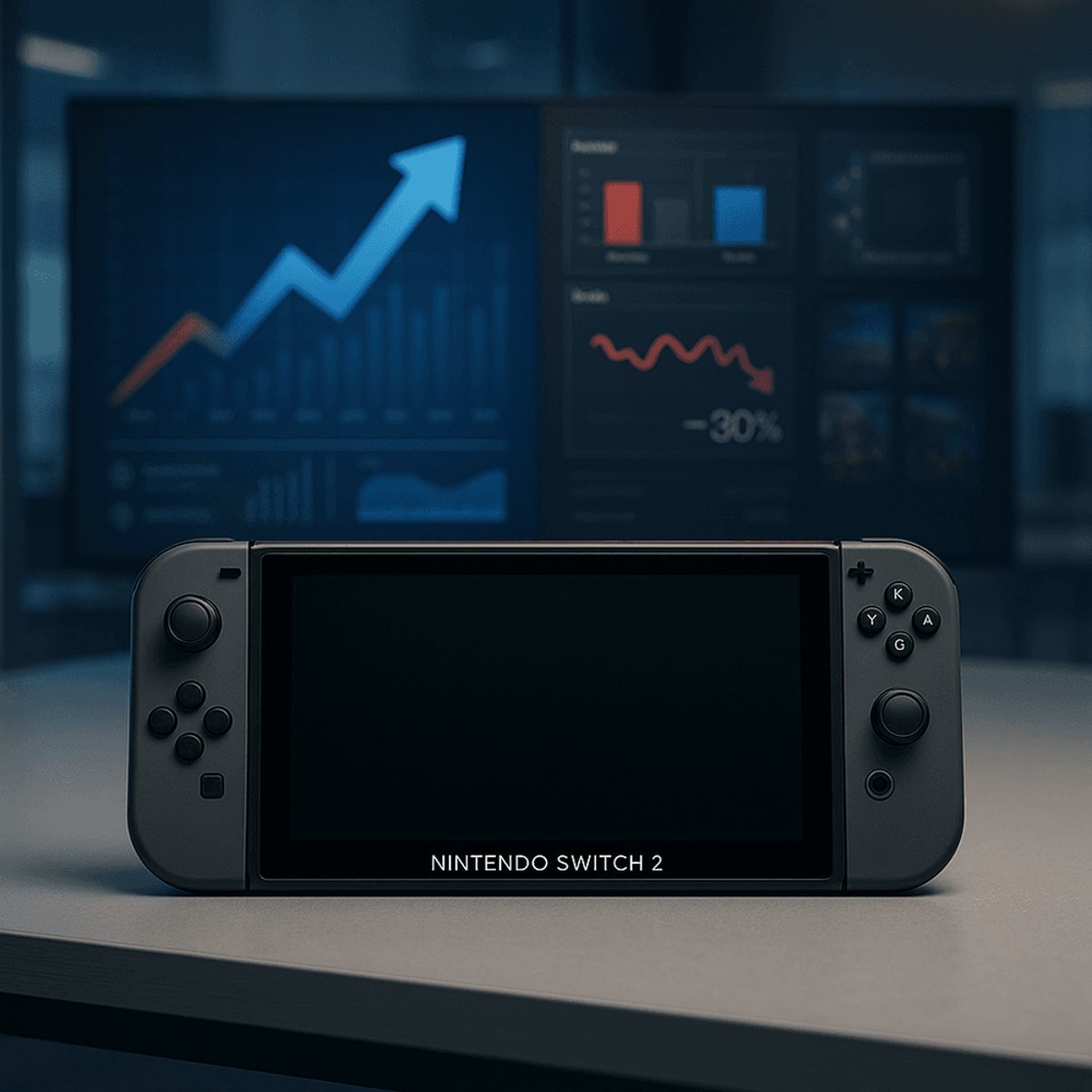
Nintendo just posted its fiscal third-quarter earnings, and the numbers tell a story of cautious optimism. The Japanese gaming giant maintained its full-year sales and profit guidance despite missing revenue expectations by roughly $300 million, betting that Switch 2 momentum will carry through the rest of the fiscal year. But investors aren't convinced - the stock's down more than 30% since its August peak, as concerns mount over rising memory costs and whether Nintendo's games pipeline can sustain the hype that drove record-breaking Switch 2 launch lines from Tokyo to Manhattan.
Nintendo is holding the line. The gaming giant just reported fiscal third-quarter earnings that fell short on revenue but beat on profit, all while keeping its full-year Switch 2 sales target firmly in place at 19 million units. It's a statement of confidence - or stubbornness - depending on how you read the market's reaction.
The numbers paint a mixed picture. Nintendo brought in 806.32 billion yen ($5.2 billion) in revenue for the quarter ending December 31, missing LSEG analyst estimates of 847.73 billion yen by nearly 5%. Net profit came in at 159.93 billion yen, actually beating expectations of 147.3 billion yen. That profit performance suggests the company's managing costs well, but the revenue miss is what has investors nervous.
The bigger question hanging over Kyoto isn't about last quarter's performance - it's about what comes next. Nintendo first raised its Switch 2 sales forecast to 19 million units back in November, up from an initial 15 million target. That was before the full weight of current headwinds became apparent. The company's sticking with that ambitious number even as its stock tells a different story.
Since the Switch 2's global launch in June, when fans lined up for hours in scenes reminiscent of classic iPhone launches, Nintendo's share price soared to record highs above 14,000 yen in August. Then reality set in. The stock has shed more than 30% of its value since that peak, now trading in a markedly different sentiment environment.
Two concerns dominate investor thinking right now. First is the memory price situation. The semiconductor industry is experiencing an unprecedented surge in memory chip costs, driven partly by AI demand squeezing supply chains. Memory is a critical component in gaming consoles, and rising costs could either compress Nintendo's margins or force the company to eat higher production expenses to maintain Switch 2 pricing.
The second worry is about content. Hardware sales are only half the equation - Nintendo needs a steady stream of compelling first-party and third-party titles to keep Switch 2 owners engaged and attract new buyers. The company hasn't laid out a detailed roadmap that convinces Wall Street the games pipeline is robust enough to sustain momentum through the fiscal year ending March 2026 and beyond.
What made the original Switch such a phenomenon was the combination of innovative hardware and tentpole franchises like Zelda, Mario, and Animal Crossing hitting at the right moments. The Switch 2 launched with strong initial demand, but maintaining that requires Nintendo to prove it can deliver the software lineup to match.
The maintained guidance suggests Nintendo's internal projections still support the 19 million unit target, even with the revenue shortfall in Q3. That could mean the company expects stronger Q4 performance, or it's banking on software attach rates and pricing holding firm enough to hit profit targets regardless of slight unit variations.
But the market's 30% haircut since August reflects skepticism. Investors are essentially pricing in either lower unit sales, margin compression from component costs, or both. The fact that Nintendo beat profit expectations this quarter while missing revenue suggests the company's managing the situation tactically, but whether that's sustainable is the real test.
Competitively, Nintendo occupies a unique position. Unlike Sony and Microsoft, which compete directly in the high-performance console space, Nintendo carved out the hybrid handheld-console niche with the original Switch. The Switch 2 aims to defend that territory with upgraded specs while maintaining portability. If memory costs squeeze too hard or the games lineup disappoints, that differentiated position could erode.
The next few months will be telling. Nintendo has one quarter left in this fiscal year to either validate its 19 million unit forecast or explain why it's adjusting expectations. The company's track record of conservative guidance makes this maintained forecast notable - Nintendo doesn't typically overpromise.
Nintendo's decision to hold guidance in the face of a revenue miss and a battered stock price is either conviction or denial - we'll know which by March. The Switch 2 launched with the kind of hype money can't buy, but translating that into sustained sales requires navigating memory cost headwinds and delivering a games lineup that justifies the hardware. For now, Nintendo's betting it can thread that needle to hit 19 million units. Investors clearly have doubts, and the next quarterly report will either vindicate management's confidence or force an uncomfortable reckoning with reality.