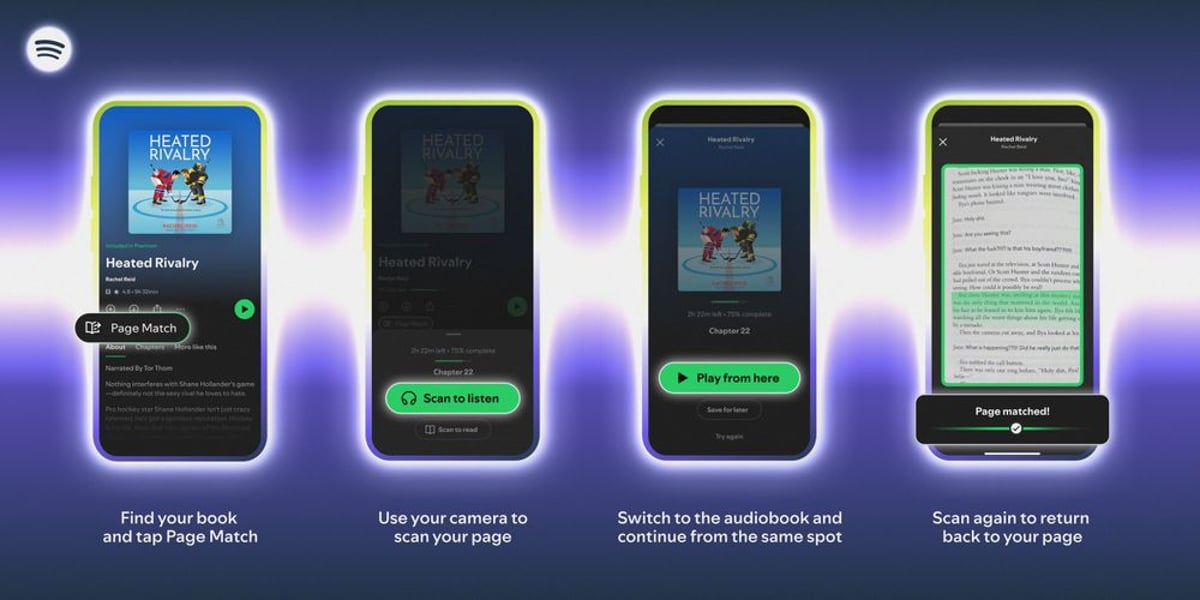
Spotify just launched Page Match, a computer vision and matching feature that syncs your physical book reading progress with audiobooks in seconds. Point your phone's camera at any page, and the app instantly jumps to the matching audio timestamp. It's a direct shot at Amazon's Whispersync ecosystem, but with one key advantage: it works with physical books from any publisher, not just Kindle editions. The move signals Spotify's aggressive push into audiobooks as it battles to keep users engaged beyond music streaming.
Spotify just made switching between your dog-eared paperback and your morning commute audiobook effortless. The company unveiled Page Match at its Turn the Page event in New York, a feature that uses your phone's camera and computer vision to instantly sync your reading progress across formats. Snap a photo of your current page, and the app jumps to the exact moment in the audiobook. No more scrubbing through chapters trying to find where you left off.
The technology feels like magic in practice, though it's not perfect yet. During hands-on testing reported by The Verge, recognition times ranged from one second to ten seconds depending on lighting and text clarity. The reverse function - finding your place in a physical book from an audiobook timestamp - works too, but requires more patience. The app can't tell you an exact page number since editions vary wildly between hardcover, paperback, and international releases. Instead, it guides you with a progress bar and directional prompts, highlighting the exact sentence once you land on the right page.
What separates Page Match from Amazon's decade-old Whispersync for Voice is physical book support. Amazon's system only syncs between Kindle ebooks and Audible audiobooks within its walled garden. Spotify's approach works with any physical book or ereader (except ebooks on your phone, since the camera can't read your screen). That openness could be a decisive factor for readers who still prefer ink and paper but want audio flexibility.
The feature launches with "most English-language titles" according to Spotify's announcement, with plans to expand language support over time. It's a calculated bet on format-agnostic readers who split time between mediums based on context rather than loyalty.
Behind the feature lies a broader strategy. Owen Smith, Spotify's global head of audiobooks, revealed that the platform has seen 36% year-over-year growth in customers starting audiobooks, with listening hours jumping 37%. Those gains come almost entirely from existing subscribers, not new signups. The company isn't trying to steal Audible customers outright - it's weaponizing convenience to keep current users glued to the platform longer.
The numbers back up the urgency. A recent study cited by The New York Times found that just 16% of American adults read for pleasure in 2023. That cultural shift away from traditional reading creates both a crisis and an opportunity. Audiobooks offer a workaround for time-starved consumers who want to consume books while commuting, exercising, or doing chores.
Spotify's audiobook library has ballooned from 150,000 titles to over 500,000 in just two years, rivaling Audible's catalog size. The company clearly sees long-form audio content as critical to its engagement metrics. Music streaming maxes out around 90 minutes per day for heavy users. Audiobooks can keep someone listening for 8-10 hours during a workday or road trip.
The company's doubling down on the category with ecosystem plays beyond Page Match. Its Recap feature, which launched on iOS late last year and hits Android this spring, uses AI to generate summaries of audiobooks. Think of it as Spotify's answer to the "previously on" recaps in TV shows, helping listeners remember plot points after gaps between listening sessions.
Even more telling is the new partnership with Bookshop.org, letting users buy physical copies of audiobooks directly through the Spotify app. It's a clever move that acknowledges many readers want to own both formats - and keeps them inside Spotify's universe rather than sending them to Amazon.
The competitive dynamics are fascinating. Amazon owns both the Kindle hardware ecosystem and Audible, giving it vertical integration advantages. But that closed system also limits flexibility. Spotify can't compete on device ownership, so it's competing on interoperability instead. Support any book format, work with any publisher, integrate with indie retailers like Bookshop.org.
There's a precedent here. Spotify used a similar playbook against Apple Music by going cross-platform and offering free tiers. It worked then - Spotify has roughly twice Apple Music's subscriber base. The question is whether readers care enough about format flexibility to shift audiobook habits.
The technology itself isn't revolutionary. Computer vision text recognition has been reliable for years, powering everything from Google Lens to receipt scanning apps. What's novel is the application - using OCR not to digitize text, but to create a bridge between analog and digital reading experiences. It's a reminder that innovation often comes from combining existing technologies in unexpected ways rather than inventing something entirely new.
For publishers, Page Match represents both opportunity and concern. It might drive audiobook sales by making the format more accessible to print readers. But it also gives Spotify more control over the reading experience, potentially reducing direct relationships between publishers and readers. The same tension that defined Spotify's music negotiations is now playing out in publishing.
Spotify's Page Match represents a bet that the future of reading is format-fluid, not format-loyal. By bridging the gap between physical books and audiobooks with computer vision, the company is positioning itself as the platform for people who read however and whenever they want. It's a direct challenge to Amazon's Kindle-Audible dominance, using openness as a weapon against vertical integration. Whether it succeeds depends less on the technology - which works well enough - and more on whether Spotify can convince readers that convenience matters more than ecosystem lock-in. With audiobook listening hours up 37% and the library tripling in size, the early signs suggest they're onto something. The real test comes when readers have to choose between Amazon's seamless Kindle integration and Spotify's bring-your-own-book flexibility.