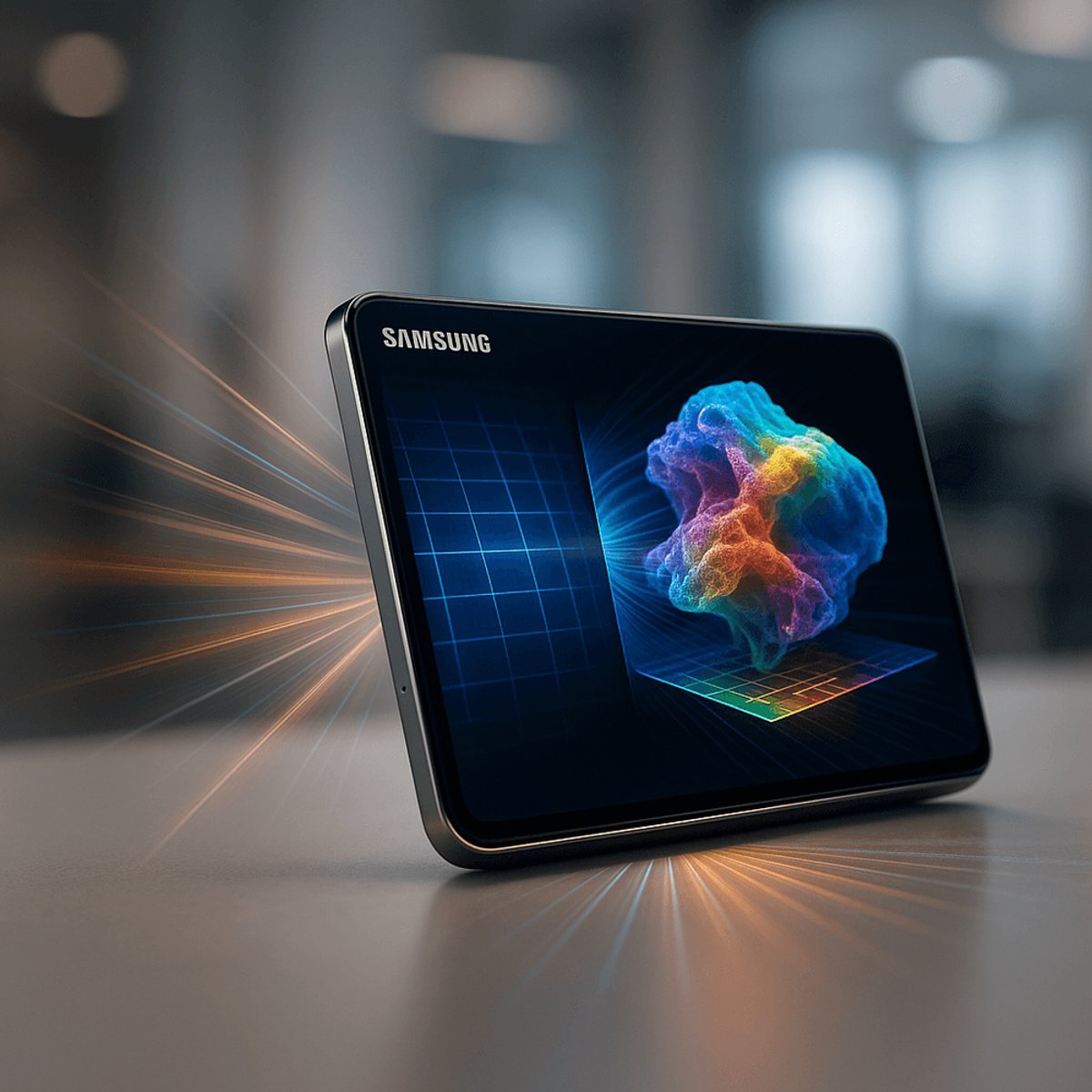
Samsung just made glasses-free 3D displays commercially viable. The tech giant and Korea's POSTECH published breakthrough research in Nature on a metasurface lens system that switches between crisp 2D and immersive 3D on command - all while being thinner than your smartphone screen. The voltage-controlled metalens widens viewing angles sixfold to 100 degrees and shrinks the entire optical system down to 1.2mm, solving the bulk and narrow-angle problems that have plagued 3D displays for decades.
Samsung just flipped the script on 3D displays. The company's collaboration with Korea's Pohang University of Science and Technology (POSTECH) has produced the first switchable 2D/3D display system using voltage-controlled metalens technology, published this week in the journal Nature. It's a breakthrough that could finally make glasses-free 3D practical for everything from smartphones to medical imaging.
The secret is in the metasurface - an ultra-thin optical layer composed of nanoscale structures that manipulate light in ways conventional lenses can't match. While traditional Light Field Displays have promised glasses-free 3D for years, they've been stuck with bulky optics, viewing angles around 15 degrees, and annoying dependencies on real-time eye tracking. Samsung's approach uses polarization - the direction light waves oscillate - to dynamically adjust the focal properties of a metasurface lenticular lens (MLL) on the fly.
Here's how it works in practice. The system employs a polarization controller sitting in front of the display that switches the metalens between concave and convex modes using simple voltage control. When you're reading text or browsing the web, the controller activates and the metalens acts as a concave lens, offsetting a convex lens behind it. Light passes straight through like flat glass, delivering full-resolution 2D. Flip to 3D mode for video or gaming, and the controller switches off - the metalens becomes convex, working with the existing lens to create depth and dramatically widen viewing angles.
The performance numbers tell the real story. Samsung's team achieved an ultra-wide viewing angle of 100 degrees with an ultra-thin profile of just 1.2mm, according to the Nature publication. That's more than a sixfold improvement over conventional Light Field Displays' 15-degree viewing cone, and it's thin enough to integrate into mobile devices without adding bulk. The high numerical aperture design - a measure of how much light the lens can gather - enables this dramatic improvement through nanoscale engineering rather than massive glass elements.
But this isn't just lab science. The research team, working between Samsung Research's Visual Technology Team and POSTECH's Nanoscale Photonics & Integrated Manufacturing Laboratory, fabricated a large-area metalens measuring 50 x 50mm (25 cm²) and validated it on OLED panels - the same display tech powering flagship smartphones today. That's a critical step toward commercialization that most academic research never reaches.
Light Field Displays work by directing light from multiple angles to create a glasses-free 3D experience that mimics how we perceive depth in the real world. Different images hit each eye from different viewing positions, creating stereoscopic depth without cumbersome headgear. The technology has long been considered promising for entertainment, augmented reality, and medical imaging, but commercialization has been elusive. Conventional approaches require thick optical arrays, suffer from reduced resolution as pixels are split between multiple viewing angles, and often need eye-tracking systems to maintain the 3D effect.
Samsung's metalens sidesteps these problems through materials science and optical engineering. The metasurface lens is significantly thinner than conventional optics while enabling complex optical functions through nanostructures that control light at wavelength scales. For end users, it means choosing between high-resolution 2D for productivity tasks and immersive multi-view 3D for media - all on the same screen, switched instantly.
The implications stretch across product categories. Smartphones and tablets could offer 3D video and gaming without dedicated hardware. AR applications could layer depth information naturally. Medical imaging systems could display 3D scans without requiring doctors to wear glasses or huddle around narrow viewing cones. Commercial display systems for retail or entertainment could serve multiple viewers simultaneously from different positions.
This marks Samsung's latest move in meta-optics, a next-generation optical technology that controls light beyond what conventional refractive lenses can achieve. With the Nature publication - one of the most prestigious scientific journals globally - Samsung strengthens its research credentials while signaling serious commercial intent. The company has moved from optical design through nanoscale fabrication to real-time switching validation, covering the full stack needed to bring metalens displays to market.
The timing aligns with broader industry momentum around spatial computing and 3D interfaces. While competitors chase VR headsets and AR glasses, Samsung's exploring how to bring dimensional displays to devices people already carry. The 1.2mm thickness and OLED compatibility suggest this technology could ship in premium smartphones within product cycles, not decades.
What's particularly notable is how Samsung solved the resolution problem that has dogged Light Field Displays. By switching modes rather than trying to serve both 2D and 3D simultaneously, the system delivers full pixel density in 2D mode - no compromise. Only when users explicitly want 3D does the display redirect light for depth, and even then the 100-degree viewing angle means multiple people can watch together.
The research represents years of industry-academia collaboration between Samsung's commercial R&D teams and POSTECH's fundamental research capabilities. That partnership model - pairing corporate resources with academic exploration - is increasingly how breakthrough display technologies reach production, especially in areas like meta-optics where nanoscale manufacturing requires both cutting-edge science and industrial-scale execution.
Samsung's metalens breakthrough solves the fundamental challenges that have kept glasses-free 3D displays in the lab for decades. By achieving a 100-degree viewing angle in a 1.2mm profile compatible with existing OLED manufacturing, the company has cleared the path from research to products. The Nature publication signals both scientific validation and commercial ambition - this isn't speculative research, it's technology ready for integration into next-generation smartphones, tablets, and display systems. For an industry that's struggled to make 3D displays practical without headgear or eye-tracking hardware, Samsung and POSTECH just delivered the enabling technology. The question now is how fast it ships.