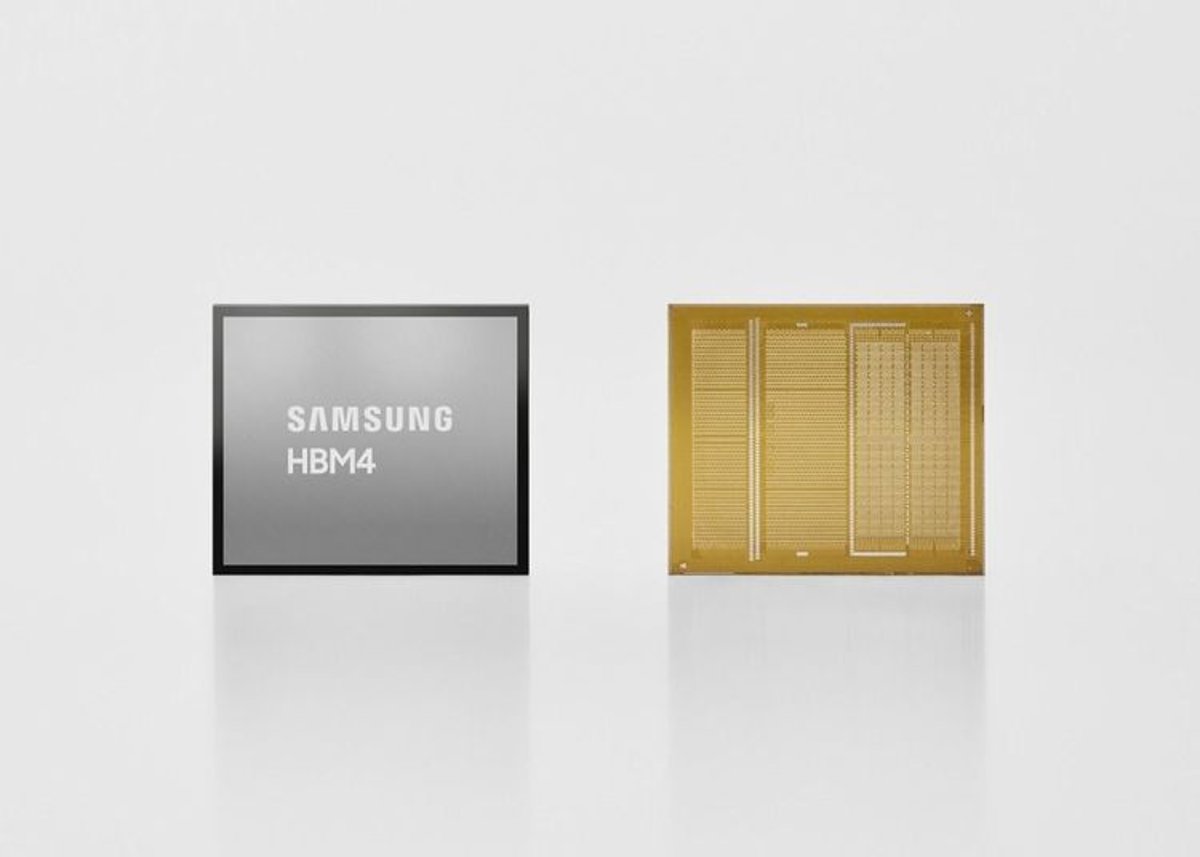
Samsung just fired the opening salvo in the next-gen AI memory wars. The company has begun shipping commercial HBM4 chips to customers, marking the first time anyone's delivered the next-generation high-bandwidth memory that powers AI datacenter infrastructure. With speeds hitting 11.7 Gbps - 46% faster than the industry standard - Samsung's betting its early lead will reshape the AI hardware landscape and triple its HBM sales this year.
Samsung isn't waiting around. While competitors were still refining their designs, the Korean tech giant started mass-producing and shipping its HBM4 chips - the specialized memory that sits at the heart of AI accelerators and datacenter GPUs. It's a bold move that could cement Samsung's position in a market where every nanosecond of data transfer matters.
The announcement comes as hyperscalers and GPU manufacturers scramble to secure memory supplies for their next-generation AI systems. According to Samsung's newsroom, the company achieved this milestone by skipping the conservative approach - instead of using proven older tech, they jumped straight to their most advanced 6th-generation 10nm-class DRAM process (1c) and 4nm logic.
"Instead of taking the conventional path of utilizing existing proven designs, Samsung took the leap," Sang Joon Hwang, Executive Vice President and Head of Memory Development at Samsung, told reporters. The gamble appears to have paid off. The company says it hit stable yields and industry-leading performance right out of the gate, with no redesigns needed.
The specs tell the story. Samsung's HBM4 consistently processes data at 11.7 gigabits per second, blowing past the 8 Gbps industry baseline by roughly 46%. That's also a 22% jump over HBM3E's maximum pin speed of 9.6 Gbps. But Samsung isn't stopping there - the chips can be pushed to 13 Gbps, creating headroom as AI models balloon in size and complexity.
Total memory bandwidth per stack has jumped 2.7 times compared to HBM3E, maxing out at 3.3 terabytes per second. For context, that's the equivalent of streaming thousands of 4K movies simultaneously - except it's happening between a GPU and its memory thousands of times per second. In AI training and inference workloads, where data bottlenecks can cripple performance, that bandwidth translates directly to faster model training and lower latency.
Capacity options range from 24GB to 36GB using 12-layer stacking technology, with plans to scale to 48GB through 16-layer stacking as customer timelines demand. But raw speed means nothing if it melts your datacenter. Samsung doubled the data I/O pins from 1,024 to 2,048, which typically would send power consumption and heat through the roof. Instead, through low-voltage through-silicon-via (TSV) technology and power distribution network optimization, they achieved a 40% improvement in power efficiency. Thermal resistance is up 10%, heat dissipation improved 30%.
The production strategy is equally aggressive. Samsung's leveraging what it calls "comprehensive manufacturing resources" - a diplomatic way of saying they have one of the biggest DRAM production capacities in the industry. A tightly integrated Design Technology Co-Optimization between Samsung's Foundry and Memory divisions means they control more of the supply chain than competitors who outsource packaging or logic dies.
That vertical integration matters. Advanced packaging expertise translates to streamlined production cycles and reduced lead times - critical when customers are racing to launch next-gen AI systems. Samsung says it's in "close discussions" with global GPU manufacturers and hyperscalers working on next-generation ASICs, though they're not naming names yet.
The financial implications are substantial. Samsung anticipates its HBM sales will more than triple in 2026 compared to 2025, and the company is proactively expanding HBM4 production capacity. For a company that's been playing catch-up to SK Hynix in the HBM market over the past year, this represents a potential turning point.
The roadmap extends beyond today's announcement. HBM4E sampling is expected to kick off in the second half of 2026, while custom HBM samples will start reaching customers in 2027 according to their specifications. That custom angle is particularly interesting - it suggests Samsung is willing to tailor memory solutions for specific AI accelerator designs, potentially deepening partnerships with hyperscalers building proprietary chips.
This isn't just about bragging rights. The AI infrastructure market is projected to grow exponentially as companies pour billions into training and deploying large language models, computer vision systems, and multimodal AI. Memory bandwidth has become one of the primary bottlenecks limiting AI performance. Whoever controls the supply of cutting-edge HBM effectively controls a chokepoint in the AI value chain.
Competitors like SK Hynix and Micron are undoubtedly racing to bring their own HBM4 products to market. SK Hynix has dominated HBM sales to Nvidia in recent quarters, while Micron has been gaining ground. Samsung's early shipment changes the competitive dynamics, but the real test will be yield rates, reliability in production deployments, and whether customers validate the performance claims in their own systems.
For GPU manufacturers and hyperscalers, the arrival of commercial HBM4 opens new possibilities for system architecture. Higher bandwidth and improved power efficiency mean they can either push performance higher or maintain current performance at lower power consumption - both critical as datacenters wrestle with electricity costs and sustainability commitments.
Samsung's first-to-market HBM4 shipment is more than a technical achievement - it's a strategic play for dominance in AI infrastructure at a moment when memory bandwidth has become as critical as compute power. The 46% speed advantage over spec and 2.7x bandwidth increase directly address the data bottlenecks choking AI model scaling. With sales projected to triple this year and production capacity expanding, Samsung is betting that early delivery and vertical integration will let it reclaim market share from SK Hynix. But the real validation comes next, as customers deploy these chips in production datacenters and either confirm the performance gains or reveal unexpected challenges. For now, Samsung has momentum - and in semiconductor markets, being first often matters as much as being best.