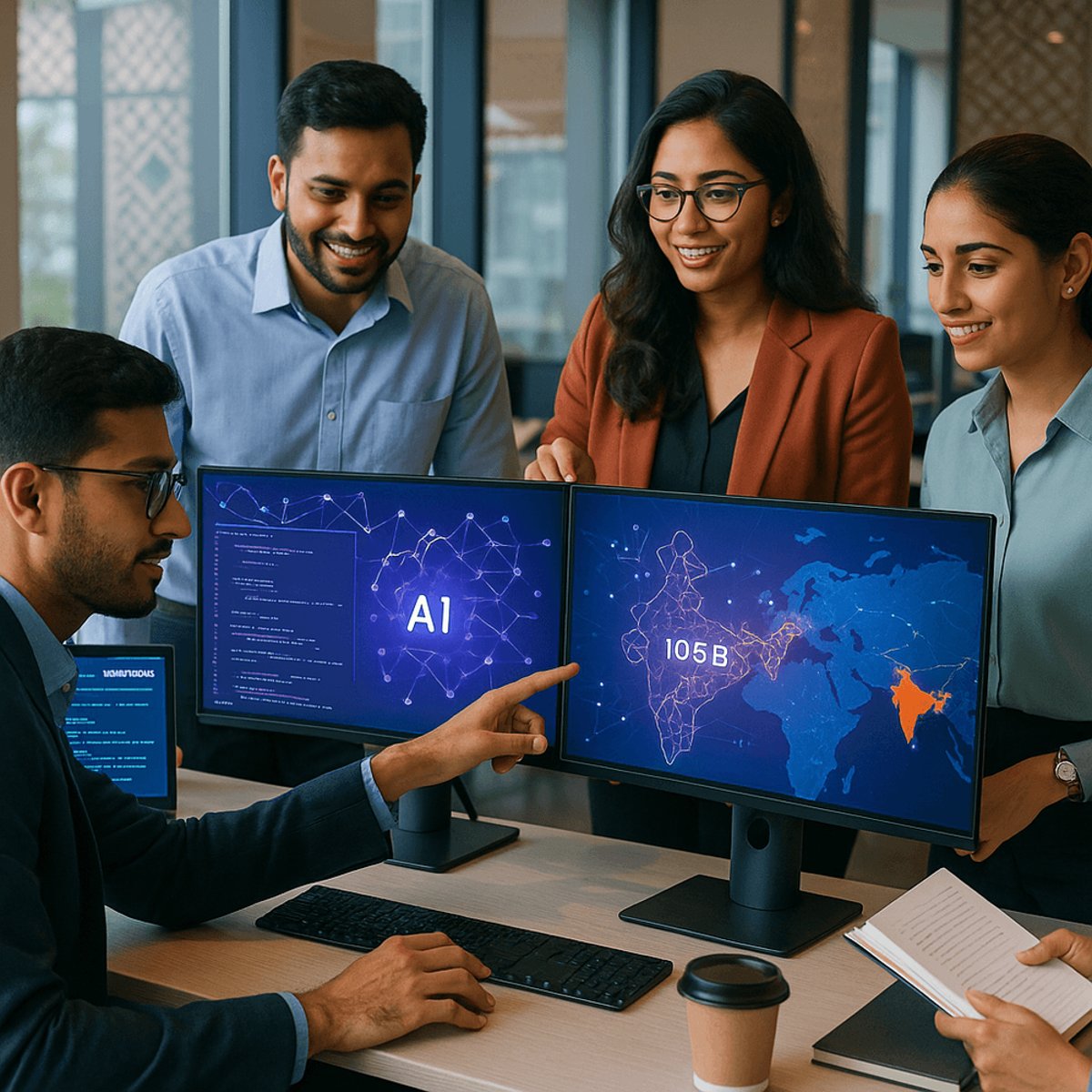
Indian AI startup Sarvam just made its boldest move yet in the battle between open and closed artificial intelligence. The Bangalore-based lab unveiled a suite of open-source models - including a massive 105-billion parameter flagship - that directly challenges the closed-source approach dominating the AI industry. The launch signals India's growing ambitions to become a major player in the global AI race, with models specifically optimized for the country's linguistic and cultural complexity.
Sarvam AI just threw down the gauntlet in the open-source versus closed-source AI debate. The Indian artificial intelligence lab unveiled a comprehensive lineup of foundation models at the India AI Impact Summit 2026, headlined by a 105-billion parameter behemoth that rivals models from much larger, better-funded Western competitors.
The release includes two core language models - Sarvam 30B and Sarvam 105B - alongside specialized multimodal capabilities: a text-to-speech system, a speech-to-text transcription model, and a vision model designed specifically for parsing documents in Indian languages. It's an ambitious technical bet that open-source infrastructure can power India's AI transformation without relying on proprietary systems from OpenAI or Anthropic.
What makes this launch particularly significant isn't just the model sizes - it's the timing and strategic positioning. While Western AI labs have largely pivoted toward increasingly closed development practices, citing safety concerns and competitive pressures, Sarvam is doubling down on transparency and accessibility. The company's approach mirrors the philosophy that propelled Meta's Llama models to widespread adoption, but with a laser focus on India's unique linguistic landscape.
India's AI ecosystem has been heating up rapidly. The country's massive developer community and relatively lower compute costs have made it an attractive testing ground for open-source AI alternatives. Google recently announced expanded AI infrastructure investments in India, while Microsoft has been quietly building partnerships with Indian enterprises hungry for AI capabilities that work with Hindi, Tamil, Telugu, and dozens of other regional languages.
The multimodal capabilities Sarvam is rolling out address real bottlenecks in the Indian market. Document processing remains a nightmare for businesses operating across India's linguistic diversity - a single company might need to parse legal documents in English, Hindi, and three regional languages. Current Western-trained vision models struggle with Indian scripts, creating a genuine market opportunity for locally-trained alternatives.
But launching models is the easy part. The real test will be whether Sarvam can build a sustainable business around open-source AI. The economics remain brutal - training a 105-billion parameter model requires millions in compute costs, ongoing fine-tuning demands constant investment, and giving the models away for free doesn't exactly scream profitability. Mistral AI in Europe has pioneered a hybrid approach, offering open-source models alongside premium API access, and Sarvam will likely need a similar playbook.
The competitive landscape is getting crowded fast. India already has several AI labs working on foundation models, including Ola's Krutrim AI, which claimed to have built India's first full-stack AI earlier this year. The difference is Sarvam's commitment to open-source distribution - making the models freely available for developers to modify, fine-tune, and deploy without licensing restrictions.
From a technical standpoint, the 105-billion parameter count puts Sarvam roughly in the same weight class as Meta's Llama 2 70B or Mistral's larger variants, though the actual performance benchmarks remain to be seen. What matters more than raw parameter count is how well these models handle the complexity of Indian languages, which include significantly different grammatical structures and writing systems compared to the English-dominated training data most AI models rely on.
The text-to-speech and speech-to-text capabilities are particularly strategic. India's next wave of internet users is increasingly voice-first, preferring to interact with technology through speech rather than typing. If Sarvam's models can deliver accurate transcription and natural-sounding synthesis across multiple Indian languages, they could power everything from customer service bots to educational platforms serving hundreds of millions of users.
This launch also represents a geopolitical bet. As concerns grow globally about AI concentration in American and Chinese companies, countries like India are actively investing in domestic AI capabilities. Open-source models offer a path to technological sovereignty - ensuring that critical AI infrastructure isn't controlled by foreign corporations with potentially misaligned interests.
The vision model for document parsing could be Sarvam's sleeper hit. Banks, insurance companies, and government agencies across India process millions of documents daily, many in regional languages that existing OCR systems handle poorly. A specialized model trained on Indian scripts and document formats could unlock massive efficiency gains across the economy.
Sarvam's aggressive open-source push arrives at a pivotal moment for AI's evolution. If these models deliver on their promise - particularly for India's underserved linguistic communities - they could prove that open-source AI isn't just viable, but actually superior for markets that Western labs have largely overlooked. The real measure of success won't be benchmark scores or parameter counts, but whether Indian developers, businesses, and government agencies choose to build on Sarvam's foundation rather than licensing from Silicon Valley. That adoption battle will determine whether open-source AI can carve out sustainable economics, or if the closed-model approach will eventually dominate globally. For now, India's AI ecosystem has a credible homegrown alternative to rally around.