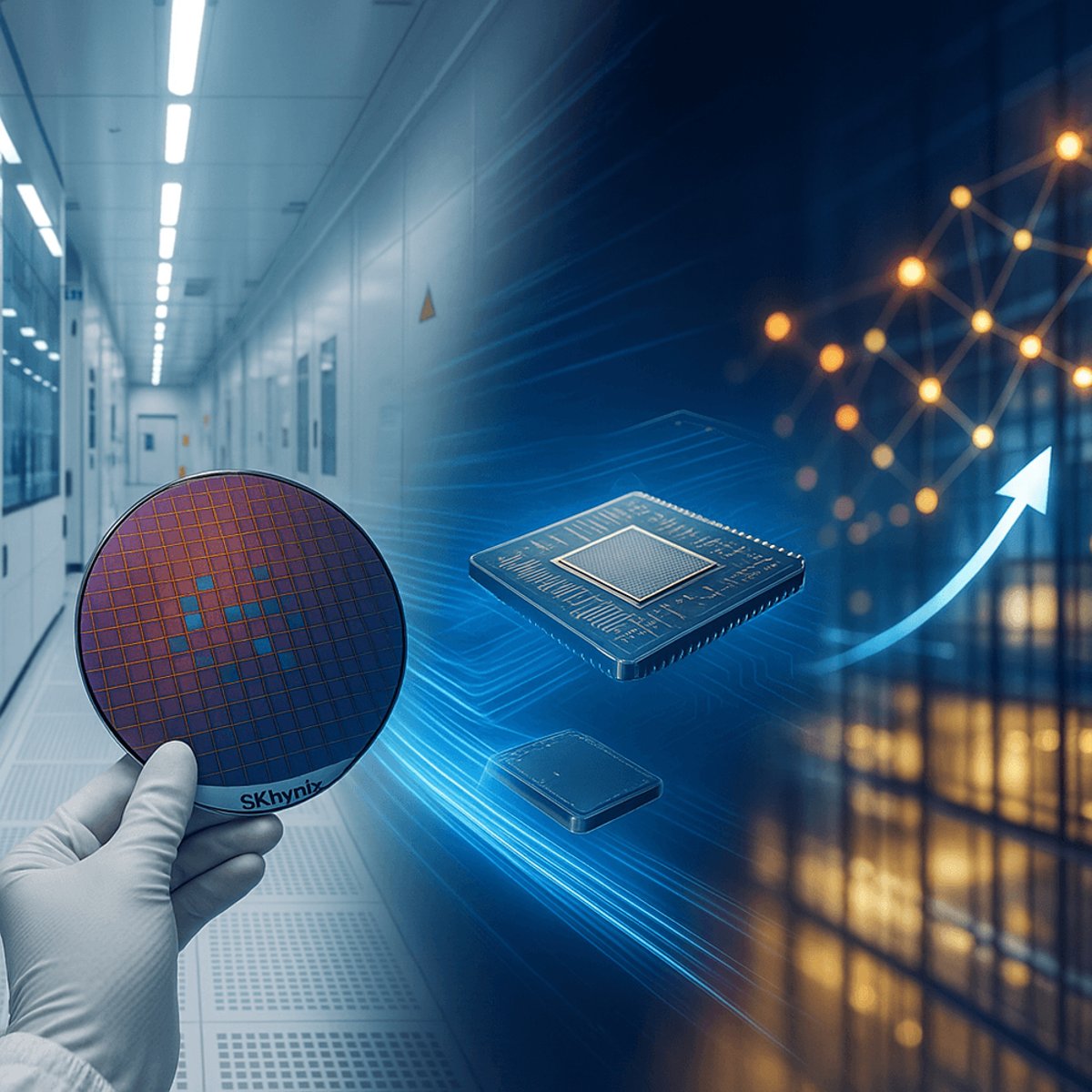
The AI boom's biggest bottleneck might finally get relief. SK hynix, the world's second-largest memory chipmaker, is preparing a $10-14 billion US IPO that could reshape the semiconductor landscape and address the industry's crippling 'RAMmageddon' shortage. The South Korean giant's move to American markets signals a major shift in how chip companies finance expansion during the AI infrastructure arms race, with Wall Street buzzing that the listing could trigger a wave of Asian semiconductor IPOs.
SK hynix just threw the semiconductor industry a potential lifeline. The memory chip powerhouse is eyeing Wall Street for what could become 2026's biggest tech IPO - a $10-14 billion offering that addresses the AI sector's most pressing infrastructure crisis head-on.
The 'RAMmageddon' shortage has become tech's quiet emergency. Data centers can't get enough high-bandwidth memory (HBM) to power AI training clusters. Nvidia has been allocating GPU shipments based on memory availability rather than chip production. Cloud providers are rationing capacity. And OpenAI, Microsoft, and Google have all reportedly faced training delays due to memory constraints.
SK hynix already dominates the HBM market with roughly 50% share, supplying the specialized memory that sits directly on AI accelerators. But demand has outstripped supply so dramatically that the company's been selling out production quarters in advance. According to TechCrunch, the US listing is designed specifically to raise capital for massive capacity expansion - new fabs, advanced packaging facilities, and R&D for next-generation memory architectures.
The timing couldn't be sharper. HBM prices have surged over 40% in the past year, and SK hynix's operating margins have hit record highs. The company shipped HBM3E, the latest generation, into volume production six months ahead of competitors. Its largest customer? Nvidia, which has publicly credited SK hynix's memory for enabling its H100 and H200 GPU performance.
But here's where it gets interesting for the broader market. A successful SK hynix IPO would mark the first major Asian semiconductor listing on US exchanges in years, potentially opening the floodgates. Industry watchers expect peers like Samsung and Taiwan's memory makers to watch closely. If SK hynix can command a premium valuation by tapping US capital markets, it changes the calculus for how Asian chipmakers fund expansion during this AI infrastructure buildout.
The strategic implications run deeper than just one company's funding round. Memory capacity is the constraint preventing hyperscalers from deploying AI infrastructure at the pace they'd like. Amazon Web Services has billions allocated for AI infrastructure that's essentially waiting on memory supply. Meta has publicly discussed memory bottlenecks limiting its AI training ambitions. A $14 billion injection into SK hynix's production capacity could start shifting those constraints within 18-24 months as new fabs come online.
Wall Street's appetite for semiconductor exposure has never been stronger, despite the sector's notorious cyclicality. The AI narrative has convinced investors that this memory upcycle has staying power, unlike previous boom-bust patterns driven by PC or smartphone demand. SK hynix's IPO would test that thesis directly - can a memory maker command tech-growth valuations typically reserved for software companies?
The company's competitive position supports premium pricing. Beyond HBM dominance, SK hynix supplies DRAM for data centers and NAND flash for storage, giving it exposure to multiple AI infrastructure layers. Its technology roadmap includes HBM4, which promises doubled bandwidth, and partnerships with Nvidia and AMD on co-optimized memory-processor designs.
But risks loom. Memory markets have historically been brutal, with oversupply collapses wiping out years of profits. SK hynix itself posted losses as recently as 2023 during the post-pandemic inventory correction. The question facing investors: is AI demand structural enough to justify massive capacity additions, or are we building toward another glut?
The IPO structure matters too. Whether SK hynix pursues a primary offering (new shares, capital to the company) versus secondary (existing shareholders selling) will signal management's confidence in deploying growth capital versus existing investors seeking liquidity. Early indications suggest a primary offering heavily weighted toward funding fab construction, which would directly address the capacity shortage.
For the AI ecosystem, SK hynix's listing represents more than just another IPO. It's infrastructure financing for the entire industry's expansion. Every dollar raised and deployed into memory production loosens constraints for Microsoft's Azure AI, Google's Gemini training runs, and Amazon's Trainium chip deployments. The semiconductor supply chain is finally getting the memo that AI infrastructure needs patient capital and long-term capacity planning, not just spot-market purchasing.
SK hynix's potential $14 billion US listing isn't just a capital markets event - it's a direct intervention in the AI infrastructure crisis. If successful, the IPO could unlock the manufacturing capacity needed to ease memory shortages that have been throttling the entire AI industry's expansion. More broadly, it tests whether Wall Street will finance semiconductor capacity at the scale and speed this moment demands. The 'RAMmageddon' shortage won't end overnight, but SK hynix just signaled that relief might finally be coming - assuming investors share the company's belief that AI memory demand justifies unprecedented expansion. For hyperscalers waiting to deploy billions in AI infrastructure, this IPO might be the most important listing of 2026.