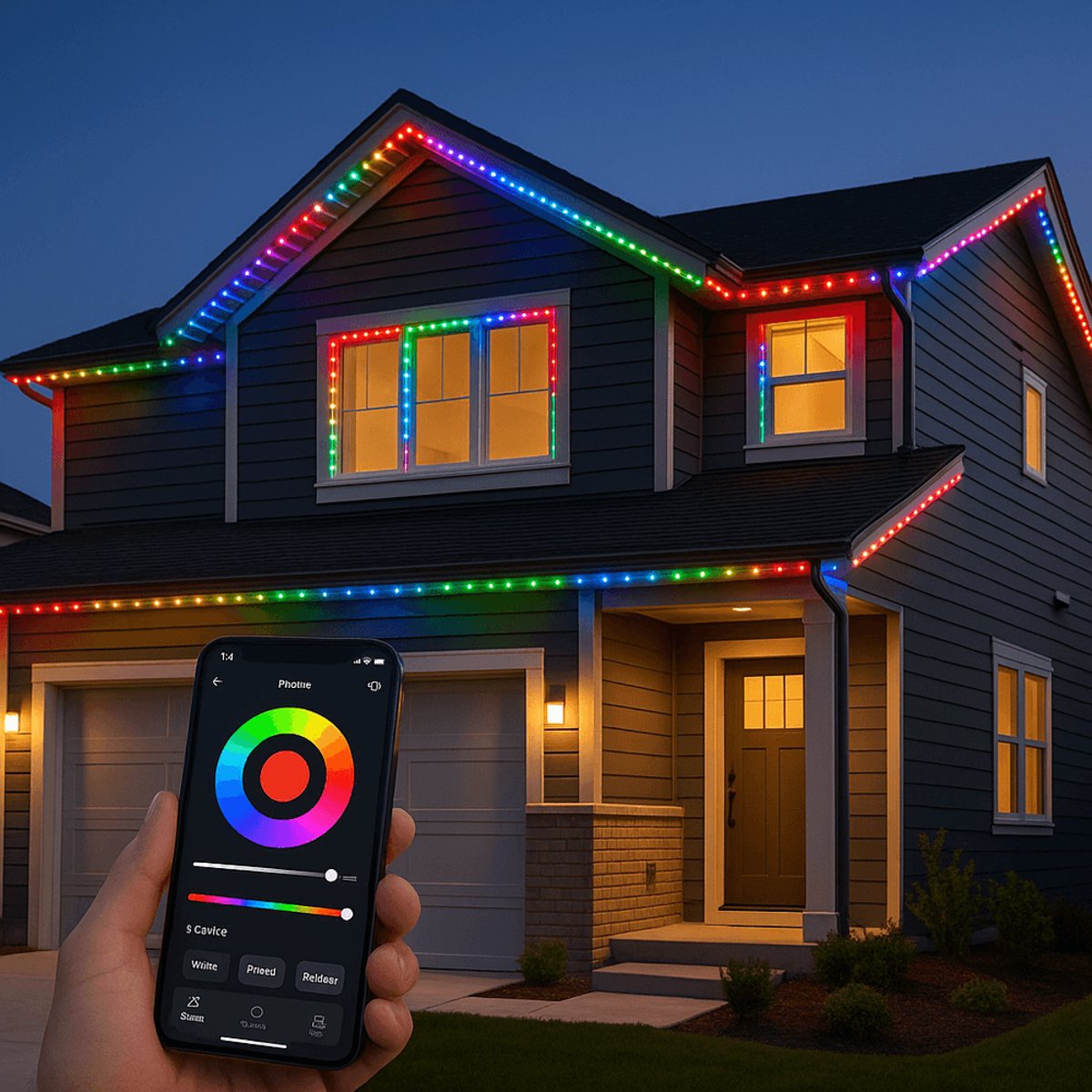
The smart home lighting market is witnessing a significant shift as permanent outdoor lighting systems gain traction over traditional seasonal installations. Wired's comprehensive buyer's guide reveals how companies like Govee, Eufy, and Lepro are targeting homeowners seeking year-round smart lighting solutions that eliminate the seasonal ladder climbs.
The smart home lighting industry is evolving beyond simple bulb replacements, with permanent outdoor lighting systems emerging as the next frontier for tech-savvy homeowners. Wired's extensive testing reveals how this category addresses a persistent pain point - the seasonal ritual of installing and removing decorative lights.
Govee leads the premium segment with its $440 100-foot system featuring IP67 weatherproofing and Matter protocol support. The company's approach mirrors successful smart home strategies by offering comprehensive app control with preset "Scenes" for different occasions. According to Wired's testing, installation proved straightforward using both adhesive strips and screw mounting options.
Eufy, owned by Anker Innovations, positions its S4 model as the reviewer favorite despite a higher $500 price point. The system incorporates RGB lighting with warm and cool whites, plus 120 preset holiday scenes and an AI-powered customization feature. Notably, Eufy includes radar motion sensors and maintains compatibility across Apple, Google, and Amazon ecosystems through Matter protocol support.
The budget segment sees Lepro offering competitive $190 pricing for 100-foot installations, though with significant app experience compromises. Wired's testing found users must navigate through AI prompts to access basic controls - a friction point that could limit mass adoption.
Architectural compatibility emerges as the critical adoption barrier. The technology works optimally on one- and two-story homes with accessible eaves and smooth mounting surfaces. Stucco exteriors, cross-beam eaves, and three-story designs present installation challenges that exclude significant market segments.
"The stucco makes it impossible to stick anything to it, and I have an HOA that forbids permanent changes," Wired's reviewer noted, highlighting how housing stock limitations could constrain market growth.
Weatherproofing standards vary significantly across the category. While premium options achieve IP67 ratings for light components, control boxes typically receive lower IP65 ratings, requiring protected outdoor outlets. Lepro's entry-level models lack power adapter weatherproofing entirely, creating potential reliability issues.
The testing methodology reveals industry maturity gaps. Unlike established smart home categories with standardized installation processes, permanent outdoor lighting requires custom cutting and splicing for optimal fit. Govee and Eufy provide this capability, while budget alternatives often lack architectural adaptation features.
Market dynamics show clear premium positioning, with leading systems priced 7-10x higher than traditional string lights. However, the value proposition extends beyond simple cost comparison - these systems eliminate recurring seasonal installation costs and provide year-round functionality through app-based color and pattern control.
Alternative solutions emerge for incompatible housing. Twinkly's $61 smart string lights and GE Cync's $89 LED strips target renters and complex architectural designs. These products maintain smart functionality while avoiding permanent installation requirements.
Competitive pressure appears limited, with Wired explicitly warning against Lumary's offering due to app complexity and power reliability issues. This suggests early-stage market consolidation around established smart home brands rather than pure lighting specialists.
The integration with existing smart home ecosystems through Matter protocol indicates industry standardization efforts. Both Govee and Eufy prioritize compatibility with Alexa, Google Assistant, and Apple HomeKit, suggesting recognition that standalone app experiences won't drive mass adoption.
The permanent outdoor lighting category represents smart home technology expanding into previously manual tasks, with clear market leaders emerging around installation flexibility and ecosystem integration. While architectural limitations constrain addressable market size, the $400+ price premium suggests strong unit economics for companies successfully targeting compatible housing stock. Success will likely depend on continued app experience refinement and broader smart home platform integration rather than pure hardware innovation.