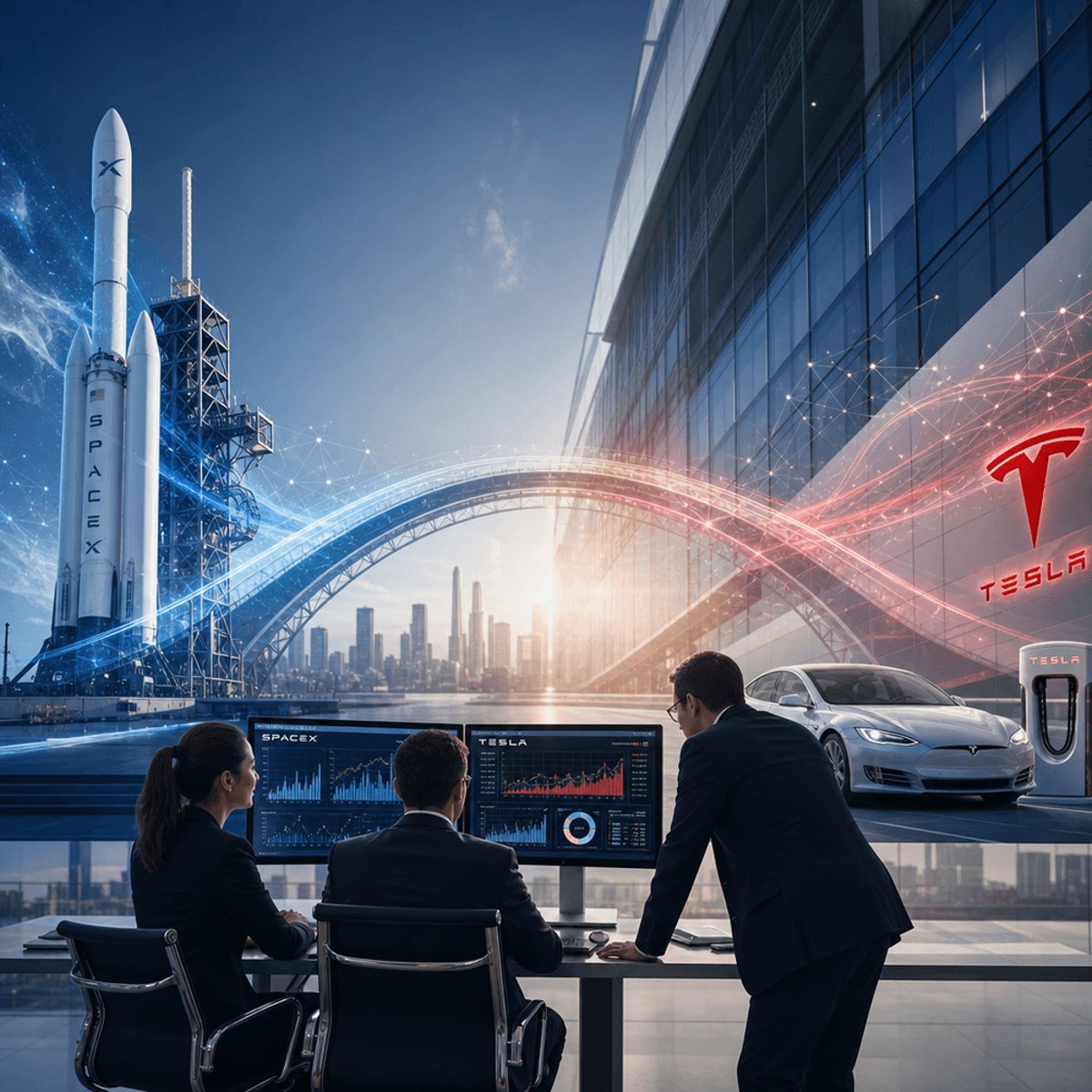
In a stunning revelation that sent both stocks surging in after-hours trading, SpaceX COO Gwynne Shotwell didn't rule out a potential tie-up with Tesla during interviews surrounding the rocket company's blockbuster Nasdaq debut. Speaking to CNBC as SpaceX completed what sources describe as a record-breaking IPO, Musk's longtime lieutenant suggested the move 'might make Elon's life a little easier' - the first public acknowledgment from SpaceX leadership that consolidating the CEO's sprawling empire is on the table.
SpaceX just dropped the biggest hint yet that Elon Musk's corporate empire might be headed for consolidation. As the rocket company celebrated its historic public market debut on Friday, COO Gwynne Shotwell told CNBC she wouldn't dismiss the possibility of a Tesla tie-up, casually noting it 'might make Elon's life a little easier.'
The bombshell came during what should have been routine IPO victory lap interviews. Instead, Shotwell - Musk's trusted second-in-command for over 18 years - opened the door to speculation that's been swirling in Silicon Valley for months: Could the CEO's sprawling portfolio of companies actually merge into a single entity?
Both stocks responded immediately. Tesla shares jumped 7% in extended trading while SpaceX's freshly minted ticker surged 12% in its first hours of after-hours activity, suggesting investors see strategic merit in what would be an unprecedented aerospace-automotive combination.
The timing is loaded with significance. Musk has faced mounting pressure from Tesla's board about his divided attention, especially as he's added CEO duties at xAI to his existing roles at SpaceX, Tesla, Neuralink, and the Boring Company. Tesla investors have grown increasingly vocal about what they see as a part-time CEO problem, with several shareholder proposals this proxy season demanding commitments on time allocation.
'We've watched Elon build multiple generational companies simultaneously,' one longtime SpaceX investor told us on background. 'But there's been this open question about whether that's sustainable, or whether consolidation makes more sense as these businesses mature.'
Shotwell's comments mark the first time anyone in Musk's inner circle has publicly entertained the merger possibility. The executive, who holds the title of President and COO at SpaceX, has historically been fiercely protective of the rocket company's independence, making her openness to the Tesla discussion all the more noteworthy.
The strategic logic isn't immediately obvious - rockets and electric cars operate in entirely different markets with different regulatory frameworks, supply chains, and customer bases. But dig deeper and potential synergies emerge. Both companies share DNA around vertical integration, manufacturing innovation, and battery technology. Tesla's energy storage business could theoretically support SpaceX's growing satellite internet infrastructure, while SpaceX's materials science advances could flow back to automotive applications.
The IPO itself provides the mechanism. For the first time, SpaceX has a public currency it could use in a stock-for-stock deal with Tesla. Previously, any combination would have required complex private market transactions. Now the path is theoretically clearer, even if the regulatory hurdles would be immense.
Wall Street analysts scrambled to model potential deal structures. Morgan Stanley's space economy team published a late-Friday note suggesting a merged entity could command a $2 trillion market cap, though they cautioned the antitrust review alone could take years. 'This would be the most complex industrial merger since the AOL-Time Warner era,' the note warned.
What Shotwell didn't address: How exactly a tie-up would simplify Musk's life operationally. Running a combined aerospace-automotive conglomerate might actually be more complex than maintaining separate entities. But if the goal is consolidating board obligations, earnings calls, and regulatory filings, there's logic there.
The COO's comments also come as SpaceX enters a new chapter as a public company. The IPO reportedly valued the business north of $200 billion, making it one of the largest public offerings in U.S. history. Trading under the ticker that sources say the company secured months ago, SpaceX now faces quarterly earnings pressure and public market scrutiny it's never experienced in its 24-year history.
For Tesla investors, the prospect cuts both ways. Some see potential upside from access to SpaceX's high-growth satellite and launch businesses. Others worry about dilution and the complexity of valuing such a sprawling entity. 'This could either be visionary or a value-destroying distraction,' one Tesla bull who requested anonymity told us. 'There's not much middle ground.'
Musk himself hasn't commented on Shotwell's remarks, though he did post a rocket emoji on X Friday evening, which devoted followers interpreted as acknowledgment of the IPO milestone - or perhaps the merger speculation.
The regulatory path would be treacherous. A SpaceX-Tesla combination would trigger reviews from the FTC, DOJ, and potentially national security agencies given SpaceX's defense contracts and role in critical space infrastructure. The Committee on Foreign Investment in the United States might want a say given Tesla's China exposure combined with SpaceX's sensitive technology.
But if there's one thing Musk's career has demonstrated, it's a willingness to attempt the improbable. He turned electric cars from a punchline into an industry-defining force. He made reusable rockets routine when aerospace giants said it was impossible. Merging his two most valuable companies into a single entity would be audacious even by his standards - which might be exactly why Shotwell is floating the idea now.
Shotwell's comments transform what should have been a straightforward IPO celebration into the opening salvo of what could become the most consequential corporate combination in tech history. Whether it's trial balloon or serious strategic planning, the mere fact that SpaceX's number two is discussing it publicly signals this isn't just Wall Street speculation anymore. For investors in both companies, the next few months will reveal whether this was an offhand remark or the first chapter in Musk's most ambitious restructuring yet. Either way, the conversation has officially moved from 'if' to 'how' - and that shift alone is enough to reshape expectations for both companies as they navigate their next phases of growth.