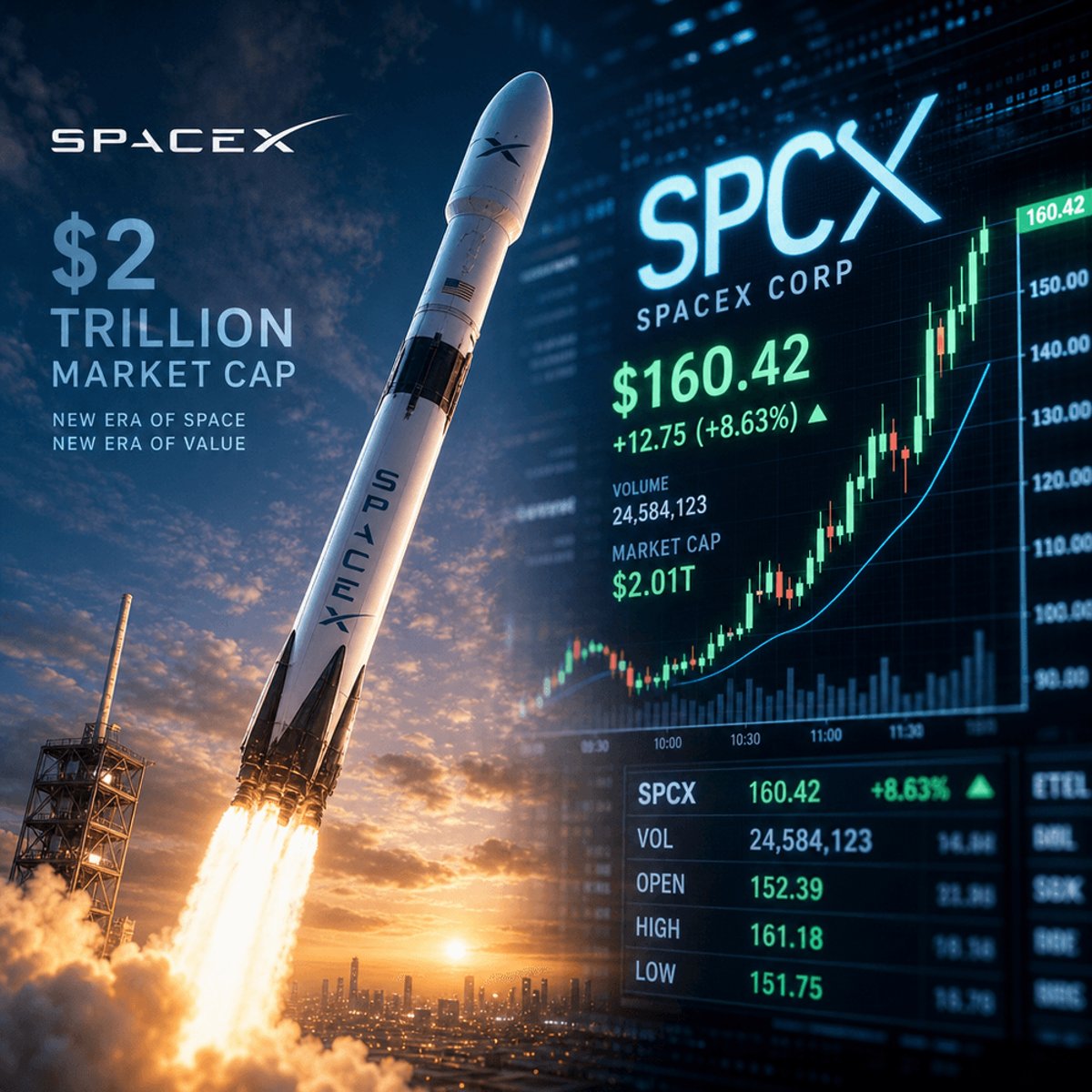
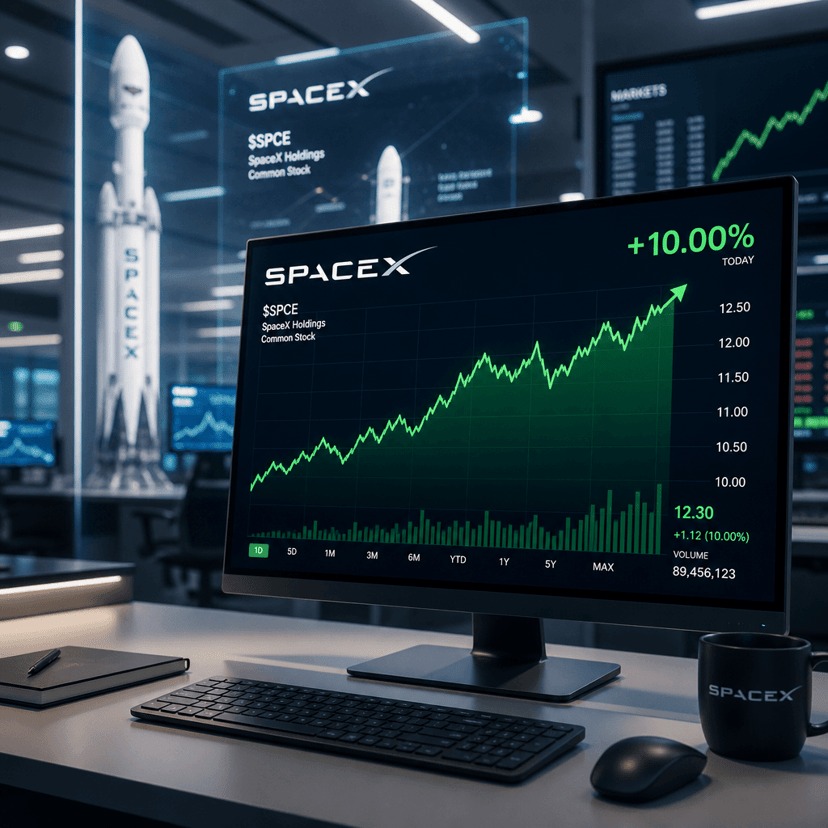
The most anticipated tech IPO in years just delivered. SpaceX shares blasted past $160 in early trading Friday, propelling Elon Musk's rocket company through the $2 trillion market cap ceiling and cementing its position as one of the most valuable publicly traded companies in history. The surge represents a stunning 18% pop from the company's revised $135-per-share IPO pricing, signaling massive investor appetite for the space giant's commercial prospects.
SpaceX just rewrote the rulebook on space economics. Shares of Elon Musk's rocket company rocketed past $160 just minutes after the opening bell Friday, pushing the company's market capitalization through the psychological $2 trillion barrier and delivering one of the most explosive IPO debuts in recent memory.
The opening surge caps a whirlwind week for SpaceX, which priced its long-awaited initial public offering at $135 per share on Thursday evening - already at the high end of its revised range. But investors clearly weren't satisfied with that entry point. According to CNBC's live market updates, the stock broke through $160 in the first minutes of trading, representing an 18.5% first-day pop that's rare for mega-cap offerings.
The $2 trillion valuation puts SpaceX in rarefied air, catapulting it past established tech titans and into the realm occupied by only Apple, Microsoft, and Nvidia. It's a remarkable achievement for a company that was literally weeks away from bankruptcy in its early days, surviving on last-minute cash infusions and sheer willpower.
But the market's clearly buying what Musk is selling. SpaceX dominates commercial spaceflight with a stranglehold on launches, its reusable Falcon 9 rockets have fundamentally changed the economics of getting to orbit, and the Starlink satellite internet business is already generating billions in annual revenue. The company's Starship program - designed to eventually transport humans to Mars - adds a moonshot element that investors seem willing to pay a premium for.
The IPO trajectory itself tells the story of surging demand. SpaceX initially floated a price range in the $110-$125 zone before bumping it to $125-$135 as institutional orders poured in. The company ultimately priced at $135, raised roughly $10 billion in fresh capital, and still left plenty of meat on the bone for first-day traders.
Wall Street analysts had been cautiously optimistic heading into the debut, but few predicted this kind of explosive move. The opening price action suggests retail investors and momentum traders are piling in alongside the institutional allocations, creating the kind of frenzied demand usually reserved for consumer tech darlings like Apple or social media phenomena.
The timing couldn't be better for SpaceX. The company's recent successful Starship test flights have validated years of development work, while Starlink continues adding subscribers at a rapid clip. Government contracts from NASA and the Department of Defense provide steady baseline revenue, even as commercial satellite launches and space tourism initiatives open new markets.
Competitors are watching nervously. Blue Origin, Jeff Bezos's space venture, remains private and years behind in launch cadence. Traditional aerospace giants like Boeing have struggled with cost overruns and technical delays on their space programs. SpaceX has essentially lapped the field.
The $2 trillion milestone also has implications for Elon Musk personally. While he's maintaining majority control through a dual-class share structure, the valuation bump adds tens of billions to his net worth and gives him fresh ammunition for his stated goal of making humanity a multi-planetary species. It also provides currency for potential acquisitions, though SpaceX has historically preferred building over buying.
Investors are essentially betting that space is the next trillion-dollar economy, and that SpaceX will capture the lion's share of that growth. The company's vertical integration - building its own engines, rockets, capsules, and ground systems - gives it cost advantages that competitors can't match. Its launch cadence of more than 100 missions per year dwarfs the rest of the industry combined.
But risks remain. The company burns billions on Starship development, regulatory hurdles could slow Mars ambitions, and competition in satellite internet is intensifying. Amazon's Project Kuiper is finally launching satellites, and terrestrial 5G networks are improving. The stock's opening pop also means future returns will need to come from execution rather than multiple expansion.
Market watchers are now focused on whether SpaceX can hold these gains through the trading day and into next week, or if profit-taking will cool the rally. The company's roadshow presentations emphasized long-term Mars colonization goals alongside near-term Starlink growth, giving both momentum traders and buy-and-hold investors reasons to stay interested.
The $160 opening and $2 trillion valuation represent more than just big numbers - they're a validation of SpaceX's decade-long bet that reusable rockets and satellite internet could transform space from a government science project into a thriving commercial market. Whether the company can justify this valuation depends on executing its ambitious Starlink expansion and Starship development roadmap. But for now, investors are signaling they believe in Musk's vision of a spacefaring civilization, and they're willing to pay a premium to own a piece of it. The real test comes in the months ahead as the post-IPO lockup expires and early employees and investors get their first chance to cash out.