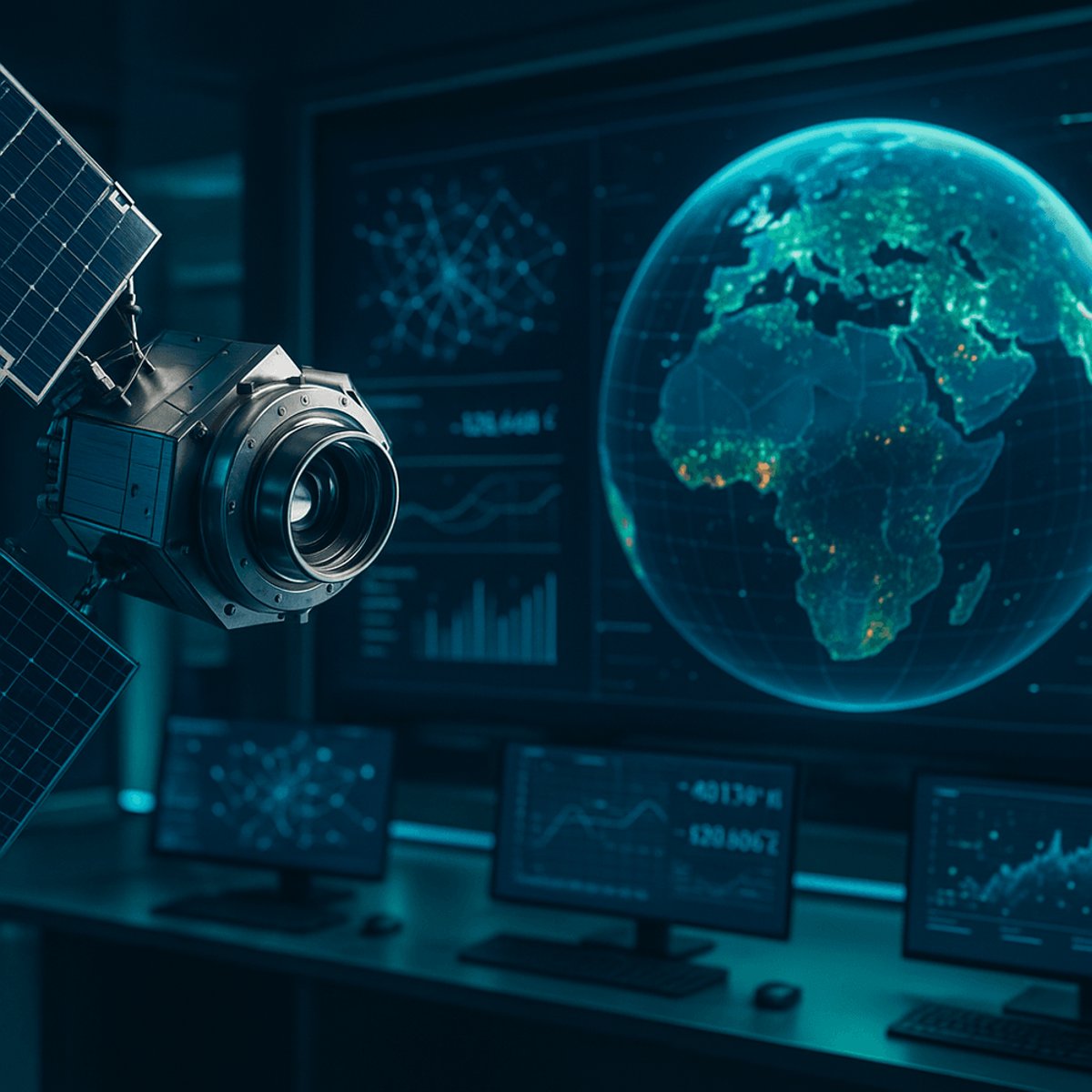
Spanish space tech startup Xoople just closed a $130 million Series B to build out its AI-powered Earth mapping constellation. The Madrid-based company is simultaneously announcing a strategic partnership with defense contractor L3Harris to manufacture the advanced sensors that'll power Xoople's spacecraft fleet, marking one of Europe's largest space tech funding rounds this year and signaling growing investor appetite for AI-driven geospatial data.
Xoople, a Spanish startup building AI-native Earth observation infrastructure, just landed $130 million in Series B funding according to an exclusive report from TechCrunch. The round positions the Madrid-based company to accelerate deployment of its satellite constellation designed specifically to feed machine learning models with real-time geospatial data.
The timing couldn't be sharper. As AI models grow increasingly hungry for training data, Earth observation startups are racing to provide the visual intelligence that powers everything from precision agriculture to climate risk modeling. Xoople's bet is that purpose-built satellites optimized for AI workflows will outcompete legacy imaging systems designed for human analysts.
Alongside the funding announcement, Xoople revealed a strategic manufacturing partnership with L3Harris, the Florida-based aerospace and defense contractor. L3Harris will build the specialized sensors for Xoople's spacecraft, bringing decades of defense-grade hardware expertise to a commercial space venture. The deal marks a notable crossover between traditional defense contractors and the emerging commercial space AI sector.
The $130 million infusion makes this one of Europe's most substantial space technology funding rounds this year, and it puts Spain on the map as a serious player in the satellite AI race. While most European space tech capital has historically flowed to UK and German ventures, Xoople's raise suggests investors are broadening their geographic lens as the sector matures.
Xoople's approach differs from traditional Earth observation companies that retrofitted existing satellite designs for AI applications. The startup is engineering its constellation from the ground up with machine learning inference at the core, potentially allowing for on-board processing that reduces latency and bandwidth costs. This architecture could prove crucial as customers demand near-instant insights rather than waiting for downlinked raw imagery.
The L3Harris partnership brings significant validation beyond just manufacturing capacity. Defense contractors like L3Harris have spent decades perfecting the kind of ruggedized, radiation-hardened sensors that must survive the harsh environment of low Earth orbit. That expertise typically costs startups years of trial and error, but Xoople is essentially buying its way past that learning curve.
Market dynamics are working in Xoople's favor. The global Earth observation market is projected to surpass $15 billion by 2030, driven largely by AI-powered analytics that can detect changes invisible to human observers. From tracking deforestation in near real-time to monitoring supply chain disruptions via shipping traffic, the use cases keep expanding as models get more sophisticated.
What sets this round apart is the strategic timing. Xoople is raising growth capital just as the first wave of venture-backed Earth observation companies face make-or-break moments. Several high-profile satellite startups have struggled to achieve unit economics, burning through capital faster than they can sign customers. Xoople's substantial war chest and hardware partnership suggest it's positioning to survive the inevitable consolidation.
The funding also reflects broader investor confidence in the intersection of space infrastructure and artificial intelligence. As foundation models demonstrate capabilities in visual reasoning and multi-modal understanding, the bottleneck shifts from algorithmic innovation to data access. Satellite constellations become strategic assets in a world where AI companies are desperate for unique training data.
For Spain's tech ecosystem, the round carries symbolic weight beyond the dollar figure. The country has produced successful startups across fintech and consumer internet, but hasn't yet claimed a flagship position in deep tech sectors like space. Xoople's trajectory could inspire a new generation of Spanish founders to tackle capital-intensive, hardware-heavy problems.
The company hasn't disclosed which investors led the Series B or what valuation the round implies, leaving open questions about the cap table dynamics. The lack of detail around customer traction or deployment timeline also makes it difficult to assess execution risk, though the L3Harris deal suggests Xoople has moved beyond pure vaporware.
What's clear is that Xoople now has the runway to prove its thesis. With $130 million in the bank and a tier-one hardware partner lined up, the pressure shifts from fundraising to execution. Can the team actually build and launch a constellation that delivers on the AI-native promise? The next 18 months will tell whether this capital translates to orbit.
Xoople's $130 million Series B and L3Harris partnership represent a significant bet that the future of Earth observation belongs to AI-first architectures rather than retrofitted legacy systems. The round gives Spain a legitimate contender in the space tech race and validates the thesis that satellite data will become critical infrastructure for training next-generation AI models. But capital alone doesn't put satellites in orbit - execution risk remains high, and the company will need to prove it can translate manufacturing partnerships and investor confidence into functioning spacecraft that deliver differentiated data. The real test starts now.