The U.S. is considering sanctions against China over allegations of AI model theft, according to Treasury official Bessent, marking a sharp escalation in the tech cold war between Washington and Beijing. The warning comes as Chinese open-weight AI models rapidly gain ground against American leaders like OpenAI and Anthropic, raising urgent questions about intellectual property protection and national security in the race for AI dominance.
The gloves are coming off in the AI arms race. Treasury official Bessent just put China on notice that the U.S. could deploy sanctions over what Washington is calling systematic theft of AI model technology. It's a dramatic threat that could fundamentally reshape how AI development happens globally.
The timing isn't coincidental. Chinese companies have been releasing increasingly capable open-weight models that rival—and in some benchmarks, exceed—the performance of flagship offerings from OpenAI and Anthropic. Models like DeepSeek and Qwen have caught Western AI labs off guard with their rapid advancement, especially given the strict export controls on advanced chips that were supposed to slow China's progress.
Bessent's warning, reported by CNBC, suggests the U.S. government believes Chinese developers didn't achieve these results through independent research alone. The accusation of model theft implies Chinese firms may have illicitly obtained training data, model architectures, or algorithmic innovations from American companies—though specific evidence hasn't been publicly disclosed yet.
This marks a significant escalation beyond existing chip export restrictions. While the U.S. has already limited China's access to cutting-edge semiconductors from Nvidia and others, targeting AI models themselves opens a new battleground. The challenge is enforcement. Unlike physical chips, AI models are digital and can be reverse-engineered, shared anonymously, or leaked through insider channels.
The rise of Chinese open-weight models has been particularly vexing for U.S. policymakers. Unlike closed systems from OpenAI or Anthropic, open-weight models release their parameters publicly, allowing anyone to download, modify, and deploy them. This openness accelerates innovation but also makes it harder to trace potential intellectual property violations or control how the technology spreads.
For OpenAI, which has faced its own controversies around data usage and model training, the theft allegations put the company in an awkward position. The maker of ChatGPT has invested billions in developing GPT-4 and its successors, and any suggestion that China obtained shortcuts to similar capabilities threatens both its competitive advantage and its valuation. Anthropic, founded by former OpenAI researchers with a focus on AI safety, faces similar concerns about its Constitutional AI techniques being replicated without authorization.
The potential sanctions could take multiple forms. The Treasury Department might target specific Chinese AI companies with asset freezes or restrictions on doing business with American firms. More drastically, Washington could impose secondary sanctions on any company globally that uses allegedly stolen Chinese AI models, forcing businesses worldwide to choose between American and Chinese technology ecosystems.
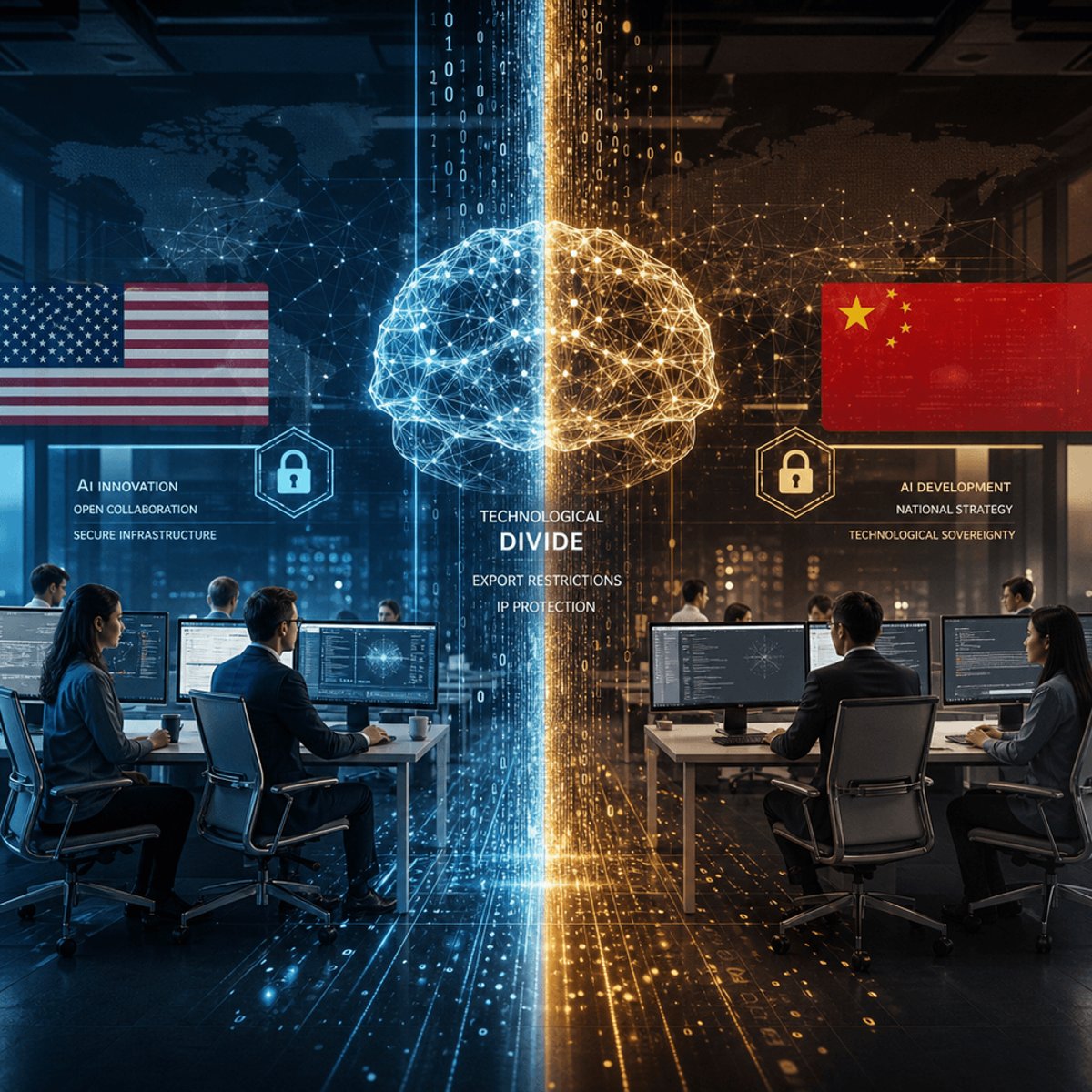
That bifurcation is already happening to some degree. Export controls have created separate supply chains for advanced chips. Extending this division to AI models would accelerate the split, potentially creating incompatible technological spheres where American and Chinese AI systems develop along completely different trajectories.
For the global AI industry, the implications are massive. Startups and enterprises that have adopted Chinese open-weight models for cost or performance reasons might face compliance nightmares. Research collaboration between American and Chinese institutions could freeze further. And the open-source AI movement, which has championed transparency and shared development, could find itself caught in the crossfire of geopolitical tensions.
The allegations also raise thorny questions about what constitutes theft in AI development. Models are trained on vast datasets scraped from the internet, often without explicit permission. Architectural innovations build on publicly published research papers. The line between legitimate research that builds on prior work and illicit copying of proprietary systems isn't always clear—and that ambiguity could make sanctions difficult to justify or enforce.
China hasn't officially responded to Bessent's warning yet, but Beijing has consistently denied accusations of technology theft and argued that American restrictions are protectionist measures designed to maintain hegemony. Chinese officials are likely to frame any AI sanctions as further evidence of U.S. efforts to contain China's technological rise.
What happens next depends partly on what evidence the U.S. presents. If Washington can demonstrate clear cases of model theft—perhaps through leaked internal documents or forensic analysis of Chinese models—it would strengthen the case for sanctions. But vague accusations without proof could backfire, making the U.S. look like it's simply trying to handicap a competitor that's catching up through legitimate means.
Bessent's sanction threat represents a pivotal moment in the AI cold war. If implemented, these measures could fragment the global AI ecosystem even more dramatically than chip export controls have. For companies like OpenAI and Anthropic, it's a mixed blessing—protection from alleged theft, but also acceleration toward a bifurcated world where innovation happens in separate, incompatible spheres. The real question isn't whether U.S.-China AI competition will intensify, but whether the rest of the world will be forced to pick sides in a technology divide that makes collaboration—and perhaps progress itself—increasingly difficult.