TL;DR: Clanker at a Glance
Clanker is an AI-powered token deployment platform that lets anyone create tradeable crypto tokens on Base through simple text commands. In October 2025, decentralized social network Farcaster acquired Clanker and now uses protocol fees to buy back and hold CLANKER tokens. The platform has generated over $50 million in fees since launching and ranks as the fourth-largest protocol on Base by weekly revenue. WYDE's cause tokens launch on Clanker's infrastructure, routing a portion of every trade to verified nonprofits.
From Bot to Backbone: How Clanker Became Farcaster's Token Engine
Clanker started as an experiment in November 2024. Developers Jack Dishman and a pseudonymous contributor built an AI agent that could deploy tokens when users tagged it in posts. The idea was simple: type a message describing your token idea, tag @clanker, and the bot handles everything else.
Within weeks, the project sparked what many called the "AI memecoin boom" on Base. Users flooded the platform with token requests. Some were jokes. Some became legitimate communities. All of them generated trading fees that flowed back to creators.
By October 2025, Clanker had processed over 4,200 token deployments and generated more than $50 million in protocol fees. Farcaster, the decentralized social network where Clanker lived, saw an opportunity. On October 23, 2025, Farcaster announced it had acquired Clanker.
The acquisition transformed both platforms. Farcaster gained native token infrastructure. Clanker gained permanent integration into a social network with 1.4 million registered users. The deal signaled Farcaster's push deeper into SocialFi, where social activity and financial activity merge.
The Buyback Engine: How Protocol Fees Now Fuel Token Scarcity
The acquisition came with a significant tokenomics shift. Farcaster announced three changes that fundamentally altered CLANKER's supply dynamics.
Fee-Funded Buybacks: All protocol fees generated by Clanker now purchase and hold CLANKER tokens. This creates consistent buying pressure as long as people keep deploying and trading tokens on the platform. The Clanker trading agent generates between $400,000 and $500,000 in weekly fees, even during periods of low trading activity.
Legacy Token Burns: Tokens accumulated in fee vaults from earlier Clanker versions get burned. This removes supply permanently rather than letting it sit idle or potentially flood the market.
Permanent Liquidity Lock: Roughly 7% of the total CLANKER supply has been locked in a one-sided Uniswap liquidity pool. This cannot be withdrawn, ever. The locked liquidity provides market depth that benefits all traders.
The result is a self-reinforcing cycle. More token deployments generate more fees. More fees fund more buybacks. More buybacks reduce circulating supply. Reduced supply, combined with locked liquidity, creates structural support for the token.
Under the Hood: The Smart Contract Architecture That Makes It Work
At its core, Clanker is a set of audited smart contracts on Base. When someone deploys a token, the system executes several operations in sequence.
The Factory: Minting and Pool Creation
The factory contract handles token creation. It mints a new ERC-20 token with a fixed 100 billion supply, creates a Uniswap V4 trading pool for the new token, deposits initial liquidity across multiple price ranges, and registers fee recipients.
The Hook Layer: Programmable Fees
Clanker V4 uses Uniswap's hook system to implement custom fee logic. Creators choose between:
Static fees that charge a fixed percentage on every trade. You might set 1% on buys and 0.75% on sells. The rate never changes regardless of market conditions.
Dynamic fees that adjust based on volatility. A base rate (often 0.5% to 1%) applies during calm periods. During volatile periods, fees can spike to 5% or higher. This protects liquidity providers when markets move fast and rewards patient traders when markets are stable.
Every trade also pays a 0.2% protocol fee to Clanker/Farcaster, which now funds the buyback program.
The Revenue Router: Up to Seven Fee Recipients
Here's where Clanker gets interesting for projects like WYDE. At deployment, creators configure up to seven fee recipients. Each recipient gets an immutable percentage of all future trading fees.
A typical configuration might look like:
-
40% to project treasury
-
25% to community rewards pool
-
20% to liquidity incentives
-
15% to partners or integrators
These splits cannot change after deployment. This protects all parties: buyers know the fee structure won't shift against them, and recipients know their allocation is permanent.
The Liquidity Staircase: Why Token Price Behavior Varies So Much
Most token launches dump all liquidity at a single price point. Clanker does something different. It creates up to seven Uniswap positions across different price ranges, forming what developers call a "liquidity staircase."
The staircase shape determines how much supply is available at different prices. A steep staircase concentrates supply at low prices, meaning early buyers can accumulate cheap but price rises quickly once that supply exhausts. A gradual staircase spreads supply across many price points, allowing larger purchases without as much price impact.
Creators configure this at launch. The choices reflect strategy:
-
Meme tokens often use steep staircases for dramatic early price action
-
Utility tokens often use gradual staircases for stable accumulation
-
Community tokens often balance both with concentrated mid-range liquidity
MEV Protection: Defending Launches From Bot Exploitation
Every token launch attracts bots trying to front-run regular traders. Clanker includes several modules to level the playing field.
Two-Block Delay: No swaps allowed for the first two blocks after deployment. This prevents bots from sniping the exact launch moment.
Sniper Auctions: Instead of first-come-first-served, early buyers participate in auctions. Up to five auction rounds occur, one every two blocks. If a round has no bidders, auctions stop and regular trading begins.
Descending Fee Curves: Launch fees start extremely high (around 80%) and decay to normal levels (around 5%) over roughly 30 seconds. Impatient bots pay premium fees. Patient humans wait for rates to normalize.
These protections don't eliminate MEV entirely. They redistribute value from bots to creators and patient traders.
Deployment Paths: Four Ways to Launch Your Token
1. Cast Deployment via @clanker
The original method. Post on Warpcast (Farcaster's main client), tag @clanker, include your token name, ticker, and image. The AI bot processes your request and deploys.
Best for: Quick launches, meme tokens, testing ideas
2. clanker.world Interface
The full-control option. A web interface where you configure every parameter: fee type, liquidity shape, MEV protection, vesting schedules, airdrops, and initial buys.
Best for: Serious projects, long-term tokens, complex tokenomics
3. Third-Party Interfaces
Several platforms build on Clanker's SDK:
-
Bankr: AI trading agent that deploys tokens from X/Farcaster
-
Clanker.fun: Classic web interface for browsing and launching
-
Pool.fans: Fee tokenization and staking integration
Best for: Specific use cases, integrated workflows
4. Direct SDK/API Integration
Developers can build custom token-launching experiences using Clanker's official SDK. Your interface collects configuration, the SDK calls the factory, tokens launch with your app tagged as the source.
Best for: Builders creating new platforms
The Numbers: Clanker's Traction on Base
The platform's growth metrics tell a story of rapid adoption:
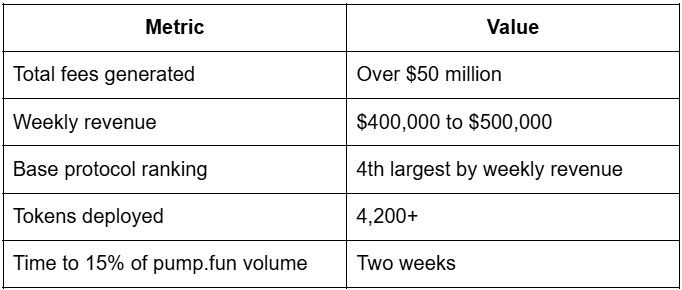
Notable launches include the $LUM token created by an AI agent called Aether, which reached $80 million market cap within a week of deployment.
Risks Worth Understanding Before You Deploy or Trade
Smart contract dependency: All Clanker tokens share the same underlying contracts. A critical bug could affect thousands of tokens simultaneously. Audits reduce but don't eliminate this risk.
Immutable fee splits: Whatever percentages you set at launch remain forever. No governance vote, no multisig, no emergency process can change them. Think carefully before deploying.
Platform concentration: Farcaster has 1.4 million registered users but only around 20,000 monthly active users as of late 2024. The ecosystem remains small compared to mainstream social networks.
Fee complexity advantages: Sophisticated users who understand dynamic fees, liquidity shapes, and MEV modules have structural advantages over casual participants.
How WYDE Launches Cause Tokens on Clanker Infrastructure
WYDE builds its Impact Exchange on Clanker's foundation. Every WYDE cause token deploys through Clanker's factory with custom fee routing that directs a portion of every trade to verified nonprofits.
The Fee Configuration for Charitable Impact
When WYDE deploys a cause token like $EAT (hunger relief), the fee recipients look like this:
-
25% to verified hunger relief nonprofits (Feeding America, local food banks)
-
25% to $EAT token holders (community rewards)
-
25% to WYDE operations (platform sustainability)
-
25% to infrastructure (including the 0.2% Clanker/Farcaster protocol fee)
The nonprofit allocation is immutable. No future governance vote or founder decision can redirect those funds elsewhere. Charity partners receive their share automatically, on-chain, from the first trade to the millionth.
Social Layer Integration Through Farcaster
Because Clanker lives inside Farcaster, cause token launches can happen through social posts. A creator could cast about a charitable initiative on Warpcast, tag @clanker with the token configuration, and launch a cause token that immediately starts generating donations from trades.
This differs from traditional charity tokens that require manual processes. WYDE inherits Clanker's automation: fee calculation, distribution, and recording all happen without human intervention.
MEV Protection for Fair Charitable Launches
WYDE can use Clanker's MEV modules to ensure causecoin launches don't get exploited. The descending fee curve means early bot activity generates more fees (and therefore more charitable donations) rather than just enriching front-runners.
Key Resources and Links
Official Documentation
Interfaces and Tools
Analytics and Data
WYDE Resources
Frequently Asked Questions
What blockchain does Clanker use? Clanker deploys tokens on Base, Coinbase's Layer 2 network built on Ethereum. Some versions also support Arbitrum and Ethereum mainnet.
How much does it cost to deploy a token? Gas fees on Base are minimal, typically under $1. There's no separate Clanker deployment fee. Creators earn from trading fees rather than paying upfront.
Can I change my token's fee structure after launch? No. Fee percentages and recipients are immutable once deployed. Admin addresses can change recipient wallets but not the percentage splits.
What's the difference between Clanker and pump.fun? Both enable easy token launches. Clanker integrates with Farcaster's social layer, offers more complex fee configurations, and uses Uniswap V4's hook system. Pump.fun operates primarily on Solana with a simpler bonding curve model.
How do WYDE causecoins differ from regular Clanker tokens? The technical infrastructure is identical. The difference is in fee routing: WYDE configures recipients so a portion of every trade automatically flows to verified nonprofits. Regular Clanker tokens route fees to creator wallets.
Disclaimer: This content is educational and does not constitute financial advice. Token values fluctuate based on market conditions. Smart contract risks exist regardless of audit status. Always conduct your own research before participating in any cryptocurrency project.
Related Articles