TL;DR: Causecoins at a Glance
Causecoins are crypto tokens where every trade automatically sends a portion of fees to verified nonprofits. No donation buttons. No remembering to give. Just trading that generates charitable impact as a byproduct. WYDE, launching Q4 2025 on Base, creates cause-specific tokens covering hunger relief, cancer research, ocean cleanup, veterans support, and more. Each token routes 25% of trading fees directly to 501(c)(3) partners through immutable smart contracts. The legal structure uses Wyoming's DUNA framework, enabling token-holder governance over nonprofit allocations after year one.
The $100 Billion Problem: Crypto Wealth That Never Reaches Charity
Crypto created enormous wealth. Some of it reaches nonprofits. In 2024, U.S. charities received more than $1 billion in cryptocurrency donations, with the average crypto gift reaching about $10,978. Over 70% of the top 100 U.S. charities now accept cryptocurrency.
But here's the disconnect: roughly 52 million Americans actively trade digital assets. Most don't donate to traditional nonprofits. The infrastructure doesn't fit their behavior. Donation portals require interrupting what you're doing, navigating to a charity's website, entering payment information, and making a conscious choice to give.
Traditional charity tokens tried to solve this with transaction taxes. Buy the token, a percentage goes to charity. The problem? Those tokens died. Trading volume collapsed. The charity cut became meaningless because nobody was trading.
Causecoins take a different approach: build tokens people actually want to trade AND own, then route the fees.
How Causecoins Generate Charitable Impact
The Fee Mechanism: Every Swap Feeds Someone
When someone buys or sells a Causecoin, the transaction generates a trading fee (typically 1-5% depending on market conditions). That fee gets split according to rules hardcoded at deployment:
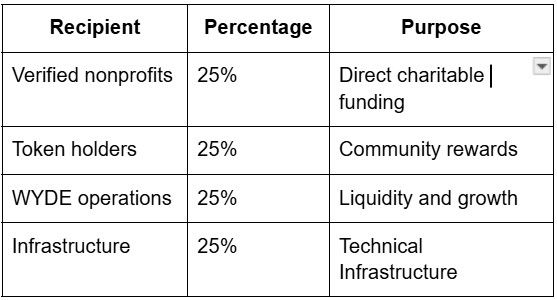
The charity portion flows automatically. No executive decides whether to follow through. No board votes on allocation timing. The smart contract executes the split on every single trade.
The Scale Math: From Micro-Donations to Macro-Impact
Here's where it gets interesting. Consider $EAT, WYDE's hunger relief token:
Per trade: Someone swaps $1,000 of $EAT. The 1% fee generates $10. Of that, $2.50 goes to hunger relief.
Per day: If $EAT sees $500,000 daily volume (modest by crypto standards), that's $1,250 per day to food banks.
Per year: At that volume, $456,250 flows to hunger relief annually from a single token.
Now multiply by up to 50 cause tokens. Add in viral moments when trading spikes. Factor in the creator economy amplification when influencers promote causes they care about.
At scale, the math becomes civilization-changing. If 5% of global food spending eventually shifted to $EAT-denominated transactions (a massive hypothetical), the fee stream could approach the entire current hunger relief charitable sector.
Nonprofit Bulk Purchasing: Why $1 Becomes 10 Meals
Feeding America and similar organizations purchase food at nonprofit bulk rates. Your $1 donation doesn't buy $1 of grocery-store food. It buys roughly 10 meals worth of food through supplier relationships and bulk logistics.
This multiplier effect makes fee-based charity more powerful than it appears. The $2.50 per $1,000 trade becomes 25 meals. The $1,250 daily becomes 12,500 meals. The compounding is real.
The Legal Foundation: Wyoming's DUNA Framework
Crypto charity has a credibility problem. Too many projects promised charitable purposes, then rugpulled or abandoned their missions. WYDE addresses this through legal structure.
What's a DUNA?
Wyoming created the Decentralized Unincorporated Nonprofit Association in 2024. It's a legal framework purpose-built for blockchain-based charitable governance:
-
Token-based voting rights: Holders can vote on nonprofit selection
-
On-chain treasury management: Funds visible and auditable
-
Legal entity status: Real contracts with real nonprofits
-
Regulatory clarity: Operating within established law, not legal gray areas
Year One: Founder-Set Partnerships
For the first 12 months, nonprofit partnerships are set by WYDE and founding charity partners. These agreements cannot change during the initial period, protecting:
-
Nonprofits: From governance volatility before the community stabilizes
-
Donors: From bait-and-switch where charity recipients change unexpectedly
-
WYDE: From legal complications during launch phase
Year Two and Beyond: Community Governance
After the first 12-month contracts conclude, token holders vote on:
-
Which nonprofits receive funding
-
How to split allocations between multiple recipients
-
Performance metrics and accountability standards
-
Whether to add or remove partner organizations
This creates accountability. Underperforming nonprofits can be replaced. High-impact organizations can receive larger allocations. The community controls the mission.
The Immutability Guarantee: Why 25% Always Means 25%
Here's what makes Causecoins different from charity tokens that came before: the percentage cannot change.
Clanker's smart contracts enforce immutable fee splits. When WYDE deploys $EAT with 25% to nonprofits, that allocation is permanent. No governance vote, no multisig decision, no founder override can redirect those funds.
This matters because:
- Trust doesn't require trust: You don't need to believe WYDE's promises. The code enforces them.
- Future-proof commitments: Even if WYDE's leadership changes, the charitable allocation continues.
- Verifiable on-chain: Anyone can inspect the contract and confirm the fee routing.
- Regulatory protection: Clear, immutable charitable purpose helps defend against securities classification.
The Creator Economy Multiplier: From Viral Moments to Sustained Impact
Traditional charity benefits from viral moments. MrBeast's videos raise millions. TeamSeas removed 30 million pounds of ocean trash from a single campaign. But viral moments fade. The infrastructure disappears.
Causecoins create permanent infrastructure that viral moments can plug into.
Scenario: A Creator Discovers $OCEANS
-
A popular gaming streamer cares about ocean conservation
-
They discover $OCEANS: every trade funds The Ocean Cleanup
-
They promote it to their audience during streams
-
Trading volume spikes during the campaign
-
After the stream ends, the token continues trading
-
The streamer's audience now holds tokens generating ongoing impact
-
Future streams can reference the same token, compounding engagement
Compare this to a one-time charity stream where money gets donated and the event ends. Causecoins turn moments into movements.
The Numbers: Creator-Driven Charity Success
The creator economy has proven its philanthropic power:
-
DrLupo: $20+ million raised for St. Jude through gaming streams
-
MrBeast & Mark Rober: $30 million for TeamSeas ocean cleanup
-
Gaming community: $100+ million annually across various causes
These creators attracted audiences. The audiences donated. But the infrastructure was temporary. Causecoins offer permanence.
Risks Worth Understanding Before You Trade
Trading Volume Is Everything
Causecoins only generate charitable impact when people trade them. A dead token with no volume sends zero to charity. Bear markets, shifting attention, or migration to competing tokens could crater impact exactly when nonprofits need funds most.
Price Volatility Remains
Supporting a cause through Causecoins doesn't protect you from market risk. Your position can lose 90% of its value. The charitable aspect doesn't change the fundamental volatility of crypto markets.
Regulatory Uncertainty
No one knows how global regulators will ultimately classify tokens with charitable functions. A determination that Causecoins constitute securities could require registration, restrict participation, or force restructuring.
Nonprofit Execution Risk
WYDE can ensure money reaches Feeding America. WYDE cannot ensure Feeding America uses those funds optimally. Charitable impact ultimately depends on nonprofit effectiveness.
Scam Token Risk
Success will spawn imitators. Bad actors will create fake "cause" tokens that claim charitable purposes but divert funds. The space needs verification systems to distinguish legitimate projects.
How WYDE Builds on Clanker Infrastructure
WYDE doesn't build from scratch. It deploys on proven infrastructure.
Clanker Integration
Every WYDE cause token deploys through Clanker's factory contracts:
-
Audited smart contracts: Security vetted by established protocols
-
Fee routing: Up to seven recipients with immutable splits
-
Liquidity management: Uniswap V4 integration with staircase positions
-
MEV protection: Sniper auctions and descending fees protect launches
Farcaster Social Layer
Because Clanker integrates with Farcaster, cause tokens can launch through social posts:
-
Creator posts about their charitable initiative on Warpcast
-
Tags @clanker with token configuration
-
Token deploys with fee routing already configured
-
First trades immediately start generating donations
Base Network
Base, Coinbase's L2, provides:
-
Low transaction costs: Makes micro-donations economical
-
Fast confirmation: Donations register quickly
-
Ethereum security: Inherits mainnet security guarantees
-
Ecosystem integration: Works with existing wallets and tools
Key Resources and Links
WYDE Resources
Infrastructure Partners
Charity Partners (Targets)
Crypto Philanthropy Resources
Analytics
Frequently Asked Questions
How is this different from just donating crypto to charity?
Donating requires active decisions. You must remember, navigate to a site, enter payment info, and complete the transaction. Causecoins generate donations passively from trading activity you're already doing. The charity receives funds without you taking any extra steps.
What if I just want to donate directly?
Nothing stops you. Causecoins add a layer of automatic giving on top of whatever direct donations you make. They're additive, not replacement.
Aren't previous charity tokens mostly dead?
Yes, because they optimized for charity at the expense of trading. Nobody wanted to hold a token with 10% buy/sell taxes and no utility. Causecoins optimize for trading first (using Clanker's proven infrastructure), then route fees to charity. The charity mechanism works because people actually trade.
How do I know the charity actually gets the money?
Blockchain transparency. Every fee split is visible on-chain. You can trace funds from trades to nonprofit wallets. The smart contract enforces the allocation; no human decision required.
Can I choose which nonprofit gets my trading fees?
In year one, partnerships are set by WYDE. After year one, token holders vote on nonprofit selection. If you want to support a specific cause, trade that cause's token (e.g., $OCEANS for ocean conservation).
What happens to the charitable donations in a bear market?
They decrease proportionally with trading volume. Causecoins don't guarantee funding levels; they guarantee that whatever trading occurs generates impact. This is a feature: sustainable funding scales with actual activity rather than depending on unsustainable promises.
Disclaimer: This content is educational and does not constitute financial advice. Token values fluctuate based on market conditions. Charitable impact depends on trading volume, nonprofit execution, and governance decisions. Always conduct your own research before participating in any cryptocurrency project.
Related Articles