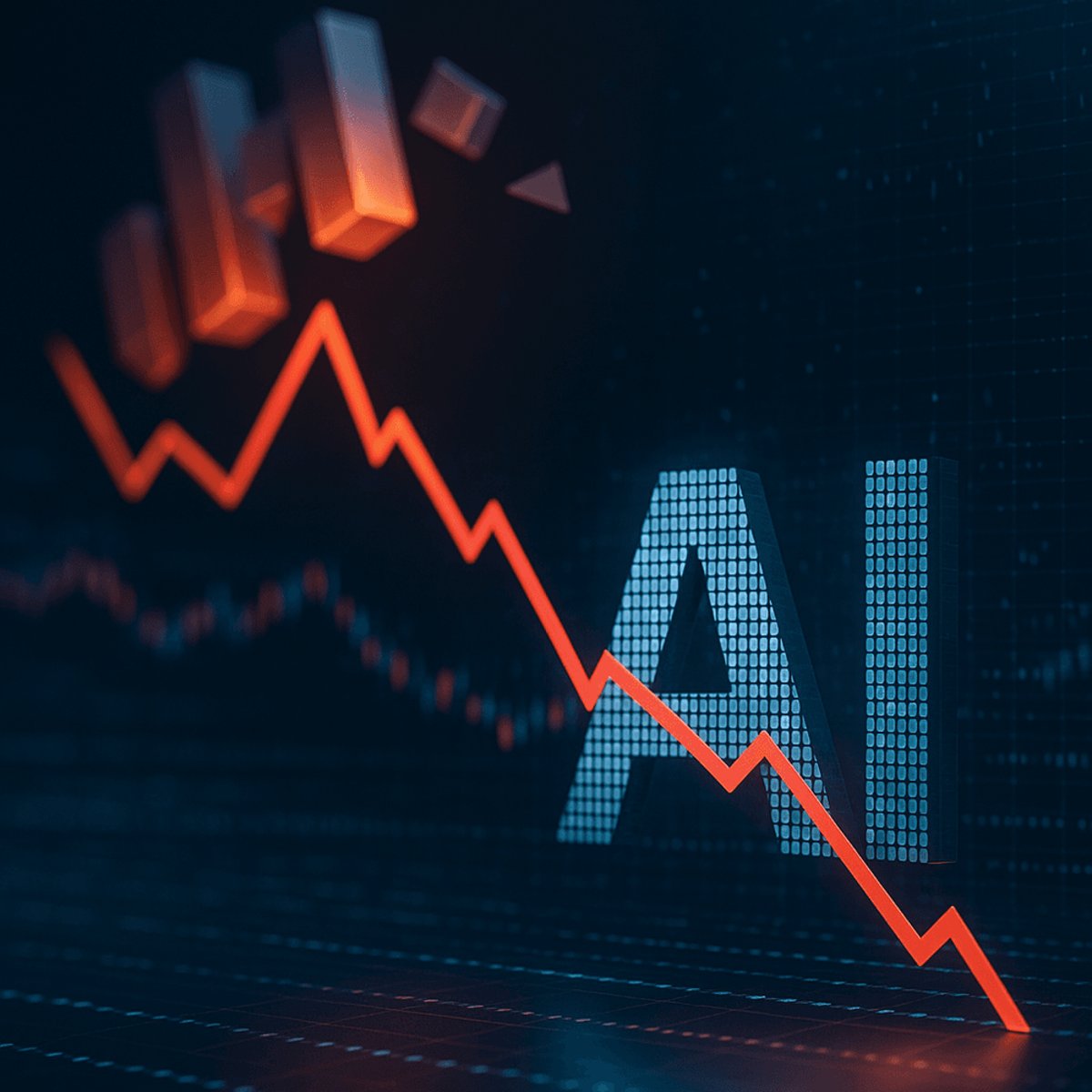
The AI boom just hit its first major speed bump. A sharp retreat in artificial intelligence stocks this week has reignited tech bubble fears among global investors, with SoftBank alone hemorrhaging nearly $50 billion in market value. From London to Tokyo, central bankers and fund managers are sounding alarms about stretched valuations in a sector that's driven market gains for two years straight.
The artificial intelligence goldrush just encountered its first major reality check. What started as routine profit-taking in Nvidia and other AI darlings has morphed into something more concerning - a broader questioning of whether the sector's astronomical valuations can hold up under scrutiny.
Goldman Sachs CEO David Solomon didn't mince words this week, warning investors of a "likely" 10-20% equity market correction sometime in the next two years. His timing feels prescient as AI stocks stumbled globally, with SoftBank bearing the brunt of the selloff. The Japanese conglomerate, which has positioned itself as the ultimate AI infrastructure play, watched nearly $50 billion in market value evaporate in just five trading days.
The contagion fears aren't limited to Silicon Valley. Bank of England Governor Andrew Bailey sounded unusually direct warnings about AI bubble risks during a CNBC interview, noting how the "very positive productivity contribution" from tech companies could be derailed by uncertainty around future earnings. "We have to be very alert to these risks," Bailey said, echoing concerns from the International Monetary Fund.
But the most telling signal came Tuesday when news broke that Scion Asset Management - the hedge fund run by "Big Short" legend Michael Burry - had built substantial short positions against both Nvidia and Palantir Technologies. The move drew immediate fire from Palantir CEO Alex Karp, suggesting nerves are fraying among AI's biggest cheerleaders.
Still, not everyone's panicking. European companies riding the AI infrastructure wave remain bullish about demand. Legrand, the French firm that supplies cooling systems to Google and Amazon data centers, has seen its shares surge 37% this year - matching Nvidia's gains. "We don't see any slowdown," Anders Danielsson, CEO of Swedish construction giant Skanska, told CNBC about his company's data center pipeline.
Kiran Ganesh, a multi-asset strategist at UBS, argues the volatility was overdue given the sector's remarkable run. "We've had a remarkably smooth rally given the scale of investment that's taken place," Ganesh said during CNBC's "Europe Early Edition." He pointed to earnings results that continue beating expectations despite the recent turbulence.
The divide between bulls and bears reflects deeper uncertainty about AI's profit timeline. While companies like Microsoft and Google are pouring billions into AI infrastructure, the revenue payoff remains largely theoretical. Meta's recent earnings showed massive AI spending with limited near-term returns, a pattern that's starting to spook investors who initially embraced the "build now, monetize later" narrative.
Global fund managers are responding by diversifying away from concentrated US tech positions. Luca Paolini, chief strategist at Pictet Asset Management, said his fund has gone neutral on US names due to stretched valuations. "Emerging markets are preferred, with diversified exposure across India, Brazil, and broader EM benefiting from AI-driven investment and monetary easing," Paolini noted in recent market commentary.
The timing of this valuation reckoning couldn't be more critical. With central banks globally still navigating inflation concerns and geopolitical tensions simmering, the tech sector that's powered market gains since 2023 suddenly looks vulnerable. Glen Smith, chief investment officer at GDS Wealth Management, sees opportunity in the chaos: "Some big tech stocks are on sale, and are presenting buying opportunities for investors, especially for investors who have missed out on the market's strength over the past two months."
What happens next will likely depend on upcoming earnings from AI's biggest players. If companies can demonstrate concrete revenue growth from their massive AI investments, the current selloff might prove temporary. But if spending continues to outpace returns, this week's turbulence could mark the beginning of a broader tech repricing that reshapes the entire sector.
The AI sector's first real stress test is revealing cracks that were always there but hidden by relentless optimism. While true believers argue this is just healthy profit-taking after an unprecedented run, the involvement of sophisticated investors like Michael Burry suggests something deeper is at play. The question isn't whether AI will transform the economy - it's whether current valuations reflect that reality or something far more speculative. For investors, this moment offers both peril and opportunity, depending on whether you believe we're witnessing a necessary correction or the start of something more serious.