The future of dating is here, and it's awkward. Three Day Rule, a 15-year-old matchmaking service that launched its AI-powered app in 2025, promised to solve swipe fatigue with personalized matchmaking trained by 60 human experts. Instead, reviewer Molly Higgins discovered something unsettling - her matches all opened with identical AI-generated lines, turning real conversations into scripted exchanges where humans became mere facilitators for bot-to-bot romance. The dystopian twist on modern dating raises fresh questions about whether AI can actually improve human connection or just automate it into oblivion.
Three Day Rule just turned matchmaking into a bot-versus-bot conversation, and humans are just along for the ride. The dating app, which launched in 2025 after operating as a traditional matchmaking service for 15 years, bills itself as the antidote to swipe culture - using AI trained by 60 professional matchmakers to deliver deeply personalized matches. But according to a hands-on review by Molly Higgins for Wired, the reality is far more dystopian.
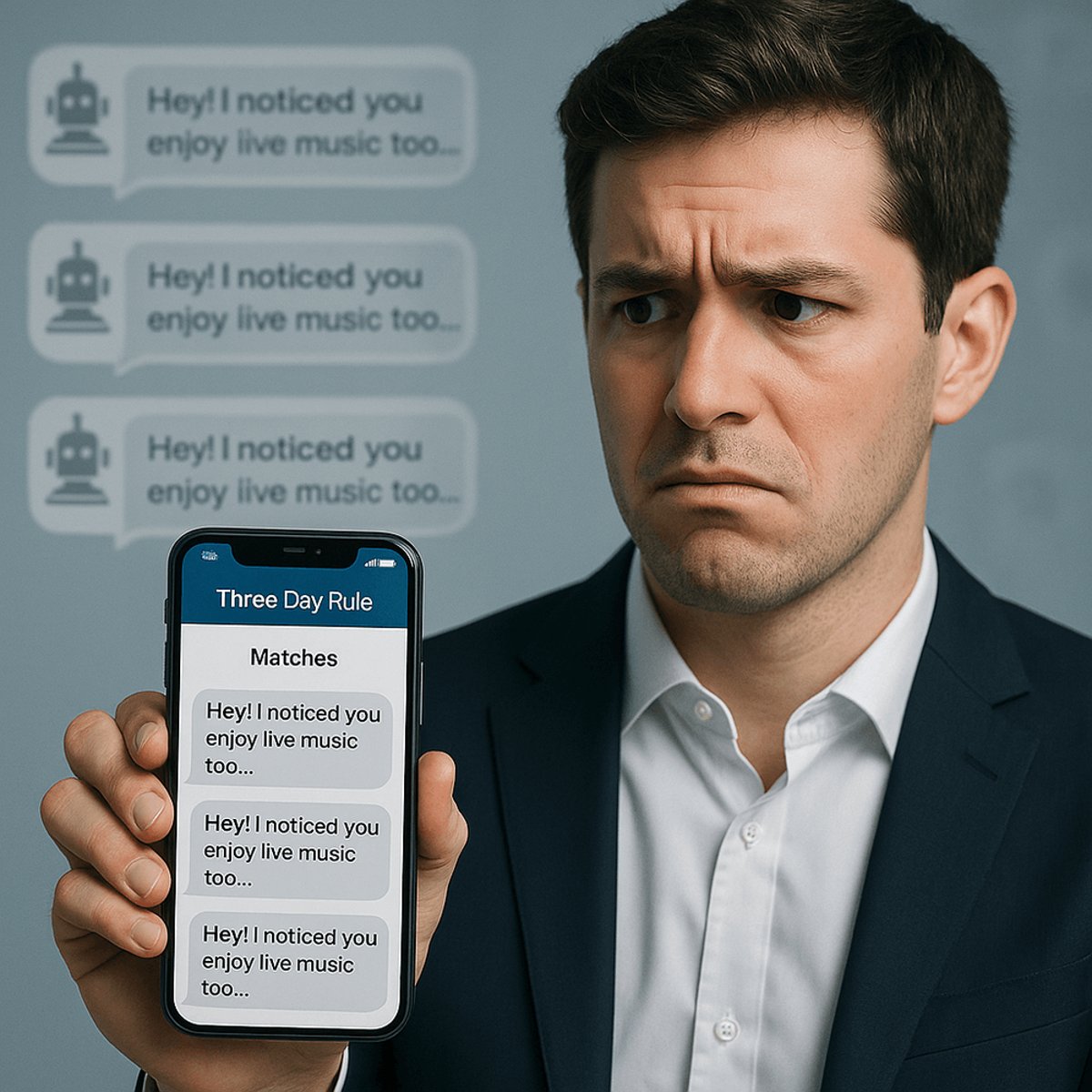
Opening her Three Day Rule app (commonly called TDR), Higgins spotted three new matches. All three led with the exact same line: "Hey Molly! I noticed you enjoy live music too; what's the best concert you've seen recently?" The promise of AI-powered personalization had devolved into cookie-cutter scripts.
The app's pitch is compelling on paper. Traditional matchmakers can cost upward of $10,000 and cater mostly to wealthy or older clients. TDR CEO Adam Cohen-Aslatei, who previously consulted for Bumble, Raya, and the now-defunct blind-dating app S'More, wanted to democratize the white-glove experience. His solution: an AI matchmaker named Tai that conducts deep intake interviews, asking roughly 100 questions about everything from hobbies to political views to physical preferences.
"It's a connection. We're asking you long-form questions to get long-form answers," Cohen-Aslatei told Wired. The questions range from relationship goals to race, religion, and disability status. Users can respond via text or voice, with Tai circling back to verify openness on sensitive topics like political alignment or openness to different body types.
The free version offers unlimited AI chat and limited conversations but no guaranteed matches. Premium costs $25 per month and unlocks AI-vetted matches, personalized introductions, conversation prompts, and guaranteed matches. The app, currently iOS-only, claims to have 250,000 singles in its database.
But Higgins' experience exposes a critical flaw. Rather than sparking organic chemistry, TDR's AI coaching created mechanical exchanges. Matches relied on AI-generated openers and prompts, turning conversations into performances. "My matches and I talked through the AI prompts rather than getting to know each other," Higgins writes. "Soon enough, I wondered if the human beings behind the screens were merely facilitating a connection between our AI bots."
The irony is sharp. Three Day Rule set out to solve the superficiality of photo-first apps like Tinder by prioritizing compatibility and depth. Yet by automating conversation starters and coaching both sides of the exchange, the app risks stripping away the very spontaneity and authenticity that make dating enjoyable. "Dating is only fun when you're getting to know real people with real quirks," Higgins concludes.
This isn't the first time AI has stumbled in the dating space. Apps like Hinge have integrated AI-powered prompts and icebreakers, but those tools remain optional guardrails rather than central mechanics. TDR's model makes AI the main event, which backfires when both parties rely on the same scripts.
The mishap highlights a broader tension in consumer AI. Tools meant to enhance human experiences often end up replacing them. Whether it's AI writing your emails, drafting your messages, or now flirting on your behalf, the line between assistance and abdication gets blurrier. Cohen-Aslatei's vision of making matchmaking "more practical, accessible, and aligned with modern sensibilities" assumes AI can replicate the intuition of human matchmakers who've spent years reading between the lines.
But matchmaking isn't just pattern recognition. It's reading body language during consultations, picking up on hesitation in a client's voice, and making gut calls that defy data. Training an AI on 60 matchmakers' decisions doesn't capture the tacit knowledge that makes great matchmakers great. And when that AI coaches both sides of a conversation, you get what Higgins got: a love story between chatbots, with humans reduced to spectators.
The app's onboarding process is thorough, perhaps excessively so. After basic demographic info, Tai digs into income, racial preferences, religious views, and political leanings. For Higgins, a physically disabled, atheist, liberal user open to all genders, Tai repeatedly double-checked her openness, seemingly skeptical that anyone could be that flexible. That caution reflects TDR's human matchmaking roots, where clarifying dealbreakers is standard practice. But in an app format, it feels invasive without the rapport-building that makes those questions palatable in person.
Three Day Rule's struggles underscore the limits of AI in nuanced, high-stakes social contexts. Dating is messy, irrational, and deeply human. Algorithms can surface shared interests, but they can't manufacture chemistry. And when both parties outsource their conversational game to the same AI, you end up with the digital equivalent of two people reading from the same script on a blind date.
The app isn't without merit. For users overwhelmed by endless swiping or intimidated by blank-slate messaging, AI prompts can lower the activation energy to start a conversation. And guaranteed matches for premium subscribers address a common frustration with free-tier apps where matches go nowhere. But TDR's heavy reliance on AI coaching tips from assistance into automation, with results that feel more robotic than romantic.
As AI permeates more corners of daily life, TDR's missteps offer a cautionary tale. The best AI tools augment human capabilities without replacing human judgment. They fill gaps, not take over entirely. In dating, that might mean AI surfacing compatible matches while leaving the actual talking to humans. Instead, Three Day Rule tried to automate the whole experience and discovered that outsourcing romance to bots creates connections that feel anything but genuine.
Three Day Rule's AI matchmaker promised to bring white-glove personalization to the masses, but ended up automating the one thing that shouldn't be scripted - authentic human connection. When both parties rely on the same AI coach, conversations become performances rather than explorations. The app's struggle reveals a broader truth about consumer AI: tools designed to enhance experiences often risk replacing them entirely. As AI continues embedding itself in intimate aspects of life, the challenge isn't just building smarter algorithms - it's knowing when to let humans be human. For now, TDR serves as a reminder that some things, like the messy spontaneity of falling for someone, resist optimization.