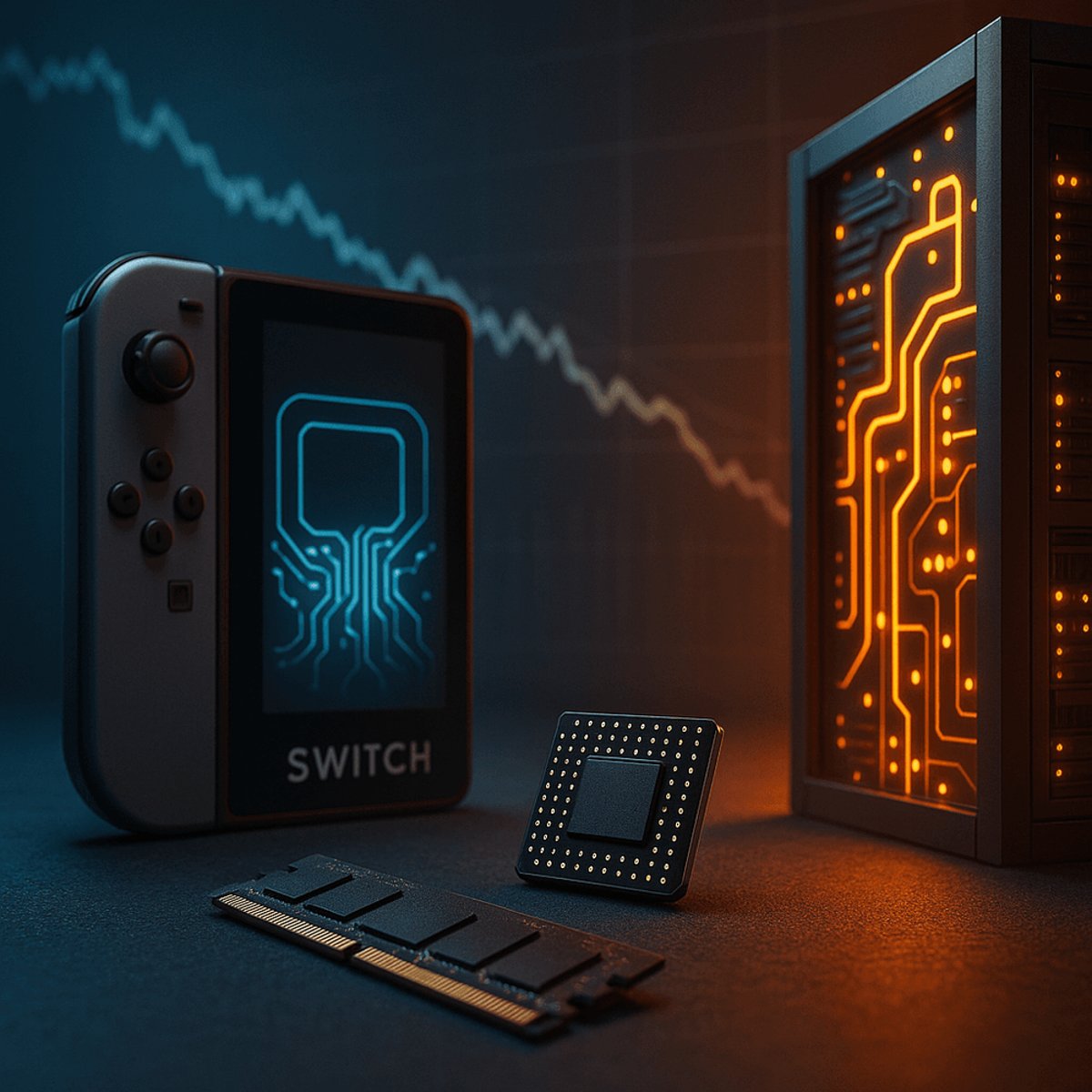
Nintendo shares plunged more than 10% Wednesday as investors digested a brutal reality: the memory chip shortage squeezing the tech industry just hit gaming's biggest comeback story. The Japanese gaming giant faces surging costs for DRAM chips - critical components in its Switch 2 console - with prices projected to spike up to 95% this quarter. Despite beating profit estimates with a 24% year-over-year jump, Nintendo's warning that sustained memory costs could erode margins sent investors running for the exits.
Nintendo just discovered what happens when gaming consoles compete with AI for the same chips. The company's shares nosedived more than 10% Wednesday, wiping out billions in market value as investors processed the real cost of the global memory shortage.
The selloff came just a day after Nintendo posted quarterly results that beat profit expectations with a 24% year-over-year jump and 86% revenue growth, powered by its original Switch console - now officially the company's best-selling device ever since launching in 2017. But the celebration was short-lived. Revenue missed analyst estimates, and company president Shuntaro Furukawa delivered the warning investors didn't want to hear: if memory chip prices stay elevated long-term, margins will take a hit.
The culprit is DRAM - dynamic random access memory chips that Nintendo relies on for its gaming consoles. The same chips are in white-hot demand from AI companies and data centers, creating a supply crunch that's sent prices into orbit. Contract prices for conventional DRAM chips are projected to jump 90% to 95% in the first quarter alone compared to the previous three months, according to market researcher TrendForce in a Monday report.
"Investors remain concerned about the impact that memory costs will have on the company's margins," Andrew Jackson, head of Japanese Equity Strategy at Ortus Advisors, told reporters. It's a concern Furukawa acknowledged directly during Tuesday's earnings call. While he insisted memory price rises aren't significantly impacting results for the current financial year, he couldn't dodge the longer-term question.
The timing couldn't be worse for Nintendo. The company released its Switch 2 console last June to massive fanfare - fans lined up from Tokyo to Manhattan in scenes reminiscent of classic iPhone launches. But sustaining that momentum through 2026 means keeping production humming and prices competitive, both of which get harder when your key components cost nearly double what they did three months ago.
Last month, a top semiconductor industry CEO told CNBC the memory chip shortage is expected to persist through 2027. That's a brutal timeline for any hardware maker, but especially one trying to convince consumers to upgrade to a new gaming console while competitors circle.
Despite the memory crunch, Nintendo maintained its full-year Switch 2 sales forecast on Tuesday - a show of confidence that's either bold or stubborn depending on how the next few quarters play out. The company's betting its pipeline of upcoming titles will be enough to drive upgrades. "Mario Tennis Fever" drops in February for the Switch 2, followed by "Pokémon Pokopia" in March, leaning hard on its two most bankable franchises.
There's also "The Super Mario Galaxy Movie" set for April release. Nintendo's hoping for a repeat of 2023, when the first Super Mario movie provided a significant boost to console sales. But movies are marketing - they can't solve supply chain math.
James McWhirter, senior analyst at Omdia, put it bluntly Tuesday: 2026 is a "make-or-break" year for the Switch 2's future as Nintendo chases mass market appeal. That's industry-speak for "this needs to work, and soon." The console gaming market doesn't give you three chances to get it right.
Nintendo shares have now lost more than 15% in 2026, a sharp reversal from the optimism that greeted the Switch 2's launch. The company's facing a collision between its hardware ambitions and the brutal reality of component economics in an AI-driven world. DRAM suppliers are allocating capacity to whoever pays the most, and right now that's not gaming companies.
The broader context makes Nintendo's situation even trickier. While AI infrastructure spending shows no signs of slowing - Nvidia, Microsoft, and Amazon are all racing to build out data centers - consumer electronics makers are stuck bidding for scraps. It's a fundamental shift in semiconductor demand that favors enterprise over consumer, servers over switches.
Investors are clearly weighing whether Nintendo can navigate this squeeze without sacrificing either production volume or profit margins. Wednesday's 10% drop suggests they're skeptical. The company's maintained its sales forecast, but maintaining margins while absorbing 90%+ cost increases on key components is a different challenge entirely.
Nintendo's predicament also highlights how the AI boom is creating unexpected ripple effects across tech. Gaming consoles aren't competing with chatbots directly, but they're competing for the same memory chips that power AI inference. It's an indirect collision that's reshaping hardware economics across the industry.
Nintendo's 10% single-day crash is more than just a bad earnings reaction - it's a warning shot about what happens when consumer hardware makers collide with AI's insatiable appetite for components. The company beat profit estimates and posted strong revenue growth, but none of that matters if investors believe margin compression is inevitable. With DRAM prices projected to nearly double this quarter and the shortage expected to last through 2027, Nintendo's challenge isn't just selling Switch 2 consoles - it's selling them profitably. The next few quarters will reveal whether the company's franchise power and sales optimism can overcome the brutal math of supply chain economics in an AI-first semiconductor market.