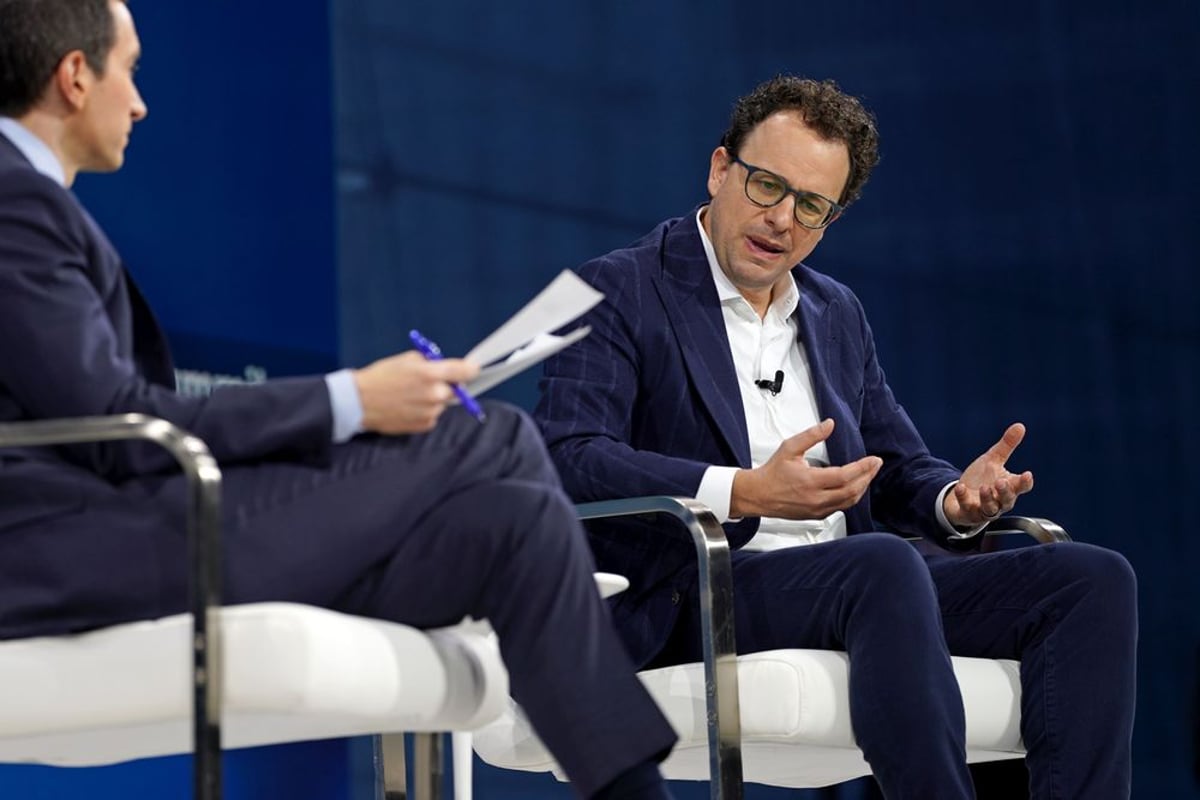
Anthropic CEO Dario Amodei fired warning shots at the AI industry's biggest spenders during Wednesday's DealBook Summit, suggesting unnamed competitors are 'YOLOing' their way toward potential financial disaster. Without explicitly naming OpenAI, Amodei drew sharp distinctions between his company's cautious enterprise-focused strategy and rivals chasing '$200 billion a year' revenue targets that could spell trouble if timing goes wrong.
The gloves came off at the DealBook Summit when Anthropic CEO Dario Amodei stepped into the ring with some pointed commentary about the AI industry's spending habits. Speaking with Andrew Ross Sorkin on Wednesday, Amodei didn't name names - but he didn't need to. His target was crystal clear: the AI companies betting everything on massive compute buildouts and eye-popping revenue projections. 'There are some players who are YOLOing,' Amodei said, according to The Verge's coverage. 'Let's say you're a person who just kind of constitutionally wants to YOLO things or just likes big numbers, then you may turn the dial too far.' The comment landed like a precision strike in an industry where OpenAI has been trumpeting plans for compute investments that could require $200 billion in annual revenue by 2027 or 2028. Amodei's critique cuts to the heart of a fundamental tension in AI: how much should companies bet on an uncertain future? His answer involves what he calls the 'cone of uncertainty' - a framework that acknowledges the wild unpredictability of AI revenue growth while trying to manage the risks. Anthropic has scaled from zero to $100 million in 2023, then to $1 billion in 2024, and now projects somewhere between $8 billion and $10 billion by year's end. That's explosive growth, but still well behind OpenAI's projected $20 billion annual run rate. The difference, Amodei argues, is in the approach to risk management. Data centers take one to two years to build, meaning decisions about 2027 compute capacity need to happen now. Buy too little, and you lose customers to competitors who can actually serve demand. Buy too much, and you're staring down bankruptcy if revenue doesn't materialize as expected. 'How much buffer there is in that cone is basically determined by my margins,' Amodei explained during the DealBook appearance. This is where Anthropic's enterprise-focused strategy becomes more than just a business model choice - it's a survival strategy. Enterprise customers typically offer higher margins and more predictable revenue streams than consumer-facing products. That predictability becomes crucial when you're making billion-dollar infrastructure bets years in advance. Amodei also touched on the industry's 'circular deals' phenomenon, where chip suppliers like Nvidia invest in AI companies that then spend those funds buying more chips. He acknowledged that Anthropic has engaged in such arrangements, though 'not at the same scale as some other players.' The math can work, he explained - a new gigawatt data center costs roughly $10 billion over five years, and vendors can invest upfront while AI startups pay back their share as revenue grows. But when these deals start stacking up to 'huge amounts of money,' the risk multiplies exponentially. The subtext of Amodei's comments reveals a deepening philosophical divide in Silicon Valley's AI arms race. On one side, you have the maximalists betting everything on compute scale and rapid consumer adoption. On the other, you have the cautious optimists like Amodei who believe sustainable growth requires managing the downside scenarios. 'We want to buy enough that we're confident even in the 10th percentile scenario,' he said. 'There's always a tail risk. But we're trying to manage that risk well.' The timing of these comments isn't coincidental. As AI valuations soar and compute costs explode, industry observers are increasingly asking whether we're witnessing the formation of another tech bubble. Amodei's separation of the 'technological side' (which he feels 'really solid' about) from the 'economic side' (where he has 'concerns') captures the current moment perfectly. The technology works and continues improving rapidly. But the business models and financial projections? That's where things get dicey. His warning about players making 'timing errors' that could trigger 'bad things' feels particularly prescient as the industry collectively holds its breath waiting to see if AI revenue can justify the massive investments already committed. For Anthropic, the strategy appears to be working. The company's enterprise focus has allowed it to avoid what Amodei called 'code reds' - those panic moments when cash flow doesn't match expectations. But the real test will come in 2025 and 2026, as the industry's biggest bets start coming due and the cone of uncertainty either narrows toward success or widens toward catastrophe.
Amodei's DealBook appearance signals a new phase in AI's competitive landscape - one where companies are being forced to defend not just their technology, but their financial strategies. As the industry races toward trillion-dollar compute investments, the divide between cautious builders and aggressive scalers will likely determine which companies survive the next market cycle. For investors and industry watchers, Anthropic's 'cone of uncertainty' framework offers a sobering reminder that even in AI's explosive growth environment, the fundamentals of sustainable business building still matter.











