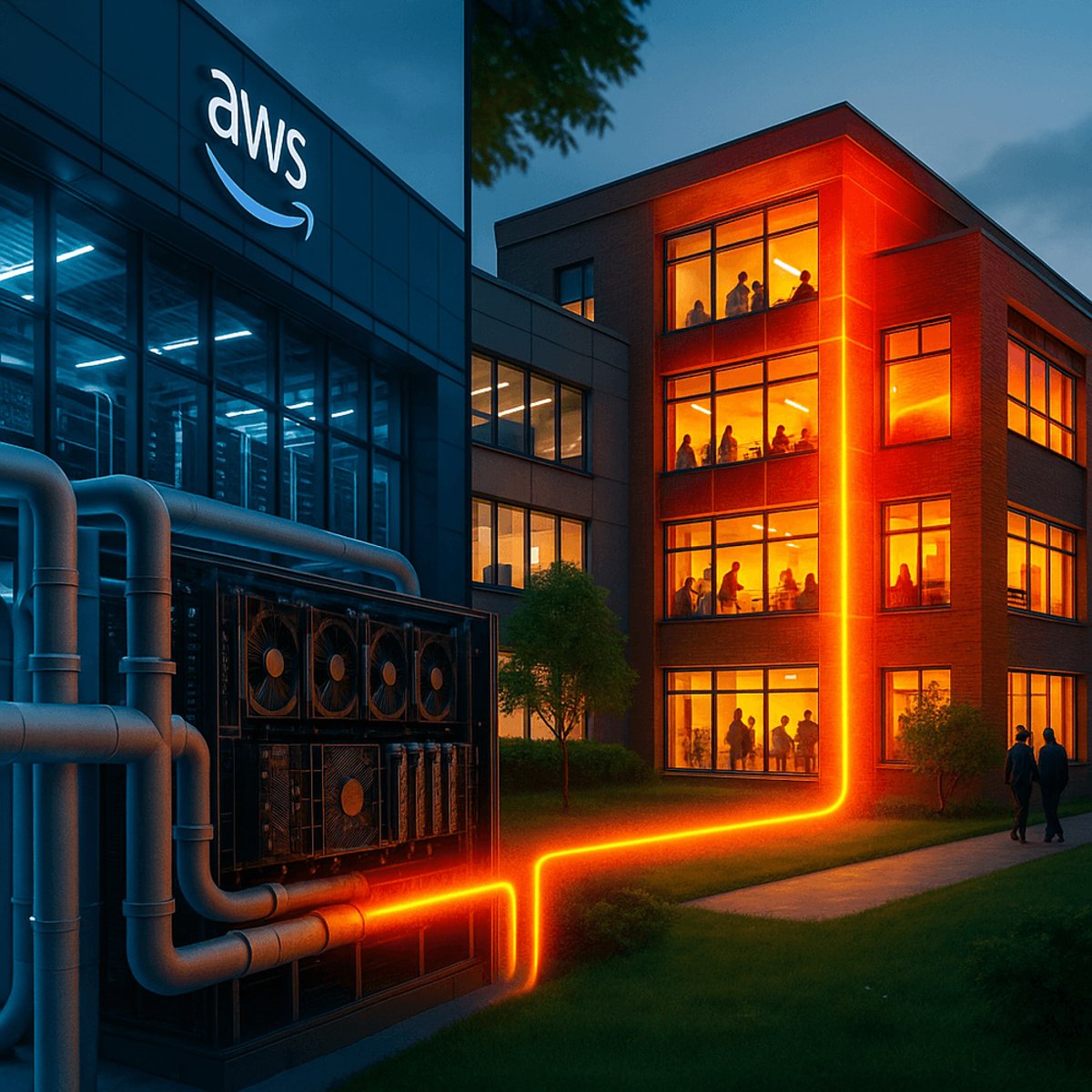
Students at Dublin's Technological University aren't just learning about AI - they're being heated by it. Since 2023, an Amazon Web Services data center in Tallaght has been supplying 100% of the campus's heating through recycled waste heat, turning one of AI's biggest liabilities into an infrastructure asset. The project, Ireland's first district heating network, abated 704 metric tons of CO2 in 2024 and now meets 92% of campus heating demand. As AI chips triple power consumption, what was once a PR problem is becoming a blueprint for sustainable data center design.
Amazon Web Services just turned AI's energy crisis into a heating solution. Students at Technological University Dublin's Tallaght campus have been warmed by waste heat from a nearby AWS data center since 2023, making them unlikely beneficiaries of the AI boom's power-hungry infrastructure. The setup represents a rare win-win in an industry under fire for its environmental footprint.
The scheme works because of a fundamental shift in how data centers operate. Traditional facilities released excess heat at around 30 to 35 degrees Celsius - too cool to be practical for district heating. But AI changed the math. Modern GPU-packed data centers running large language models generate roughly triple the computing capacity of previous generations, pushing waste heat output to 55-60°C, hot enough to warm buildings directly without additional heat pumps.
"The exciting thing is that AI can give you higher temperatures, and the water cooling makes it a lot easier. You need a lot less hardware to connect these systems," Adam Fabricius, commercial manager at HVAC provider Sav Systems and researcher at sister company EnergiRaven, told CNBC. The AI twist, he said, is what makes these projects financially viable.
Ireland's first not-for-profit energy utility, Heat Works, formed in 2020 to pipe waste heat from AWS's Tallaght facility to surrounding buildings. The data center supplies the thermal energy free of charge. The campus abated around 704 metric tons of carbon dioxide in 2024 despite adding two new buildings to the network, according to TU Dublin's calculations. The system now meets 92% of heating demand.
"While we are only in the second year of monitoring, we have evidence that the project has limited our exposure to market price shocks generally," Rosie Webb, head of decarbonization at TU Dublin, told CNBC via email. The network initially covered 55,000 square meters of public buildings - three times the size of Dublin's Croke Park stadium pitch - plus commercial space and 133 apartments.
The timing couldn't be better for Amazon. Ireland temporarily banned new data center applications in 2022 as the facilities consumed 22% of the country's power, straining Dublin's grid. The moratorium eased late last year as officials recognized AI infrastructure's economic potential, but social license remains fragile. "It may not be ultimately very cost effective on paper, but it does contribute to that good social impact by turning what is a potential bad news story of increased data centers into a good-news story," Brendan Reidenbach of the International Energy Agency told CNBC.
Big Tech is taking notice. Microsoft announced plans to fuel Denmark's Høje-Taastrup district heating network, Equinix warms 1,000 Parisian homes from a single facility, and Google launched a major heat recovery project at its Hamina, Finland data center. None of these companies profit from the arrangements - they're infrastructure investments in regulatory goodwill.
The technical leap came from liquid cooling. Dublin-based Nexalus, which patented its technology from Trinity College, uses jet impingement cooling to target the hottest spots on GPUs and CPUs. "It's like a shower head in the shower. If you've got a pain in your shoulder, you turn it to the spot where you want it to go," CEO Kenneth O'Mahony told CNBC. The precision approach captures heat at temperatures high enough for direct district heating use.
"We see data centers as energy borrowers, and actually as energy generating," O'Mahony said. "The desire should be that your data center is embedded inside the construction phase of cities, the design of the apartment blocks, producing enough heat for your entire building."
Nvidia's recent Rubin chip announcement validated the approach. The next-generation processors require less aggressive cooling than earlier models, making waste heat recovery even more practical. Rob Pfleging, CEO of liquid cooling provider Nautilus Data Technologies, said he got "chills" seeing Nvidia move toward higher operating temperatures. "The great thing about that announcement is it's moving in the right direction, because it also allows now for the much easier reuse of that heat," he told CNBC.
But scaling faces real obstacles. District heating networks carry 30-year lifespans while data center equipment turns over every seven to 10 years, creating "a very large risk of stranded assets," according to the IEA's Reidenbach. Permitting delays and high capital costs for heat network construction compound the challenge. Medium-sized data centers located near metro areas are best positioned to deliver waste heat, said Ben Hertz-Shargel, global head of grid edge at Wood Mackenzie.
Europe's head start is significant. District heating supplies around 10% of global building heat demand, with 90% still coming from fossil fuels. The U.K. visited Denmark in October to study data center integration, hoping to scale heat networks from 3% of national demand today to 20% by 2050. Analysis from EnergiRaven and Danish consultancy Viegand Maagøe found data center waste heat could power at least 3.5 million homes by 2035 if infrastructure scales in parallel with AI buildout.
"Every kilowatt of energy we reuse, there's a kilowatt of energy we don't need to import," Fabricius said. If waste heat displaces natural gas, the geopolitical and economic benefits multiply. "You're using it once for the computation, and then you're using the heat again to heat people's homes that would have otherwise been generated from gas."
TU Dublin acknowledged the risk of depending on a private data center for core energy supply. The university is exploring geothermal and other renewable sources to diversify its mix, ensuring the network isn't hostage to AWS's operational decisions. But the scheme has already accelerated TU Dublin's progress toward 2030 decarbonization targets ahead of schedule.
Dublin's experiment proves AI's energy problem contains its own solution - if cities build the pipes to capture it. AWS's free heat supply isn't charity, it's infrastructure pragmatism in a regulatory environment increasingly hostile to power-hungry data centers. The model works because AI chips run hotter, liquid cooling captures heat more efficiently, and European cities already have district heating expertise. The question isn't whether waste heat recovery makes technical sense - it's whether operators can navigate 30-year infrastructure commitments while hardware turns over every seven years. As the AI boom forces a reckoning with energy consumption, expect more universities, apartment blocks and municipal buildings to find themselves in AWS's thermal shadow. Ireland showed the blueprint. Now the industry has to scale it before regulators force their hand.