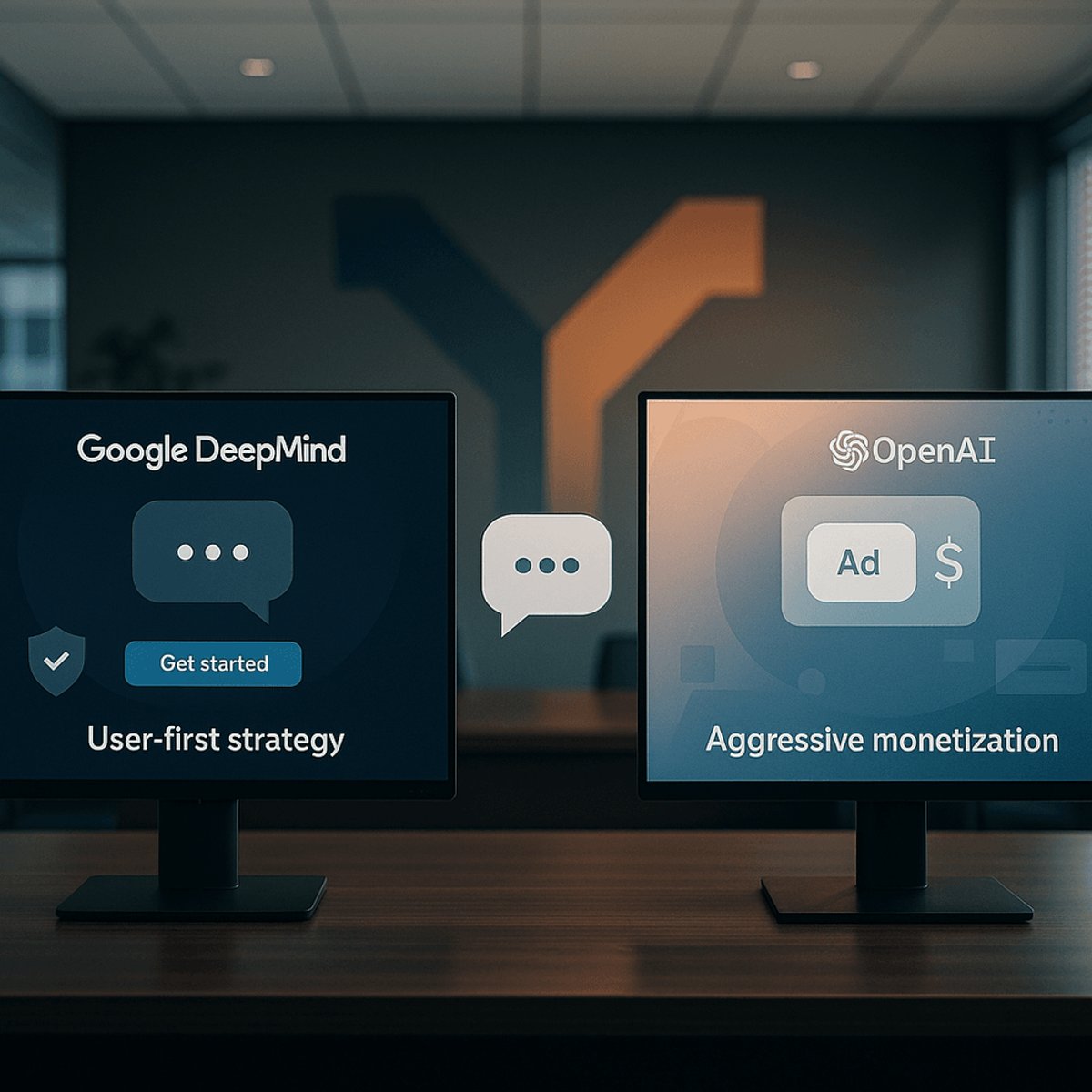
Google DeepMind CEO Demis Hassabis just threw shade at OpenAI's monetization playbook. Speaking at Davos this week, the AI leader said he's "surprised" OpenAI moved so quickly to introduce ads into ChatGPT, revealing a stark strategic divide between the two AI giants on how to monetize chatbot experiences without destroying user trust. The comments come days after OpenAI announced it would start testing ads for its 800 million weekly users who don't pay for subscriptions.
Google DeepMind CEO Demis Hassabis isn't mincing words about OpenAI's latest monetization gambit. In an interview with Axios at Davos, the AI pioneer said he's "a little bit surprised" that OpenAI has already moved to introduce advertising within ChatGPT - a decision that could fundamentally reshape how millions of users interact with AI assistants.
The timing of Hassabis's critique is pointed. Just last Friday, OpenAI announced it would begin testing ads as a way to generate additional revenue from the portion of ChatGPT's 800 million weekly active users who don't have paid subscriptions. For a company burning through cash on infrastructure that tripled to 1.9GW in 2025 and facing mounting energy costs, the ad pivot might seem inevitable. But Hassabis thinks OpenAI is making a mistake.
"I mean, look, ads, there's nothing wrong with ads - they funded much of the consumer internet. And if done well, they can be useful," Hassabis told Axios, offering a diplomatic opening before driving his point home. "But in the realm of assistants, and if you think of the chatbot as an assistant that's meant to be helpful - and ideally, in my mind, as they become more powerful, the kind of technology that works for you as the individual - there is a question about how ads fit into that model? You want to have trust in your assistant, so how does that work?"
It's a question that cuts to the heart of AI's evolution from novelty to utility. The DeepMind co-founder argues that chatbots represent a fundamentally different use case than Google Search, where the company already understands user intent and can serve relevant ads. AI assistants, he contends, are meant to become deeply personalized helpers that know about users and can assist with many aspects of their lives - making the ad model potentially corrosive to the trust required for that relationship.
What's particularly striking is that Hassabis is making this argument while working for a company built on advertising. Google's parent Alphabet generated over $300 billion in ad revenue last year. Yet the DeepMind CEO says his team isn't feeling top-down pressure to replicate that model in Gemini. "We don't feel any immediate pressure to make knee-jerk decisions like that," he said, noting that DeepMind's approach has been to "be very scientific, and rigorous, and thoughtful about each step that we take."
Reiterating earlier comments from another Davos interview, Hassabis confirmed Google has "no current plans" to introduce ads in its AI chatbot. Instead, the company is taking a wait-and-see approach, monitoring how users respond to OpenAI's experiment before making any moves.
The strategic divergence between the two AI leaders couldn't be clearer. OpenAI is betting it can thread the needle - monetizing free users without alienating them - while Google is wagering that patience will pay off as personalization becomes the real competitive moat. The company just launched new personalization features for Google's AI Mode, allowing users to opt into having Gemini tap into their Gmail and Photos for tailored responses. It's part of a broader push to make Gemini deeply useful by referencing users' Gmail, Photos, Search, and YouTube history.
Consumer backlash to AI monetization schemes has already shown up in the data. When OpenAI last month began exploring a feature that suggested apps during users' chats, people reacted negatively, saying these suggestions felt like intrusive ads. OpenAI quickly turned off the feature, claiming the suggestions weren't actually ads since they had "no financial component." But the damage was done - users made it clear that whether money changed hands wasn't the point. The app suggestions degraded the experience.
It's not the first time a tech giant has learned this lesson the hard way. Amazon faced similar resistance when it attempted to infuse ads into Alexa. Customers wanted an assistant, not a personal shopper hawking products. The backlash forced Amazon to rethink its approach.
Hassabis's comments reveal more than just philosophical differences about user experience. They expose the financial pressure OpenAI faces as an independent company competing against tech giants with diversified revenue streams. Google can afford to be patient with Gemini monetization because Search still prints money. OpenAI doesn't have that luxury - it needs to find a sustainable business model now, even if that means risking user trust.
The question is whether users will tolerate ads in their AI conversations or whether they'll migrate to competitors offering cleaner experiences. OpenAI's gamble is that most free users won't care enough to leave, especially if the ads are relevant and unobtrusive. Hassabis's bet is that users will ultimately choose the assistant that feels most aligned with their interests rather than one constantly pitching products.
For now, Google is playing the long game, using this moment to position Gemini as the user-first alternative while OpenAI tests whether it can monetize without destroying what made ChatGPT special in the first place. The next few months will reveal whether Hassabis's surprise at OpenAI's rush was warranted - or whether he'll be forced to follow suit as competitive pressure mounts.
The battle over AI assistant monetization is just beginning, and the stakes couldn't be higher. OpenAI's decision to rush ads into ChatGPT represents a fundamental bet that users will tolerate commercial interruptions in exchange for free access. Google's more cautious approach suggests the company believes trust and personalization will matter more than immediate revenue. For users, this divergence means watching two competing visions play out in real time - one prioritizing short-term monetization, the other betting on long-term relationship building. The winner will likely define how hundreds of millions of people interact with AI for the next decade.