The AI industry's most expensive race might be losing relevance. Hugging Face CEO Clem Delangue is watching enterprises abandon frontier models from OpenAI and Google in favor of open-source alternatives that cost less, run faster, and give companies full control. The shift raises an uncomfortable question for the industry's biggest players: what if the multi-billion-dollar race to build the most powerful AI doesn't actually matter for most real-world applications?
Something fundamental is shifting in the AI industry, and it's happening quietly in enterprise server rooms rather than splashy product launches. Hugging Face CEO Clem Delangue just put words to what many developers already know: the expensive frontier models everyone's racing to build might not be what actually powers production AI.
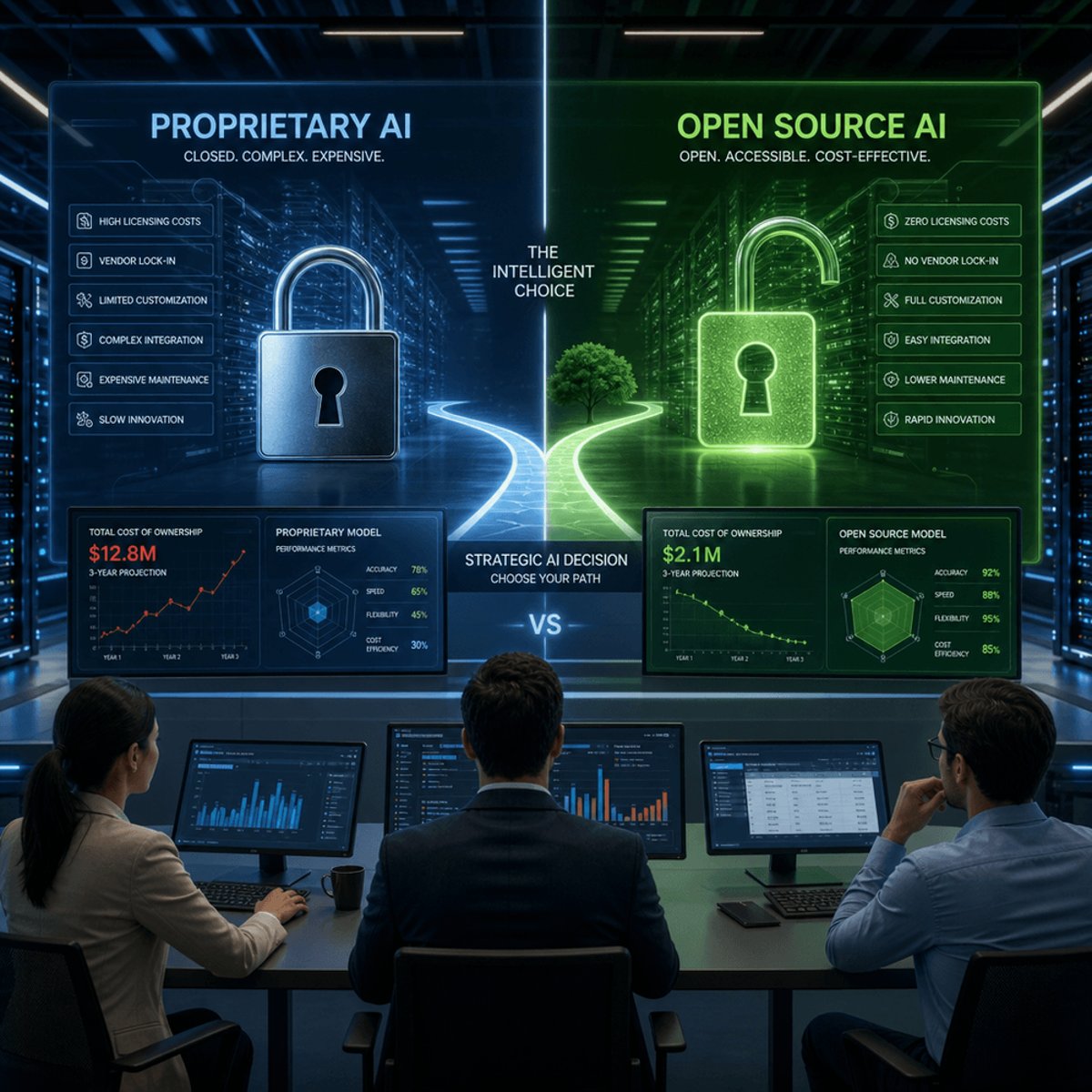
According to Delangue's observations shared with TechCrunch, enterprises are making a calculated pivot away from proprietary systems. The reasons are straightforward - cost, accessibility, and ownership. When you're running AI at scale across thousands of use cases, API fees to OpenAI or Google add up fast. Open models let companies deploy on their own infrastructure, customize without restrictions, and never worry about a vendor changing terms or pricing.
The timing matters. Just as OpenAI and Anthropic push ever-larger models with ever-higher price tags, Hugging Face has become the de facto distribution platform for open alternatives. The platform now hosts hundreds of thousands of models, with enterprise-grade options from Meta's Llama series to Mistral's efficient architectures. These aren't hobbyist projects anymore - they're production-ready systems that companies like Bloomberg and Salesforce are betting on.
Delangue's perspective comes from a unique vantage point. Hugging Face sits at the intersection of open-source AI development and enterprise deployment, processing millions of model downloads monthly. The company's seeing which models actually get used in production versus which ones generate headlines. The gap is widening.
The economics are hard to ignore. A frontier model API call might cost pennies, but multiply that across millions of daily interactions and you're looking at seven-figure monthly bills. Open models running on company hardware flip that equation - higher upfront infrastructure costs, but marginal costs approaching zero. For companies building AI into core products, the math increasingly favors ownership.
But cost isn't the only factor driving this shift. Control matters more than most vendors want to admit. With an open model, you can inspect every parameter, fine-tune for specific domains, and guarantee it won't suddenly deprecate or change behavior. You're not dependent on another company's roadmap or subject to their content policies. For regulated industries or sensitive applications, that control is non-negotiable.
The accessibility angle is subtler but equally important. Frontier models are black boxes - you send prompts, you get responses, but you can't see how they work or modify their behavior beyond prompt engineering. Open models let developers dig into the architecture, understand failure modes, and optimize for specific use cases. That level of access unlocks entirely different applications.
This creates an awkward reality for companies pouring billions into frontier model development. OpenAI reportedly spends hundreds of millions training each new generation of GPT. Google and Anthropic are in similar arms races. But if enterprises default to open models for production workloads, what's the actual market for these systems beyond demos and consumer applications?
The frontier model defenders would argue their innovations eventually trickle down to open alternatives. GPT-4's techniques informed Llama 2's architecture. Claude's constitutional AI approach influenced open safety research. In this view, frontier development is R&D that benefits the entire ecosystem, even if the commercial returns don't materialize directly.
But Delangue's question cuts deeper: do we even need frontier models if open alternatives handle most real-world tasks? The capability gap between GPT-4 and a well-tuned open model is shrinking fast. For many enterprise use cases - document processing, customer service, code completion - the difference is negligible. The frontier matters less when you're not actually operating at the frontier.
This isn't just philosophical debate. Investment dollars are following enterprise behavior. If companies deploy on open models, that's where the tooling, infrastructure, and services businesses get built. Hugging Face has already raised hundreds of millions on this thesis. Meanwhile, frontier model companies face growing pressure to prove their astronomical costs translate to sustainable business models.
The shift also changes the competitive dynamics. Instead of a race to build the single best model, we're moving toward an ecosystem of specialized open models optimized for different tasks and constraints. Some prioritize efficiency, others accuracy, still others privacy or specific domain knowledge. The value shifts from the model itself to the infrastructure, tooling, and services around deploying and managing these systems.
For developers, this is largely good news. More options, lower costs, greater control. For the companies that bet their futures on proprietary frontier models, it's a potential existential challenge. And for the industry as a whole, it raises questions about where innovation happens and how it gets funded if the most expensive R&D doesn't capture the most valuable markets.
The AI industry might be running two separate races without realizing it. Frontier labs are competing for benchmark supremacy and technological breakthroughs, while enterprises are quietly standardizing on open alternatives that are good enough, cheap enough, and controllable enough for actual production use. If Delangue's observations hold, we could see a future where the most advanced models exist primarily as research artifacts and consumer novelties, while the real commercial AI infrastructure runs on open systems. That would represent a profound shift in how AI value gets created and captured - and it's already underway.