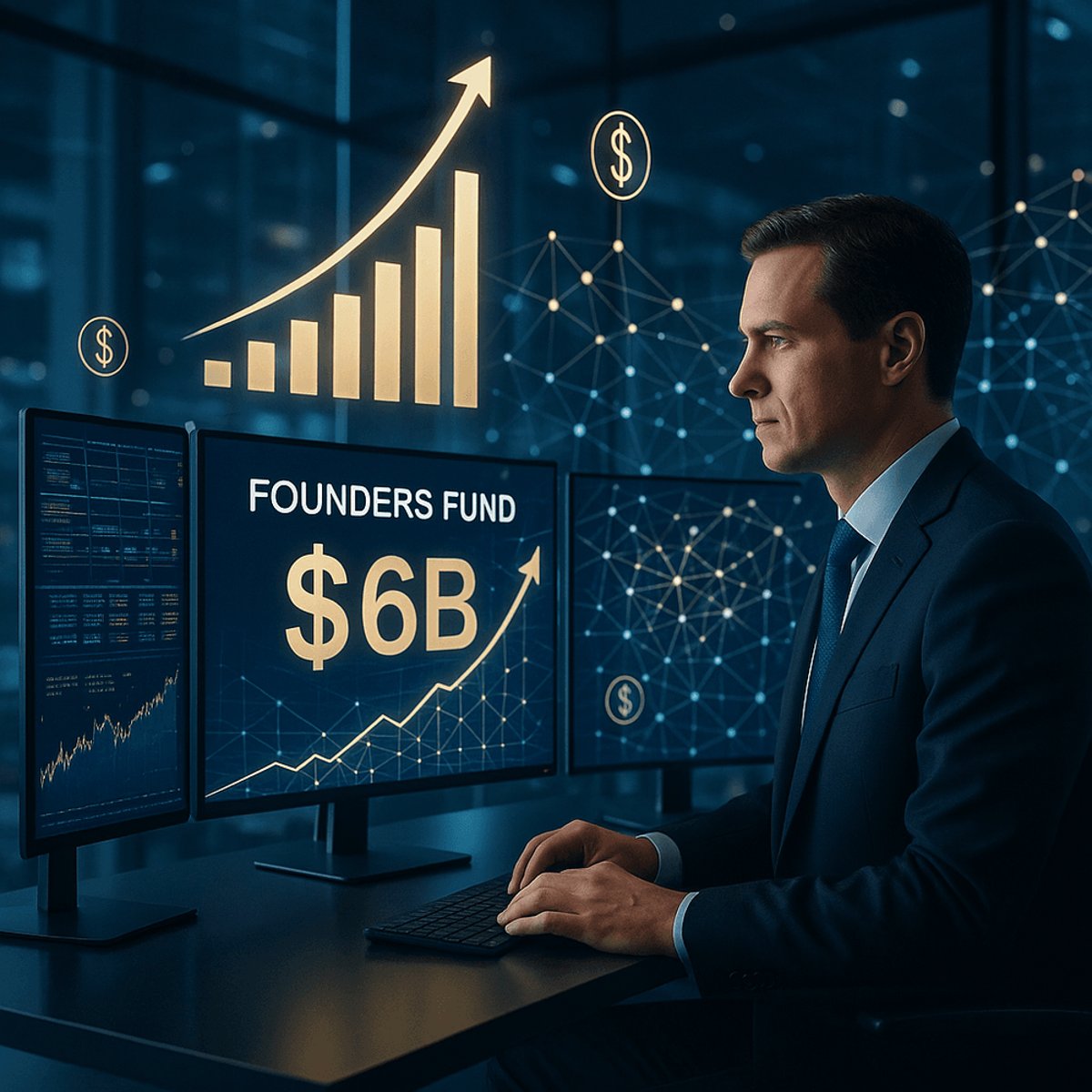
Peter Thiel's Founders Fund is closing in on $6 billion for its latest growth fund - an extraordinary haul that comes less than 12 months after the firm locked down $4.6 billion for its third growth vehicle. The breakneck fundraising pace signals intense LP appetite for access to the firm's late-stage portfolio companies and marks one of the fastest consecutive mega-raises in venture capital history. Sources familiar with the matter say the fund is already substantially oversubscribed, reflecting Founders Fund's track record backing OpenAI, SpaceX, and Stripe.
Founders Fund is pulling off what few venture firms can - raising billions while the money's still warm from the last round. The Peter Thiel-backed firm is closing in on $6 billion for its fourth growth fund, less than a year after sealing $4.6 billion for its predecessor vehicle, according to sources with knowledge of the fundraising.
The timing is remarkable. Most top-tier venture firms operate on 2-3 year fundraising cycles. Founders Fund is turning that model inside out, moving at a pace that suggests limited partners are literally lining up to get allocation. The firm declined to comment, but the numbers tell the story - institutional investors are treating Founders Fund access like concert tickets to a sold-out show.
The fresh capital is earmarked primarily for follow-on investments, allowing Founders Fund to double down on its late-stage winners without diluting early-stage firepower. That strategy has paid off spectacularly. The firm's early bets on OpenAI, SpaceX, and Anduril have turned into multi-billion dollar positions that competitors can only watch from the sidelines.
"Growth funds are where the real money gets made in venture now," one LP who requested anonymity told us. "You're not gambling on seed-stage moonshots - you're scaling proven models. Founders Fund has shown they know which horses to back when it counts."
The $6 billion target represents a 30% increase over the 2025 raise, which itself was a jump from previous vintages. For context, Founders Fund's second growth fund in 2022 clocked in at $3.4 billion. The firm is essentially doubling its growth-stage war chest every two years, a trajectory that puts it in rarefied air alongside Sequoia Capital and Andreessen Horowitz.
What's driving the feeding frenzy? Look at the portfolio. Founders Fund got into OpenAI's breakthrough $300 million round in 2023, positioning itself perfectly for the AI boom. Its defense tech thesis through Anduril arrived just as government contracts exploded. Stripe continues printing money as the infrastructure layer for internet commerce. These aren't lottery tickets - they're compounding machines.
The growth fund model also solves a critical problem for venture firms: how to capture returns from portfolio companies staying private longer. Traditional venture funds return capital through IPOs or acquisitions. But in an era where companies like SpaceX and Stripe remain private well past $50 billion valuations, follow-on funds let firms maintain and increase ownership through secondary purchases and late-stage rounds.
Founders Fund's ability to raise this quickly also reflects broader market dynamics. After a brutal 2022-2023 reset, institutional allocators are consolidating around proven managers. The venture industry's middle class is getting squeezed while the top decile firms - those with consistent track records and unique access - are swimming in commitments.
"LPs are flight to quality right now," explained one venture capital consultant who works with family offices. "You've got pension funds and endowments that got burned on emerging managers. They're going back to names like Founders Fund where there's two decades of data showing they can pick and scale winners."
The timing also coincides with a resurgence in late-stage activity. After a quiet 2024, growth rounds rebounded sharply in 2025 as AI infrastructure companies and defense tech startups commanded massive valuations. Founders Fund's portfolio positioning in both sectors gives it natural deployment opportunities that other firms lack.
Peter Thiel's personal brand doesn't hurt either. Love him or hate him, Thiel remains one of venture's most successful contrarians. His early Facebook bet, PayPal mafia connections, and willingness to fund technically ambitious moonshots have created a portfolio that looks prescient in hindsight. LPs are essentially betting that pattern continues.
The rapid fundraising also suggests Founders Fund is seeing deployment opportunities faster than anticipated. Venture firms typically raise new funds when they've deployed 60-70% of the previous vehicle. Moving this quickly implies either exceptional investment pace or LPs pushing to get into the next vintage before it's oversubscribed.
One potential deployment target: AI infrastructure companies burning through capital to train frontier models. Founders Fund's OpenAI position gives it insight into the sector's economics and natural relationships with adjacent companies building on large language model foundations. Growth-stage rounds in this space routinely hit $500 million to $1 billion, exactly the check sizes a $6 billion fund can write.
The raise also positions Founders Fund to play offense during the next market dislocation. With $6 billion in dry powder, the firm can provide rescue financing to struggling portfolio companies or opportunistically buy into competitors' winners when other firms pull back. That optionality is worth the management fees alone for sophisticated LPs.
What remains unclear is whether this fundraising velocity is sustainable. Even for Founders Fund, raising $10.6 billion in growth capital across two vehicles in under 12 months is an extraordinary feat. The firm will need to demonstrate strong returns from these vintages to maintain LP confidence for future raises.
But right now, the market is voting with its wallet. Founders Fund has created a flywheel where early wins generate returns that attract capital that funds follow-ons that compound winners that generate more returns. Breaking into that cycle as an LP is nearly impossible unless you're already in the club.
Founders Fund's ability to raise $6 billion less than a year after closing $4.6 billion isn't just impressive - it's a referendum on which venture firms matter in the current market. While emerging managers struggle to find LP commitments and mid-tier firms get passed over, Founders Fund is operating in a different reality where capital flows freely because the track record speaks for itself. The real test comes next: deploying $10.6 billion in growth capital without sacrificing returns. But if the firm's portfolio trajectory holds, LPs are betting they'll be fighting even harder to get into Fund V.