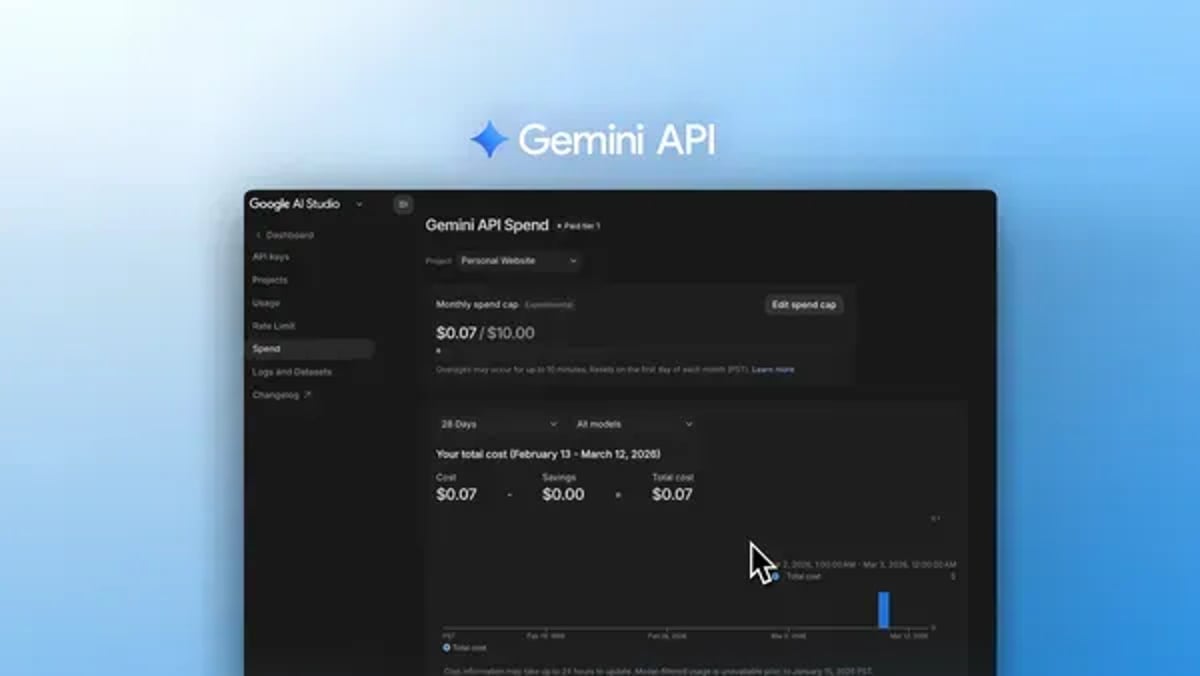
Google is rolling out new cost controls for its Gemini API, letting developers set monthly spending limits directly in AI Studio. The move comes as companies increasingly struggle with unpredictable AI infrastructure bills, and signals how quickly cost management has become a critical pain point in the generative AI boom. For developers building on Google's platform, it's a welcome safety net in an industry where API costs can balloon overnight.
Google just handed developers something they've been quietly demanding for months - actual control over their Gemini API bills. The company announced new features in AI Studio that let developers set hard monthly spending caps, a direct response to one of the most persistent complaints in the generative AI space: costs that can spiral out of control faster than you can say "token limit exceeded."
The timing isn't coincidental. As enterprises rush to embed AI into everything from customer service chatbots to data analysis pipelines, budget predictability has become just as important as model performance. According to Google's announcement, the new controls enable developers to "set monthly spend caps and scale effectively" - corporate speak for "we heard you freaking out about your bills."
This isn't just about Google being nice. The company is locked in a brutal fight with OpenAI and Anthropic for enterprise developer mindshare, and cost management has emerged as a key differentiator. While OpenAI's API has become the default for many developers, complaints about unexpected charges have created an opening for competitors willing to offer more granular controls.
The AI Studio updates put budget guardrails directly into Google's developer interface, rather than forcing teams to build their own monitoring systems or hope finance doesn't notice when the monthly API bill jumps from four figures to five. For startups operating on tight margins, that's the difference between confidently shipping an AI feature and nervously checking usage dashboards every hour.
What makes this particularly significant is how it reflects the maturation of the AI API market. A year ago, developers were just trying to get models to work. Now they're trying to get them to work affordably at scale. Google Cloud has been pushing hard into enterprise AI, and these kinds of operational controls are table stakes for CIOs who need to justify AI spending to boards.
The transparency angle matters too. Google is promising developers better visibility into where their API costs are actually going - which models, which features, which usage patterns are burning through budget. That level of detail has been frustratingly opaque across the industry, with developers often discovering cost bottlenecks only after the damage is done.
For context, this follows similar moves across the cloud infrastructure world. Amazon Web Services and Microsoft Azure have both enhanced their cost management tools as cloud bills became a board-level concern. AI APIs are following the same trajectory, just compressed into a much shorter timeframe.
The real test will be how these controls actually work in practice. Monthly caps sound great until you hit them mid-billing cycle and your production application suddenly stops working. The implementation details - how quickly limits update, what happens when you approach thresholds, how easy it is to adjust caps on the fly - will determine whether this is genuinely useful or just another dashboard to ignore.
What developers really want is predictable, usage-based pricing that doesn't require a PhD in cloud economics to understand. Google's move is a step in that direction, but it's worth noting that adding cost controls is also an implicit admission that the current pricing model is complex enough to require them.
The competitive implications extend beyond just feature parity. By making cost management easier, Google is lowering the barrier for enterprises to experiment with Gemini at scale. That's crucial as companies evaluate which AI platforms to standardize on for the long term. An API that won't surprise you with a five-figure bill is an API you're more likely to build critical infrastructure on.
Google's addition of spend caps and transparency tools to the Gemini API signals a broader shift in the AI infrastructure market from pure performance competition to operational maturity. As generative AI moves from experimental side projects to production systems handling real business logic, cost predictability becomes non-negotiable. For developers, these controls offer a safety net. For Google, they're a bet that winning enterprise AI means sweating the operational details competitors might overlook. The question now is whether OpenAI and Anthropic will follow suit, or whether they'll argue their pricing is already simple enough not to need training wheels.