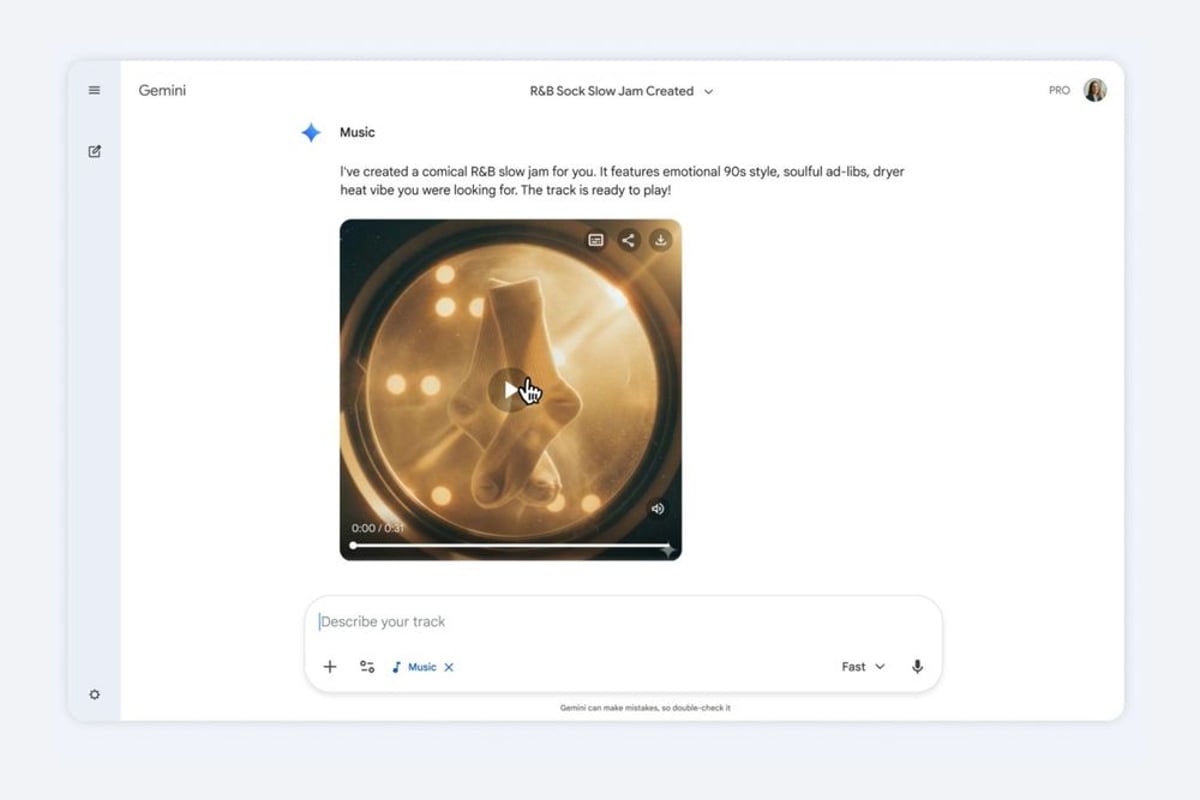
Google just turned its Gemini chatbot into a music studio. The company is rolling out beta access to DeepMind's Lyria 3 audio model directly inside the Gemini app, letting users generate 30-second tracks from text prompts, images, or videos without switching tabs. The move signals Google's push to make generative AI more creative and multimodal, putting music creation alongside text and image generation in one unified interface.
Google is making its biggest play yet in AI-generated audio, bringing music creation directly to the 100+ million people using its Gemini chatbot. Starting today, users can type a prompt like "upbeat jazz for a rainy afternoon" or upload a video clip and watch Gemini compose a custom 30-second soundtrack on the spot. No separate app, no export-import workflow - just music generation baked right into the conversation.
The feature runs on Lyria 3, the latest audio model from DeepMind, Google's AI research lab. Unlike earlier versions that required standalone tools or API access, Lyria 3 lives natively in the Gemini interface. Users can generate tracks from text descriptions, upload images to set the mood, or even drop in video clips to get matching background music. It's Google's answer to the multimodal AI race, where the goal isn't just understanding different media types but creating them too.
The rollout is global from day one, with support for English, German, Spanish, French, Hindi, Japanese, Korean, and Portuguese. Google says more languages are coming, though it didn't specify a timeline. Access is limited to adults 18 and older - likely a guardrail against copyright and content moderation headaches that have plagued other generative audio tools.
Timing matters here. Google has been playing catch-up in consumer AI since OpenAI took the world by storm with ChatGPT in late 2022. While OpenAI has hinted at audio generation features and Meta continues expanding its AI Studio, Google's been methodically building out Gemini's creative capabilities. The company already offers image generation through Imagen 3 and video tools via experimental features. Music was the missing piece.
The 30-second limit is deliberate. Longer tracks would require more compute power and raise thornier copyright questions. Music rights holders have been circling AI companies with lawsuits, and keeping outputs short helps Google argue these are "snippets" rather than replacement tracks. But it's also a technical constraint - generating longer, coherent compositions that maintain structure and don't collapse into repetitive noise remains hard for current models.
DeepMind hasn't published technical specs on Lyria 3's architecture yet, but earlier versions used diffusion models similar to image generators like Stable Diffusion. The challenge with audio is temporal coherence - making sure bars 3 and 4 still make musical sense relative to bars 1 and 2. Text-to-music models often produce technically correct notes that lack soul or narrative arc. Google's betting that Lyria 3 has cleared that bar enough for beta release.
Competitors are circling. Stability AI released Stable Audio, Meta has been testing MusicGen, and startups like Suno and Udio have built dedicated music AI platforms. But none have the distribution Google commands through Gemini. Embedding music generation where millions already chat, search, and brainstorm gives Google a distribution advantage competitors can't match.
The feature launches with familiar AI guardrails. Google says Lyria 3 won't generate tracks imitating specific artists or copyrighted material, though how well those filters work in practice remains to be seen. Each generated track includes SynthID watermarking, Google's audio fingerprinting tech designed to identify AI-generated content even after compression or editing.
What makes this launch significant isn't just the tech - it's the integration strategy. Google's treating AI music generation as a conversational feature, not a destination product. You're not opening a "Google Music AI" app. You're asking Gemini to help with a project, and music becomes another output format alongside text summaries or generated images. That's the multimodal AI vision everyone's chasing, where models fluidly work across media types based on context rather than rigid tool categories.
For now, the beta limits experimentation. Users can't fine-tune tempo, adjust instrumentation mid-generation, or extend tracks beyond 30 seconds. Those features might come as Google gauges user response and navigates the legal minefield of AI-generated music. The company's being cautious - probably wisely, given how quickly GitHub Copilot and other AI tools ran into copyright challenges.
Google's embedding music generation into Gemini signals where AI assistants are headed - toward true multimodal creativity that doesn't require juggling separate tools. The 30-second limit and 18+ age gate show caution around copyright and moderation, but the global eight-language launch demonstrates confidence in the underlying tech. For users, it's another reason to stay inside Google's ecosystem. For competitors, it's a reminder that distribution might matter more than having the best model. And for the music industry, it's yet another front in the battle over AI-generated content rights. The real test comes when millions start creating - and sharing - AI soundtracks, and we see whether those guardrails hold.