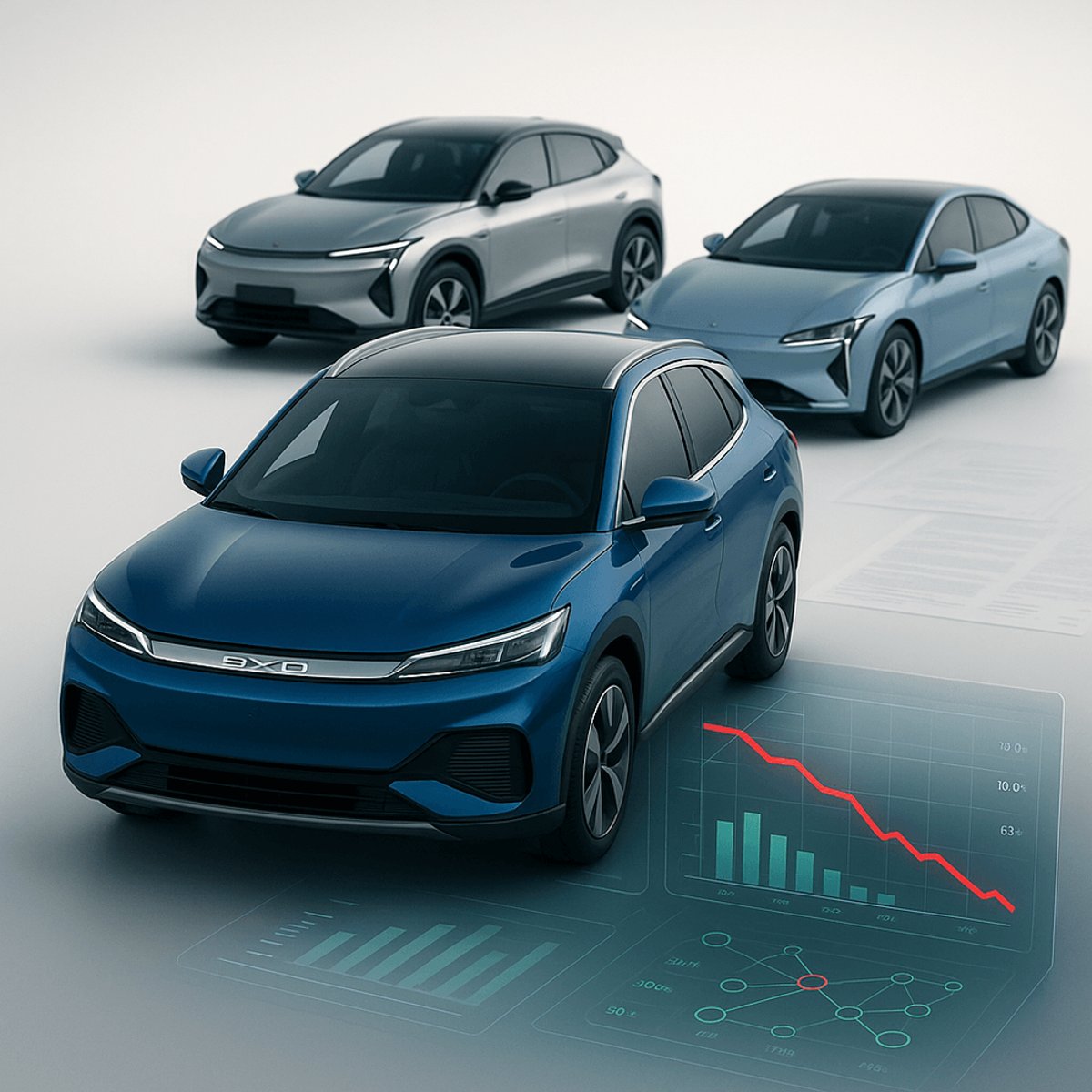
China's electric vehicle market just hit a speed bump. BYD, the world's largest EV maker, posted its lowest monthly sales in nearly two years this January, while at least six major Chinese electric car brands saw sharp month-over-month declines, according to CNBC's analysis. The slowdown comes as Beijing pulled back crucial tax incentives that had fueled a decade of explosive growth, raising questions about whether the industry that's been propping up China's sluggish economy can maintain its momentum.
BYD just stumbled. The Chinese EV giant that's been steamrolling competitors for years reported its weakest monthly performance since early 2024, sending ripples through an industry that's become crucial to China's economic stability. The January sales figures aren't just a blip - they're a red flag for the world's largest auto market.
The numbers tell a brutal story. At least six major electric car brands from Xiaomi to Xpeng saw sharp sales drops between December and January, according to CNBC's analysis. BYD's exports tapered to 100,482 vehicles in January, down from 133,172 cars the previous month. It's a dramatic reversal for a company that sold 4.56 million new energy cars last year and seemed unstoppable.
The timing couldn't be worse. Starting Jan. 1, China reinstated a 5% purchase tax on electric vehicles after exempting new energy vehicles from the full 10% vehicle purchase tax for over a decade. That policy shift hit just as the crucial Lunar New Year shopping season was ramping up.
"We see increasing pressure on China's auto market in 2026, driven by a combination of policy and competitive factors," Helen Liu, partner at Bain & Company, told CNBC. She said policy changes could prompt consumers to delay car purchases while automakers become more cautious about new vehicle launches.
But it's not just about subsidies. BYD faces a wolf pack of hungry competitors who've been waiting for an opening. Aito, whose cars run on smartphone giant Huawei's operating system, reported more than 40,000 vehicle deliveries in January - up more than 80% from a year ago. Smartphone maker Xiaomi posted deliveries of over 39,000 electric cars, though that's down from over 50,000 in December.
Geely has quietly climbed into second place in China's electric car market. In January alone, Geely sold more than 270,000 cars, including its Galaxy and Zeekr electric brands plus exported vehicles. The company expects its overall new energy vehicle sales will grow to 2.22 million cars in 2026, up 32% year-over-year.
"BYD has had a stellar run at the top and it's impressive how long they've been able to hold off their domestic competitors," said Tu Le, founder and managing director at consulting firm Sino Auto Insights. "Companies like Geely with its Xingyuan [Galaxy EV] have really taken sales on the low end, where BYD's bread is buttered."
The pressure is mounting from multiple directions. Leapmotor and Nio both saw year-over-year deliveries rise, to 32,059 and 27,182, respectively. Meanwhile, Xpeng reported just 20,011 car deliveries in January, after averaging more than 35,000 cars a month last year. Li Auto deliveries fell to 27,668 cars last month.
"We know [EV sales will] slow, we just don't know by how much," Le said. "We'll know much better after the first quarter is over."
The slowdown has broader implications that extend far beyond quarterly sales figures. New energy vehicle sales, which include hybrid and battery-powered cars, eked out just a 2.6% year-over-year increase in December - the third straight month of slowing growth, according to China Passenger Car Association data. That's troubling for an electric car industry that's been one of the few bright spots in an economy still reeling from a years-long real estate collapse.
The autos sector contributes to about 30 million jobs in China, or more than one-tenth of urban employment, according to the head of a China machinery body speaking in November. If the sector continues to weaken on top of the prolonged property slump, industry insiders expect Beijing to step in.
"Many in the industry expect Beijing to reinstate some or all of the subsidies," said Cameron Johnson, Shanghai-based senior partner at consulting firm Tidalwave Solutions, citing recent conversations with car parts manufacturers. "We'll have to see how Q1 goes."
Despite the headwinds, Le expects BYD to retain its dominance in both domestic and international markets, citing planned upgrades to the company's charging, energy storage, and intelligent driving infrastructure. BYD has yet to release a full-year domestic sales target, but told reporters late last month it plans to boost overseas sales by nearly 25% this year to 1.3 million cars.
China's top leaders are expected to release policy targets for the year at an annual parliamentary meeting in March. Until then, the industry is watching closely to see whether January's slump is a temporary dip tied to policy changes and seasonal volatility - or the start of a more serious correction in a market that's been running hot for years.
China's EV market is entering uncharted territory. The combination of subsidy cuts, fierce domestic competition, and broader economic weakness is testing whether the industry can sustain its growth without government support. BYD's stumble matters not just for the company but for China's economic trajectory - this is an industry supporting 30 million jobs and one of Beijing's few success stories amid a struggling property sector. Whether this is a temporary adjustment or the beginning of a longer slowdown will become clearer after Q1 results, but one thing is certain: the easy growth phase for Chinese EVs is over. The companies that survive will need to compete on technology and efficiency rather than just riding the subsidy wave.