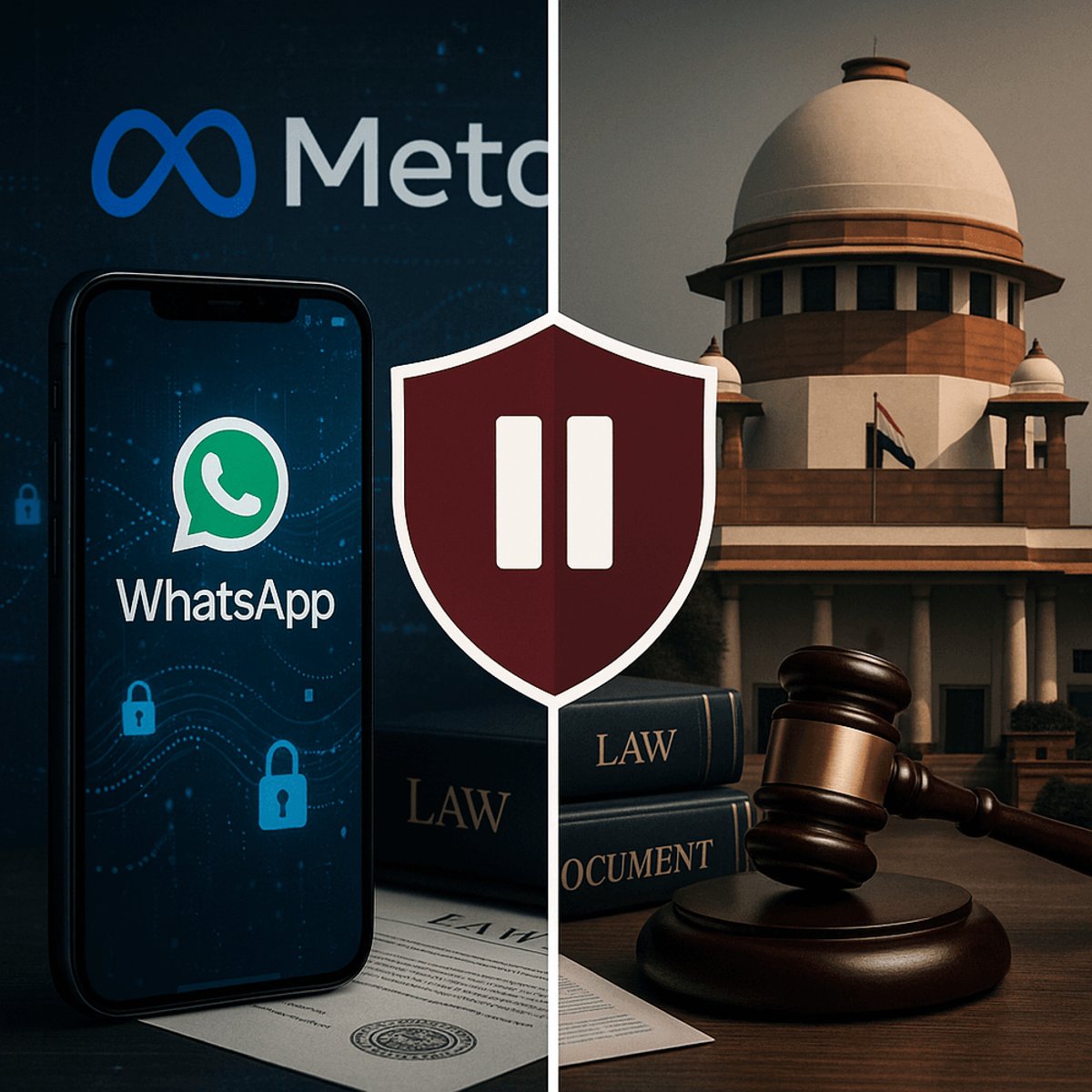
India's Supreme Court just told Meta to stop playing games with user privacy. In an unusually sharp hearing Tuesday, judges halted all WhatsApp data-sharing while they investigate whether the messaging giant is exploiting its monopoly position in the country's 500-million-user market. Chief Justice Surya Kant warned the court won't allow Meta to share "a single piece of information" while the case proceeds, questioning how users can meaningfully consent when WhatsApp is essentially the only game in town.
Meta walked into India's Supreme Court expecting a routine appeal hearing. What it got was a pointed interrogation about monopoly power, user consent, and exactly how WhatsApp turns half a billion Indian users into advertising revenue.
The Tuesday hearing centered on Meta's challenge to a ₹2.13 billion penalty - about $23.6 million - imposed by India's competition regulator over WhatsApp's 2021 privacy policy update. But the judges quickly moved beyond the fine itself to probe fundamental questions about data monetization and user choice in a market where WhatsApp has become the default communications infrastructure.
Chief Justice Surya Kant delivered the most striking rebuke, telling Meta the court would not allow the company to share even "a single piece of information" while the appeal proceeds. His reasoning cut to the heart of the consent debate: when everyone from street vendors to domestic workers depends on WhatsApp to make a living, can they really be said to have chosen to accept its privacy terms?
"How can a poor woman selling fruits on the street or a domestic worker be expected to grasp how their data is being used?" Kant asked, according to TechCrunch's reporting. The question highlights what the court sees as a fundamental mismatch between Meta's legal framework and ground reality in its largest market.
India represents more than just scale for Meta. With over 500 million users, it's WhatsApp's biggest market globally and a critical growth engine for Meta's advertising business. That commercial imperative is exactly what has judges concerned. Justice Joymalya Bagchi pressed Meta's lawyers on the commercial value of behavioral data and metadata, arguing that even anonymized information carries economic worth when used for targeted advertising.
The court wants answers about how user data flows across Meta's ecosystem. While WhatsApp maintains end-to-end encryption for message content, judges are focused on everything else: usage patterns, contact networks, transaction metadata, and behavioral signals that could feed Meta's advertising algorithms or AI training operations.
Meta's defense rested heavily on encryption. Company lawyers argued that messages remain inaccessible even to Meta itself, and that the contested 2021 privacy policy didn't weaken protections or allow chat content to be used for ads. But that argument didn't satisfy judges who see a broader data ecosystem at work beyond message text itself.
The case traces back to WhatsApp's controversial 2021 privacy policy update, which required Indian users to accept expanded data-sharing with Meta or stop using the service. The take-it-or-leave-it approach prompted India's Competition Commission to investigate whether WhatsApp was abusing its dominant market position. The regulator found that it was, imposing the penalty that Meta is now appealing.
That ruling was upheld on appeal before Meta elevated the case to the Supreme Court. Meta's lawyers told judges the penalty has already been paid, but the court's focus has shifted from the fine to the underlying practices.
Government lawyers pushed back hard against Meta's characterization, arguing that personal data isn't just collected but commercially exploited across the company's operations. The Supreme Court agreed to add India's IT ministry as a party to the case at the competition regulator's suggestion, significantly expanding the scope of the proceedings.
The timing couldn't be more challenging for Meta's India operations. WhatsApp is already navigating new SIM-binding rules designed to curb fraud, which could limit how small businesses use the platform. And globally, WhatsApp faces mounting privacy scrutiny, with U.S. authorities reportedly investigating claims about whether encrypted chats are as private as the company claims.
The Indian court's questions reflect broader global tensions around platform power and privacy. When a service becomes essential infrastructure - as WhatsApp clearly has in India - traditional notions of user consent start to break down. Judges are essentially asking whether click-through agreements mean anything when users have no realistic alternative.
Meta declined to comment on the proceedings. The company now has until February 9 to provide detailed explanations of its data practices to the court. What happens next could reshape how WhatsApp operates in its most important market and set precedents for how courts worldwide think about consent, monopoly power, and privacy in the platform era.
India's Supreme Court just reframed the global conversation about platform power and privacy. By questioning whether meaningful consent exists when a service becomes essential infrastructure, the court is tackling questions that regulators worldwide are grappling with. For Meta, the immediate impact is clear: no data-sharing until it can explain exactly how it monetizes Indian user information. But the bigger implications extend far beyond one company or one market. When half a billion people depend on your platform to work and communicate, do traditional privacy frameworks even apply? The court's February 9 deadline will force Meta to answer that question in detail, and the response could reshape how encrypted messaging platforms operate globally.