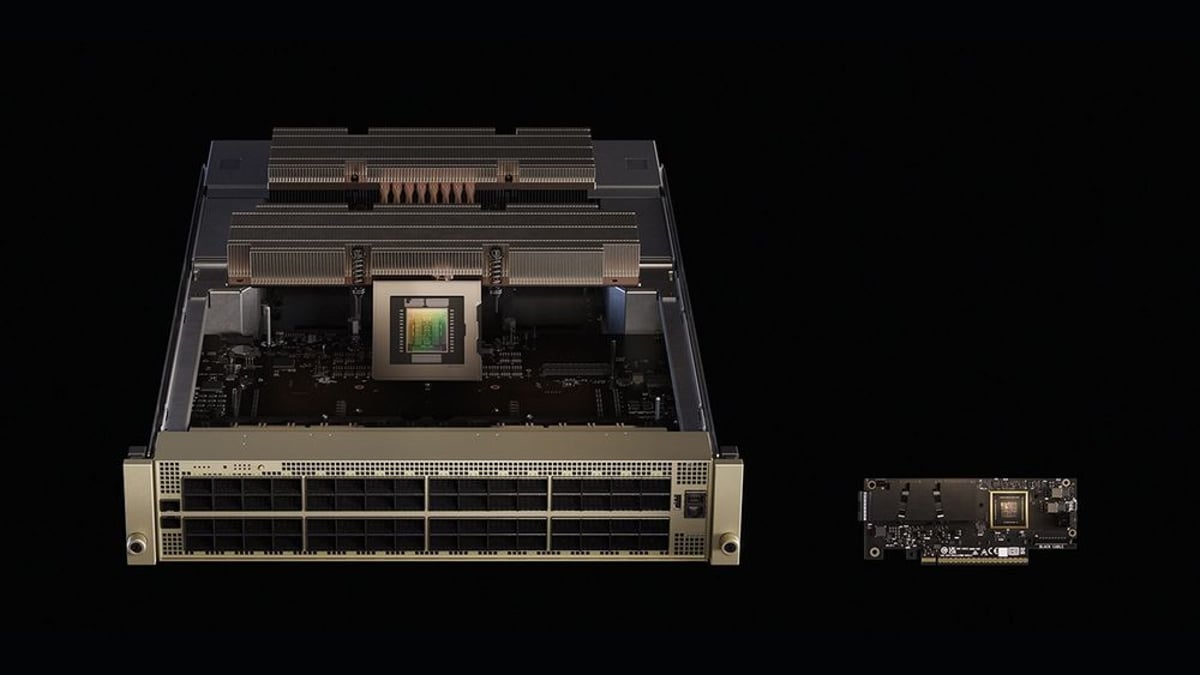
NVIDIA just scored two massive enterprise wins that could reshape AI data center networking. Meta and Oracle are both standardizing on NVIDIA's Spectrum-X Ethernet switches to power their next-generation AI supercomputers, marking a significant shift away from traditional networking approaches. The deals validate NVIDIA's push beyond GPUs into the critical networking infrastructure that connects millions of processors in AI training clusters.
The networking battle for AI supremacy just heated up significantly. NVIDIA announced today that both Meta and Oracle will deploy its Spectrum-X Ethernet switches across their AI data centers, giving the chip giant a foothold in the critical infrastructure that connects massive GPU clusters.
The timing couldn't be more strategic. As AI models balloon toward trillion parameters, traditional networking approaches are hitting hard limits. Jensen Huang, NVIDIA's CEO, framed the shift in characteristically bold terms during the announcement: "Spectrum-X is not just faster Ethernet - it's the nervous system of the AI factory, enabling hyperscalers to connect millions of GPUs into a single giant computer."
The numbers tell the story of why these companies are making the switch. NVIDIA's Spectrum-X technology has already demonstrated 95% data throughput in real-world deployments, compared to roughly 60% for standard Ethernet at scale. That 35-point difference isn't just a technical curiosity - it translates directly into training time and costs for AI models that can cost millions to develop.
Meta plans to integrate the switches into its Facebook Open Switching System (FBOSS), the software platform the company uses to manage network switches across its global infrastructure. "Meta's next-generation AI infrastructure requires open and efficient networking at a scale the industry has never seen before," said Gaya Nagarajan, Meta's VP of networking engineering, in the company announcement.
For Meta, this represents a significant infrastructure bet. The company has been aggressively scaling its AI capabilities, from recommendation algorithms that power its social platforms to its ambitious metaverse projects. The Spectrum-X integration into the Minipack3N switch suggests Meta is preparing for AI workloads that dwarf today's already massive requirements.
Oracle is taking an even more aggressive approach, planning to build what it calls "giga-scale AI factories" using NVIDIA's Vera Rubin architecture interconnected by Spectrum-X Ethernet. Oracle Cloud Infrastructure executive VP Mahesh Thiagarajan positioned the move as extending Oracle's AI leadership: "By adopting Spectrum-X Ethernet, we can interconnect millions of GPUs with breakthrough efficiency."
The technical breakthrough centers on congestion control - the bane of large-scale networking. Traditional Ethernet suffers from thousands of flow collisions when scaled up, creating bottlenecks that waste expensive GPU compute time. NVIDIA's approach uses adaptive routing and AI-driven telemetry to maintain efficiency even at massive scale.
This infrastructure play represents NVIDIA's broader strategy to own the entire AI stack, not just the processors. The company has systematically expanded from GPUs into CPUs, networking, and software, creating what industry analysts call a "platform lock-in" effect. Once enterprises commit to NVIDIA's ecosystem, switching becomes exponentially more difficult and expensive.
The competitive implications extend beyond just networking vendors. Intel and AMD have been fighting to break NVIDIA's GPU dominance, but if NVIDIA can lock in the networking layer as well, it creates another moat around its AI business. Enterprises thinking about diversifying their AI infrastructure now face the prospect of rebuilding not just compute but networking as well.
The announcement also signals how quickly AI infrastructure requirements are evolving. Just two years ago, connecting thousands of GPUs was considered massive scale. Now companies are talking about millions of interconnected processors spanning multiple data centers and even continents. NVIDIA's Spectrum-XGS technology promises to enable these "scale-across" capabilities, linking data centers globally into unified AI training systems.
For investors and industry watchers, this represents validation of NVIDIA's thesis that AI will reshape not just software but the entire data center infrastructure stack. The company's networking revenue has grown steadily but remains a fraction of its GPU business. These enterprise wins could change that equation significantly.
NVIDIA's wins with Meta and Oracle represent more than just networking deals - they're strategic moves in the broader battle to control AI infrastructure. As trillion-parameter models become the norm rather than the exception, the companies that control the plumbing connecting these massive systems will hold tremendous influence over the AI economy. For NVIDIA, success in networking creates another revenue stream and deepens its platform moat. For competitors, it's yet another barrier in an already challenging market where NVIDIA continues to extend its lead through vertical integration.