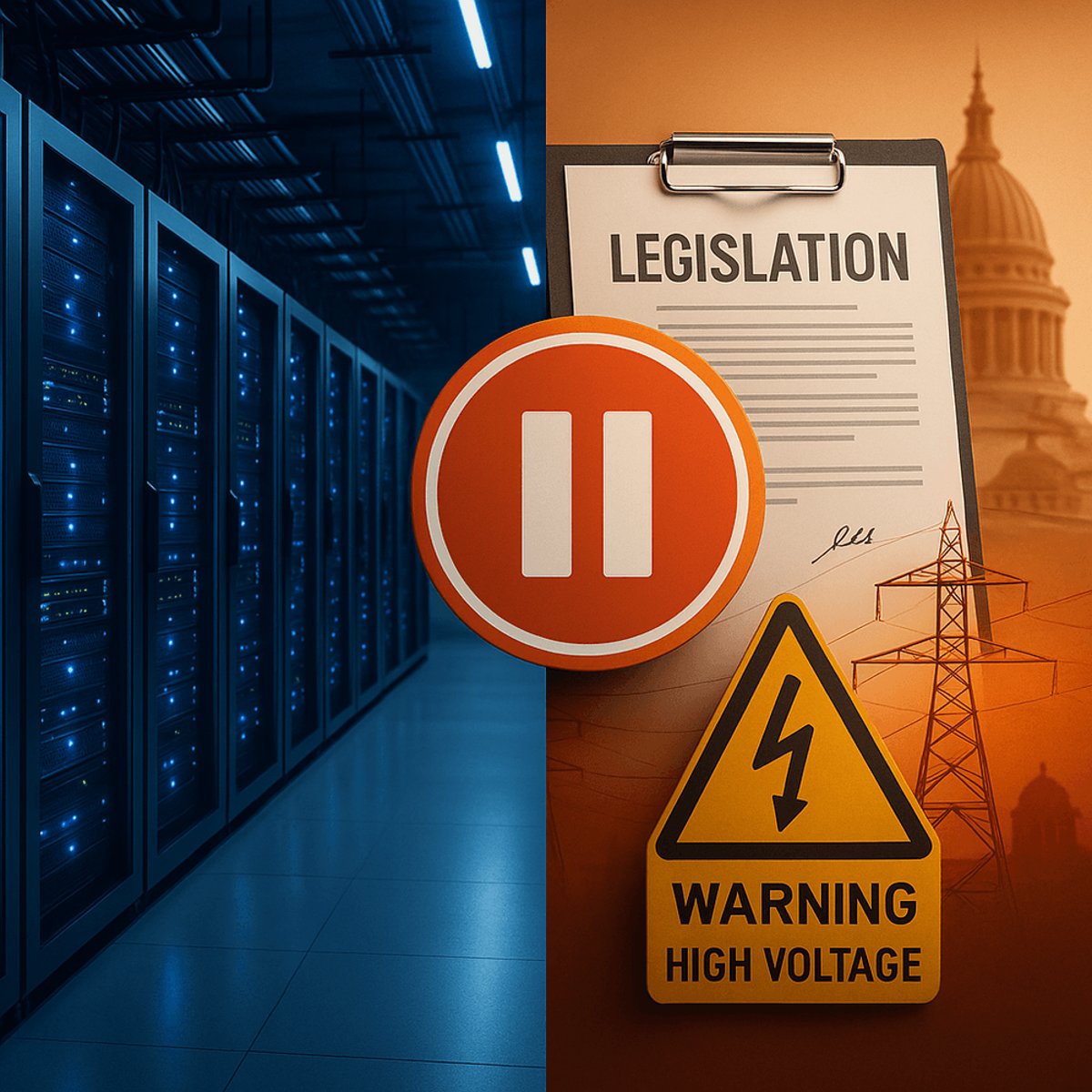
New York state lawmakers just dropped a bombshell that could reshape the AI infrastructure race. A new bill would slam the brakes on data center construction for at least three years, making New York the sixth state to push back against the industry's breakneck expansion. The proposal comes as tech giants prepare to spend hundreds of billions building AI infrastructure, but mounting concerns about energy costs and community impact are turning data centers into a political flashpoint from Albany to Silicon Valley.
New York just became the latest battleground in the escalating war over AI infrastructure. State Senator Liz Krueger and Assemblymember Anna Kelles, both Democrats, introduced legislation Friday that would freeze new data center permits for at least three years - a move that could directly clash with tech companies' multi-billion-dollar buildout plans.
The timing couldn't be more critical. Amazon, Google, Microsoft, and Meta are in an arms race to build the massive computing infrastructure needed to train and run AI models. But that expansion is colliding with growing anxiety about what these energy-hungry facilities mean for local communities and power grids.
"It's time to hit the pause button, give ourselves some breathing room to adopt strong policies on data centers, and avoid getting caught in a bubble that will burst and leave New York utility customers footing a huge bill," Krueger told Politico. She described New York as "completely unprepared" for the "massive data centers" that are "gunning" for the state.
New York isn't alone in its resistance. According to Wired, this makes at least six states now weighing similar moratoriums. Democrats have proposed data center pauses in Georgia, Vermont, and Virginia, while Republicans sponsored comparable bills in Maryland and Oklahoma. The issue is creating strange political bedfellows - progressive Senator Bernie Sanders called for a national moratorium on data centers, while conservative Florida Governor Ron DeSantis warned they'll lead to "higher energy bills just so some chatbot can corrupt some 13 year old kid online."
The pushback gained momentum last December when more than 230 environmental groups - including Food & Water Watch, Friends of the Earth, and Greenpeace - signed an open letter to Congress demanding a national construction halt. Eric Weltman of Food & Water Watch told Wired the New York bill was "our idea," revealing the coordinated strategy behind the state-level campaigns.
The concerns aren't abstract. Studies have linked data centers to increased home electricity bills, as these facilities draw enormous amounts of power from local grids. One data center can consume as much electricity as a small city, and tech companies are racing to build dozens more to support AI development.
For context, tech giants are planning unprecedented infrastructure spending. Recent reports show companies are preparing to invest hundreds of billions in AI infrastructure over the next few years, with data centers forming the backbone of that buildout. That spending spree is now running headfirst into regulatory resistance.
New York Governor Kathy Hochul is trying to thread the needle. Last month, she announced an initiative called Energize NY Development, designed to modernize how large energy users connect to the grid while requiring them to "pay their fair share." It's an attempt to welcome data centers without crushing ratepayers - but lawmakers like Krueger clearly think that's not enough.
The bill's prospects remain uncertain. New York has historically been tech-friendly, and the industry will likely mount fierce opposition, arguing that blocking data centers means ceding AI leadership to other states and countries. Tech companies have repeatedly emphasized that AI infrastructure is critical to national competitiveness and economic growth.
But the political winds are shifting. When both Bernie Sanders and Ron DeSantis are sounding alarms about the same issue, that signals a rare moment of cross-partisan concern. And with six states now considering similar measures, this isn't just a New York problem - it's becoming a national reckoning over who pays the price for the AI revolution.
The three-year timeframe in the New York bill isn't arbitrary. Sponsors want breathing room to develop comprehensive policies around energy use, environmental impact, and cost allocation before the buildout accelerates further. They're essentially asking: shouldn't we figure out the rules before we're locked into infrastructure that will shape communities for decades?
For tech companies banking on rapid expansion, these state-level roadblocks represent a serious threat to their AI ambitions. Data centers can't be built overnight, and permitting delays could hand competitive advantages to rivals who moved faster or picked different locations. The question now is whether other states follow New York's lead - or roll out the welcome mat to capture the investment fleeing stricter jurisdictions.
New York's proposed three-year freeze on data center construction marks a turning point in how states are responding to the AI infrastructure boom. What started as scattered local concerns about energy costs has evolved into a coordinated, bipartisan pushback across at least six states. For tech companies betting hundreds of billions on rapid AI expansion, these regulatory hurdles represent more than just delays - they're a fundamental challenge to the assumption that communities will simply absorb the costs of the AI revolution. The next few months will reveal whether this is a temporary speed bump or the beginning of a broader reckoning over who controls, and who pays for, the infrastructure powering artificial intelligence.