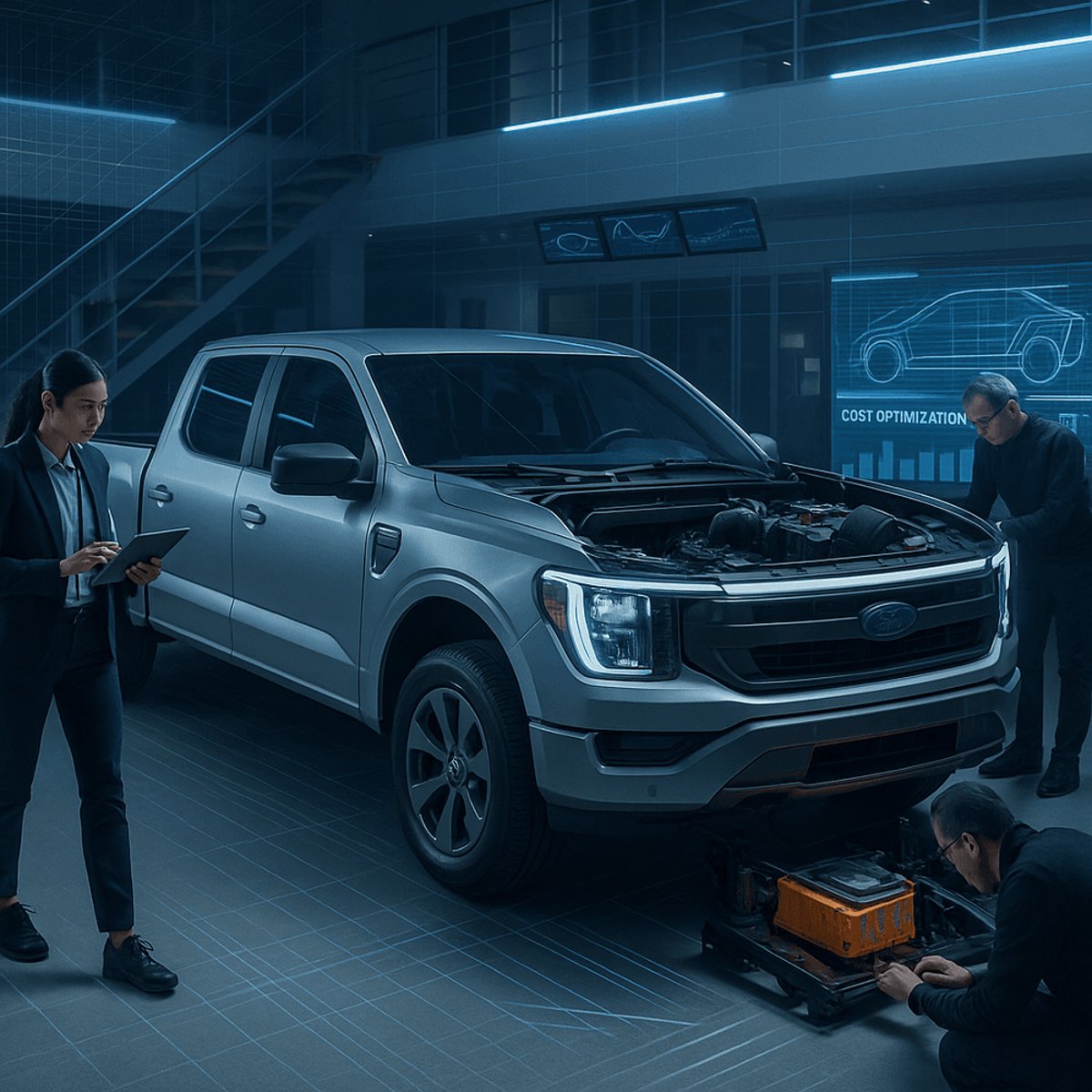
Ford is betting its electric truck future on a Tesla defector and Formula 1 engineering tactics. The automaker has assembled a skunkworks team led by former Tesla engineer Alan Clarke with a single mission: build a $30,000 electric truck that can actually turn a profit. The project marks Ford's latest attempt to crack the code that's eluded legacy automakers - making EVs affordable without bleeding cash on every unit sold.
Ford just handed the keys to its electric truck future to a Tesla refugee, and the approach he's taking reads like a startup playbook dropped into a century-old manufacturing giant.
Alan Clarke, who spent years in Tesla's engineering trenches before jumping ship to Ford, now leads what insiders are calling the most aggressive cost-cutting EV project in Detroit. His mandate is brutally simple: deliver an electric truck at $30,000 that doesn't lose money. In an industry where most EVs still hemorrhage cash per unit, that's the equivalent of squaring the circle.
According to TechCrunch's report, Clarke's team is borrowing tactics straight from Formula 1 racing, where every gram of weight and every watt of power gets obsessively optimized. But they're adding a twist that feels more Silicon Valley than Motor City - employee bounty programs that reward engineers for finding cost savings.
The strategy represents a dramatic shift for Ford, which has struggled to make its EV business profitable even as it pours billions into electrification. The company's F-150 Lightning, while critically acclaimed, still sells at a loss according to industry analysts. Meanwhile, Tesla continues to print money on its vehicles, and Rivian just announced it's targeting profitability by late 2024.
Clarke's efficiency obsession makes sense given his pedigree. Tesla built its empire on manufacturing innovations that let it undercut traditional automakers on price while maintaining healthy margins. Now Ford is essentially trying to reverse-engineer that playbook, poaching the talent that helped build it in the first place.
The F1 connection isn't just marketing speak. Racing teams have perfected the art of doing more with less - optimizing every component for weight, cost, and performance under brutally tight constraints. Clarke's team is reportedly applying similar methodologies to everything from battery pack design to wiring harness layouts, hunting for incremental gains that add up to massive cost reductions.
The bounty program adds a competitive element that's rare in traditional automotive engineering. Instead of top-down mandates to cut costs, Ford is crowdsourcing solutions from engineers across the organization, paying out rewards for innovations that shave dollars off the bill of materials. It's a tacit admission that the old ways of doing business won't work in the EV era.
Timing matters here. The $30,000 price point isn't arbitrary - it's the magic number where EVs become accessible to mainstream American truck buyers, not just early adopters and Tesla fans. Tesla's Cybertruck started at $39,900 but has crept upward with production realities. Rivian's R1T launched above $67,000. Ford sees a gap it can exploit if Clarke's team can nail the economics.
The project also signals how desperate the competitive landscape has become. Legacy automakers watched Tesla eat their lunch for years, assuming scale would eventually win out. Instead, they're discovering that decades of manufacturing experience mean little when the entire powertrain architecture changes. Now they're hiring away the people who figured it out first.
What makes this particularly interesting is the organizational challenge. Clarke is essentially running a startup inside a corporate giant, trying to move with Tesla-like speed while navigating Ford's established processes and supplier relationships. That tension - between startup agility and manufacturing scale - will determine whether this gambit works.
The stakes extend beyond one truck model. If Ford can crack the code on profitable EVs at mass-market prices, it validates a path forward for every legacy automaker struggling with the same equation. If Clarke's team fails, it suggests the advantages Tesla built might be more durable than Detroit hoped.
Ford's $30,000 electric truck project represents more than just another vehicle program - it's a test of whether legacy automakers can truly reinvent themselves for the EV era. By turning to a Tesla veteran and embracing startup-style innovation tactics inside a corporate structure, Ford is acknowledging that traditional approaches won't win this race. If Clarke's team succeeds in building a profitable electric truck at mass-market prices, they'll hand every legacy automaker a roadmap out of their EV profitability crisis. If they stumble, it'll confirm Tesla's manufacturing advantages run deeper than anyone in Detroit wants to admit. Either way, the pressure is on to prove that a century of automotive experience still counts for something when the rules of the game have fundamentally changed.