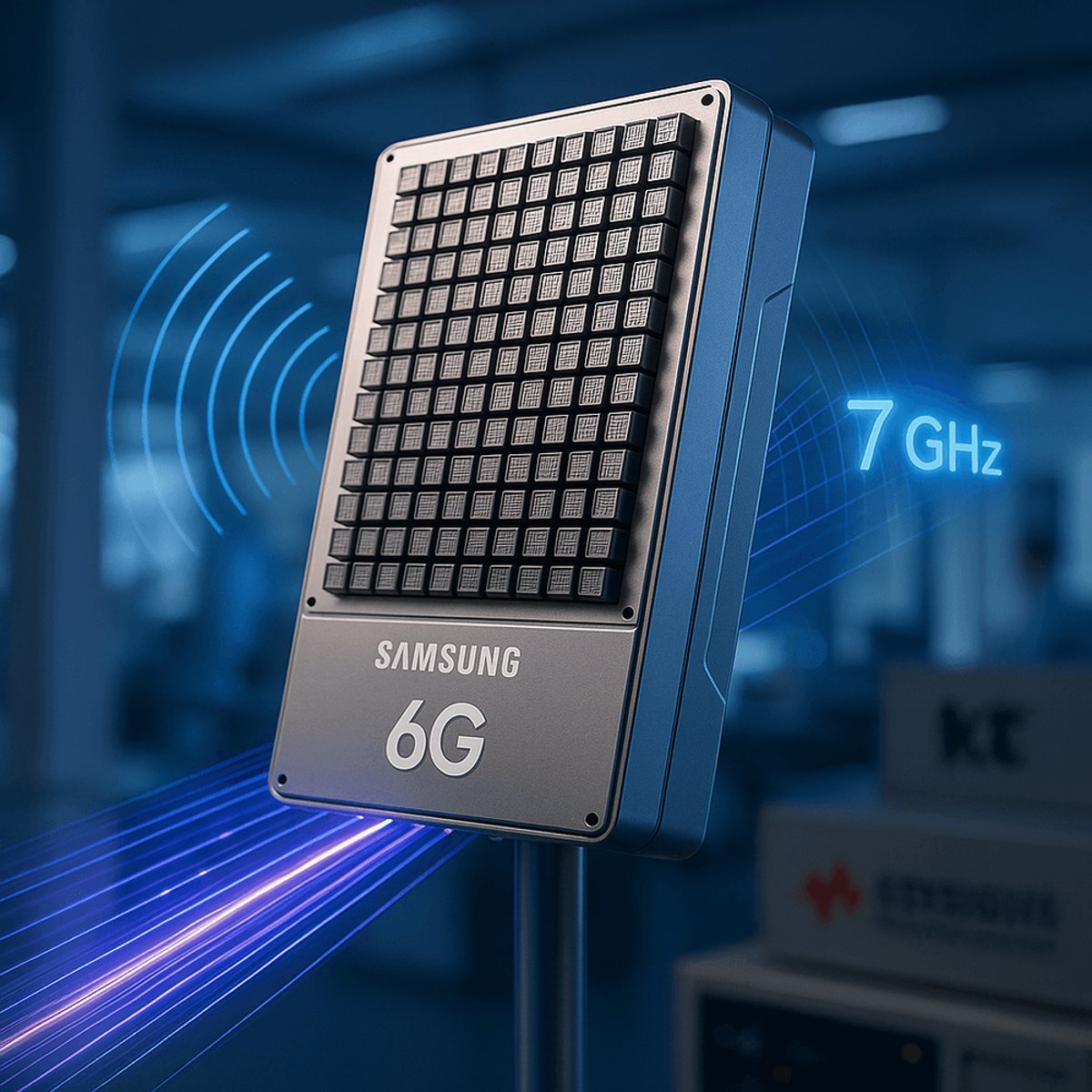
Samsung just took a big step toward making 6G real. The company successfully tested eXtreme multiple-input multiple-output (X-MIMO) technology in the 7 GHz frequency band, hitting peak speeds of 3 gigabits per second in outdoor trials with KT Corporation and Keysight Technologies. The breakthrough hinges on cramming four times as many antennas into the same space as today's 5G gear, a trick enabled by the shorter wavelengths at 7 GHz. While 6G commercialization is still years away, this validation shows the tech might actually deliver on its promises.
Samsung Electronics isn't waiting for 6G standards to finalize before proving the technology works. The company just verified X-MIMO technology in the 7 GHz band, achieving 3 gigabits per second in real-world outdoor tests conducted with South Korean telecom giant KT Corporation and test equipment maker Keysight Technologies.
The trials took place at Samsung's Seoul R&D Campus, where engineers pushed eight simultaneous data streams from a base station to a single user. According to Samsung's announcement, the breakthrough relies on ultra-high-density antenna technology that crams significantly more antenna elements into equipment roughly the same size as today's 5G gear. The result is four times the antenna density of current systems, a critical leap for handling the data tsunami coming from AI services, immersive experiences, and fixed wireless access.
The 7 GHz band is emerging as a goldilocks frequency for next-generation wireless. It's high enough to offer substantial capacity gains over 5G's typical 3.5 GHz deployments, but low enough to avoid the severe propagation challenges that plague millimeter-wave frequencies. "The 7 GHz band stands out as a promising candidate for future communications, offering an optimal balance of coverage and capacity," Samsung explains in its technical overview.
X-MIMO takes advantage of the shorter wavelengths at 7 GHz to pack more antennas into the same physical footprint. More antennas mean more spatial streams, which translates directly to higher throughput. But the technology also compensates for 7 GHz's naturally shorter propagation distance compared to lower frequencies, maintaining coverage areas comparable to today's 5G networks while delivering dramatically faster speeds.
The testing setup itself points to how serious Samsung is about 6G. The company deployed a prototype base station featuring 256 digital ports, paired with Keysight's 6G terminal testbed to simulate actual user devices. KT's involvement brought real-world network expertise to the validation, helping create outdoor test conditions that mirror what commercial deployments would face.
"Through our collaboration with KT and Keysight, we have demonstrated the potential for significant improvements in data rates for next-generation communications," JinGuk Jeong, Executive Vice President and Head of Advanced Communications Research Center at Samsung Research, said in a statement. "We remain committed to pioneering future network technologies that will enable diverse services and enhanced user experiences in the 6G era."
KT's Jong-Sik Lee, Executive Vice President and Head of Future Network Laboratory, emphasized the commercial implications: "The validation of ultra-high-density antenna technology performance in the 7 GHz band marks a critical step toward 6G commercialization. By securing stable, high-capacity operation in high-frequency bands, we have established a foundational technology for enabling ultra-fast, immersive services."
Keysight's participation highlights how the 6G ecosystem is already forming, even though widespread deployment remains nearly a decade away. "This work with Samsung and KT highlights how Keysight's industry-leading 6G capabilities are accelerating real-world innovation, unlocking new spectrum for early 6G deployments and bridging the gap between research and commercial readiness," said Kailash Narayanan, Senior Vice President and President of Communications Solutions Group at Keysight.
This isn't Samsung's only recent 6G progress. In December 2025, the company and KT successfully validated AI-based radio access network optimization technology on a live commercial network, demonstrating how artificial intelligence can improve network performance at the user level. The combination of X-MIMO hardware advances and AI-RAN software optimization suggests Samsung is building a comprehensive 6G strategy rather than cherry-picking individual technologies.
The timing matters. As AI workloads explode and devices get smarter, wireless networks face unprecedented pressure. Fixed wireless access is replacing wired broadband in many markets, while immersive services like augmented reality demand consistent multi-gigabit connections. Current 5G networks, even with their theoretical multi-gigabit speeds, often struggle to deliver that performance reliably across coverage areas.
Samsung's 7 GHz testing addresses those challenges head-on. The four-fold increase in antenna density doesn't just boost peak speeds, it improves network efficiency and reliability across the coverage area. More spatial streams mean the network can serve more users simultaneously without performance degradation, a critical capability as device counts continue climbing.
What's notable is how quickly lab research is translating to outdoor validation. Samsung and its partners moved from theoretical concepts to real-world testing faster than previous wireless generations, compressed timelines that could accelerate 6G's commercial arrival. The company says it will continue collaborating with KT on uplink coverage technologies, filling out the full duplex picture needed for actual deployments.
Samsung's 3 Gbps achievement in the 7 GHz band shows 6G moving from slideware to actual hardware. The four-fold antenna density improvement isn't just incremental progress, it's the kind of fundamental advance that enables new use cases rather than just faster versions of existing ones. With major players like Samsung, KT, and Keysight already collaborating on outdoor validations, the 6G timeline looks increasingly credible. The real test will be whether these lab speeds translate to reliable performance when networks go live, but Samsung's decision to test outdoors rather than in controlled environments suggests the company expects its tech to hold up under real-world conditions.