Samsung just dropped its Galaxy S26 series with a privacy feature no other phone can match. The S26 Ultra introduces the mobile industry's first built-in Privacy Display - hardware that controls how pixels disperse light to keep your screen visible to you but obscured from prying eyes at cafés and on transit. It's the kind of technological leap that could redefine smartphone privacy, backed by a customized Snapdragon 8 Elite Gen 5 chip delivering 39% faster AI processing than last year's model.
Samsung is making a bold claim with the Galaxy S26 series - that AI should work quietly in the background while you focus on what matters. But it's the S26 Ultra's Privacy Display that steals the spotlight, a hardware-software integration that fundamentally changes how privacy works on mobile devices.
The Privacy Display goes beyond anything previously available on smartphones. By controlling how pixels disperse light, the technology keeps content clear and bright for the user while limiting what others can see from side viewing angles. Unlike traditional privacy films that degrade viewing quality, Samsung's integrated approach preserves full clarity from all directions when off, then intelligently restricts visibility when activated - even when switching between portrait and landscape orientation.
"We believe AI should be something people can depend on every day, designed to work consistently for everyone and without the need for expertise," Samsung Device eXperience Division CEO TM Roh told press at the Galaxy Unpacked event. "With the Galaxy S26 series, we focused on making AI feel effortless, working quietly in the background so people can focus on what matters."
Users can customize when Privacy Display activates - entering PINs, opening banking apps, or viewing sensitive notifications. Partial Screen Privacy mode intelligently limits visibility for notification pop-ups, while Maximum Privacy Protection further obscures side views with minimal impact on battery life or usability.
The privacy push comes as Samsung doubles down on AI capabilities across the S26 lineup. At the heart of the S26 Ultra sits a customized Snapdragon 8 Elite Gen 5 Mobile Platform for Galaxy - Qualcomm's latest silicon tuned specifically for Samsung's needs. The chip delivers a 19% CPU performance increase over the S25 Ultra, according to internal Samsung benchmarks, enabling the device to handle complex workloads even when multiple AI tasks run simultaneously.
That 39% improvement in NPU performance powers always-on Galaxy AI features that run seamlessly in the background. The upgraded Now Nudge feature surfaces contextual suggestions at the right moment - if a friend asks for photos from a recent trip, the S26 automatically suggests relevant images from Gallery without requiring manual album searches. When a message mentions a meeting, the phone recognizes related Calendar entries and checks for conflicts.
Circle to Search with Google gets enhanced multi-object recognition on the S26 series, letting users explore multiple parts of an image simultaneously. Spot an outfit you love? The feature identifies everything from jacket to shoes in one search.
Samsung's Bixby assistant receives a major conversational upgrade, functioning as a true device agent that understands natural language without requiring exact commands. The S26 series also integrates choice of agents including Gemini and Perplexity, handling multi-step tasks in the background. With Gemini, booking a taxi becomes as simple as asking, reviewing details, and tapping confirm.
The camera system sees significant hardware improvements on the S26 Ultra. Wider apertures on the 200MP main camera (F1.4) and 50MP 5x telephoto (F2.9) allow 47% and 37% more light respectively compared to the S25 Ultra, according to Samsung specifications. Enhanced Nightography Video keeps footage clearer in dim scenes, while upgraded Super Steady adds horizontal lock for greater stability during action shots.
Photo Assist gets a natural language interface - users can describe edits in their own words rather than hunting through menus. Changing a scene from day to night, removing a spill on clothing, or restoring missing parts of objects becomes conversational. Creative Studio consolidates creation and customization into one space, turning sketches, photos or prompts into polished visuals from stickers to personalized wallpapers.
To sustain this level of performance, Samsung redesigned the Vapor Chamber cooling system with thermal interface material positioned along the processor sides, spreading heat more efficiently across a larger surface area. Super Fast Charging 3.0 reaches 75% charge in 30 minutes on the S26 Ultra with a 60W adapter.
Security gets post-quantum cryptography extensions to critical system processes including software verification and firmware protection. Knox Matrix adds PQC-enabled end-to-end encryption for services like eSIM transfers. AI-powered Call Screening identifies unknown callers and summarizes intent, while Privacy Alerts use machine learning to notify users when apps with device admin privileges unnecessarily access sensitive data like precise location or call logs.
The standard S26 and S26+ models feature either Snapdragon 8 Elite Gen 5 for Galaxy or Exynos 2600 processors depending on market, with the same AI features but scaled camera systems. The S26 sports a 6.3-inch FHD+ display and 4,300mAh battery, while the S26+ offers 6.7-inch QHD+ screen and 4,900mAh capacity. All three models run Android 16 with One UI 8.5 and receive seven years of security updates.
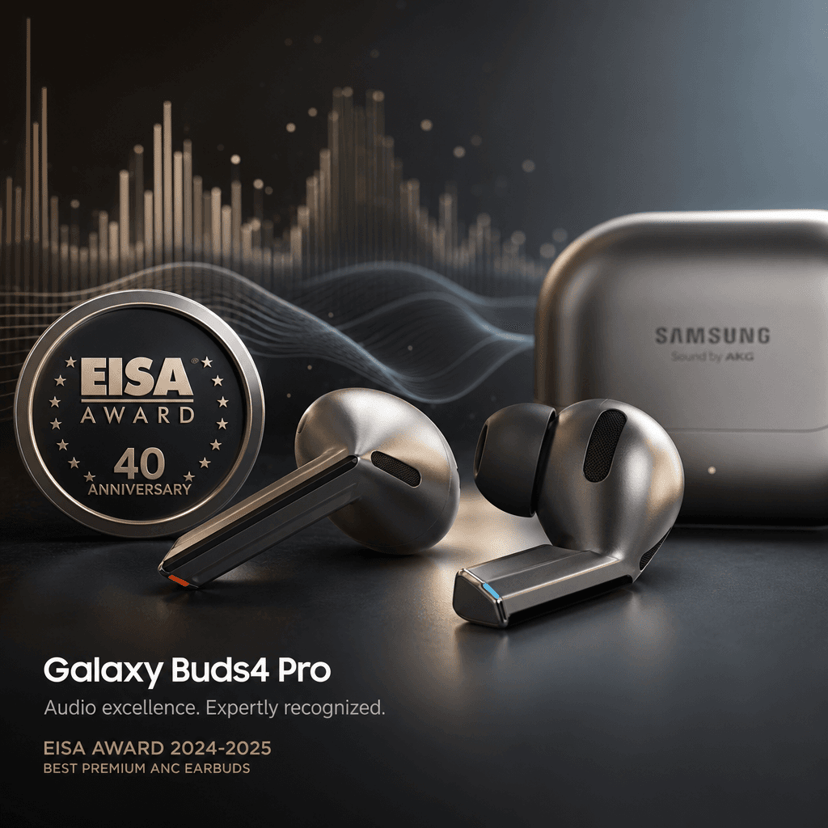
The Galaxy Buds4 series launches alongside the phones, extending AI agent interactions through voice activation and Head Gestures on the Buds4 Pro for hands-free control.
Pricing wasn't disclosed in the official announcement, though pre-orders open February 25 with availability varying by region. Samsung positions the S26 series as its third-generation AI phones, building on two years of Galaxy AI development since the technology's introduction.
The Galaxy S26 series marks Samsung's most significant privacy and AI integration yet, with the Privacy Display representing genuine hardware innovation rather than iterative improvements. Whether consumers prioritize pixel-level privacy enough to justify flagship pricing remains to be seen, but the technology gives Samsung a clear differentiator in a crowded premium smartphone market. The 39% AI processing boost and seven-year update commitment signal Samsung's long-term bet on device-based AI rather than cloud dependency - a strategy that could age well as privacy regulations tighten globally. Pre-order customers will be the first to test whether Samsung's vision of effortless, background AI actually delivers on the promise when the phones ship later this month.