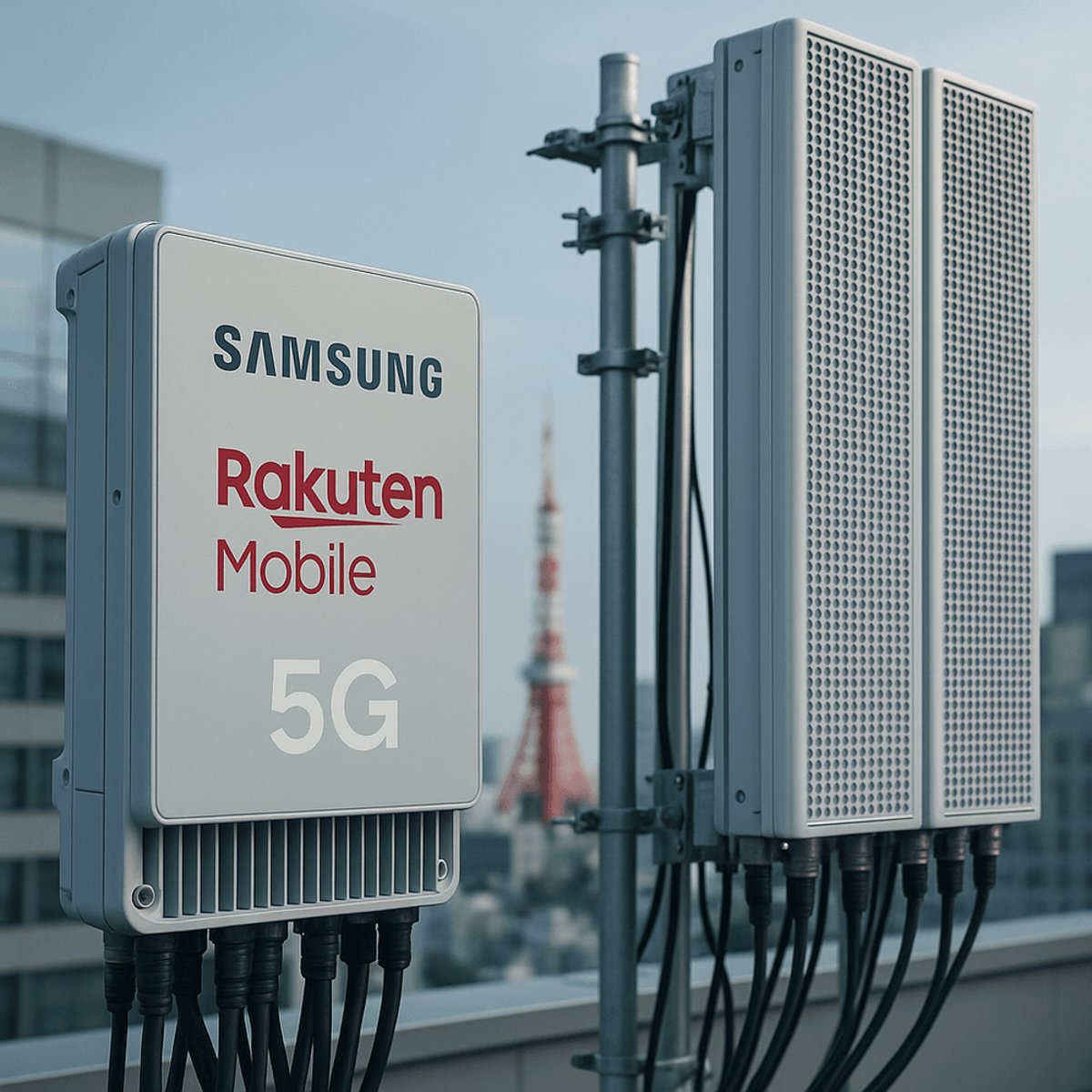
Samsung just locked down a major infrastructure win in Japan's competitive telecom market. The electronics giant will supply Open RAN-compliant 5G radios to Rakuten Mobile, powering the carrier's nationwide network expansion across Japan. The deal marks Samsung's first major partnership with Rakuten Mobile and reinforces the company's growing presence in the Open RAN ecosystem, where interoperability between vendors has long been telecom's holy grail. Commercial deployment kicks off later this year.
Samsung Electronics just scored a significant infrastructure win that could reshape Japan's 5G landscape. The company will supply Open RAN-compliant 5G radios to Rakuten Mobile, supporting the carrier's ambitious nationwide network expansion. After months of testing and validation, the partnership is set to enter commercial deployment in 2026, according to Samsung's announcement.
This isn't just another telecom equipment deal. Rakuten Mobile has built its reputation on being the world's first fully virtualized, cloud-native mobile network operator. By choosing Samsung as its radio provider, the Japanese carrier is betting on Open RAN technology to deliver the kind of flexibility and cost efficiency that traditional proprietary systems can't match. It's a validation of Samsung's years-long push into virtualized RAN and O-RAN leadership, built through large-scale commercial deployments worldwide.
The technical scope is substantial. Samsung will provide a full suite of O-RAN compliant radios, including low-band 700MHz and mid-band 1.7GHz solutions, plus Massive MIMO radios supporting the 3.8GHz band. These compact, lightweight radios can be mounted on buildings and poles, making them ideal for dense urban environments where space is at a premium. The Massive MIMO solutions are particularly critical, they'll accelerate network capacity in high-traffic areas, ensuring subscribers get consistent high-speed connectivity even when the network is under stress.
"Rakuten Mobile has made continuous efforts in delivering best-in-class mobile services to our customers through various endeavors such as expanding 5G coverage and optimizing network performance," Sharad Sriwastawa, co-CEO of Rakuten Mobile and President of Rakuten Symphony, told Samsung. "By working together with our leading Open RAN partner Samsung, we're looking forward to our continued collaboration in expanding Open RAN deployment globally, on top of adding momentum to accelerating 5G deployments in Japan."
The timing is strategic. Open RAN has long promised to break the stranglehold that traditional equipment vendors like Ericsson and Nokia have held over mobile networks. But the technology has faced skepticism about whether it can deliver carrier-grade reliability at scale. Rakuten Mobile's selection of Samsung demonstrates that O-RAN isn't just viable in lab environments, it can work in multi-vendor networks serving millions of subscribers.
For Samsung, this partnership opens a new customer relationship in one of Asia's most sophisticated telecom markets. The company has been aggressively building its network equipment business, leveraging its experience in chipsets, radios, and core network infrastructure. Samsung's end-to-end 5G portfolio now includes everything from purpose-built RAN and vRAN to Open RAN, AI-RAN, and core solutions. The company provides network infrastructure to operators serving hundreds of millions of users globally.
"Samsung is proud to join forces with Rakuten Mobile as we harness our collective capabilities to drive next-generation connectivity through industry-leading solutions," said Angelo Jeongho Park, Executive Vice President and Head of Global Sales & Marketing for Networks Business at Samsung Electronics, in the company's statement. "This underscores Samsung's successful entry into a new customer partnership and further solidifies our Open RAN leadership. We expect to bolster our joint efforts with Rakuten Mobile to make greater strides on the global stage by embracing AI and openness."
The emphasis on AI is telling. Samsung is already positioning its network solutions around AI-powered automation and optimization, anticipating the next wave of network evolution. The company's research and development efforts are simultaneously advancing 5G networks while paving the way for 6G, with a product portfolio that spans AI-powered automation tools, private network solutions, and next-generation radio technologies.
Rakuten Mobile's approach has always been unconventional. While traditional carriers spent decades locked into proprietary systems from single vendors, Rakuten built its network from scratch using cloud-native architecture and Open RAN principles. The strategy has allowed the company to deploy and scale faster than incumbents, though it's also faced challenges around coverage and profitability. This Samsung partnership should help address the coverage equation, particularly in urban areas where capacity demands are highest.
The deal also highlights the shifting competitive dynamics in telecom equipment. Samsung has been steadily gaining ground against European incumbents, particularly in markets where operators are looking for alternatives to the traditional duopoly. The company's advantage lies in its ability to offer integrated solutions across the entire technology stack, from semiconductors to software. That vertical integration can translate into better performance and tighter coordination between network layers.
What makes this deployment particularly interesting is the multi-band approach. By covering low-band, mid-band, and high-band spectrum, Samsung's radios will need to handle everything from wide-area coverage to ultra-high-capacity hotspots. It's a real-world stress test of Open RAN technology across the full spectrum of use cases that carriers face daily.
Samsung's partnership with Rakuten Mobile represents more than just a supplier agreement, it's a bet on the future architecture of mobile networks. As Open RAN technology proves itself in one of the world's most demanding markets, other carriers will be watching closely. If Samsung and Rakuten can deliver on their promise of flexible, high-performance 5G at scale, it could accelerate the industry's shift away from proprietary systems. For Samsung, success here could unlock similar opportunities across Asia-Pacific and beyond, positioning the company as a credible alternative to traditional telecom equipment giants. The real test begins when commercial deployment starts later this year and millions of Japanese subscribers put the network through its paces.