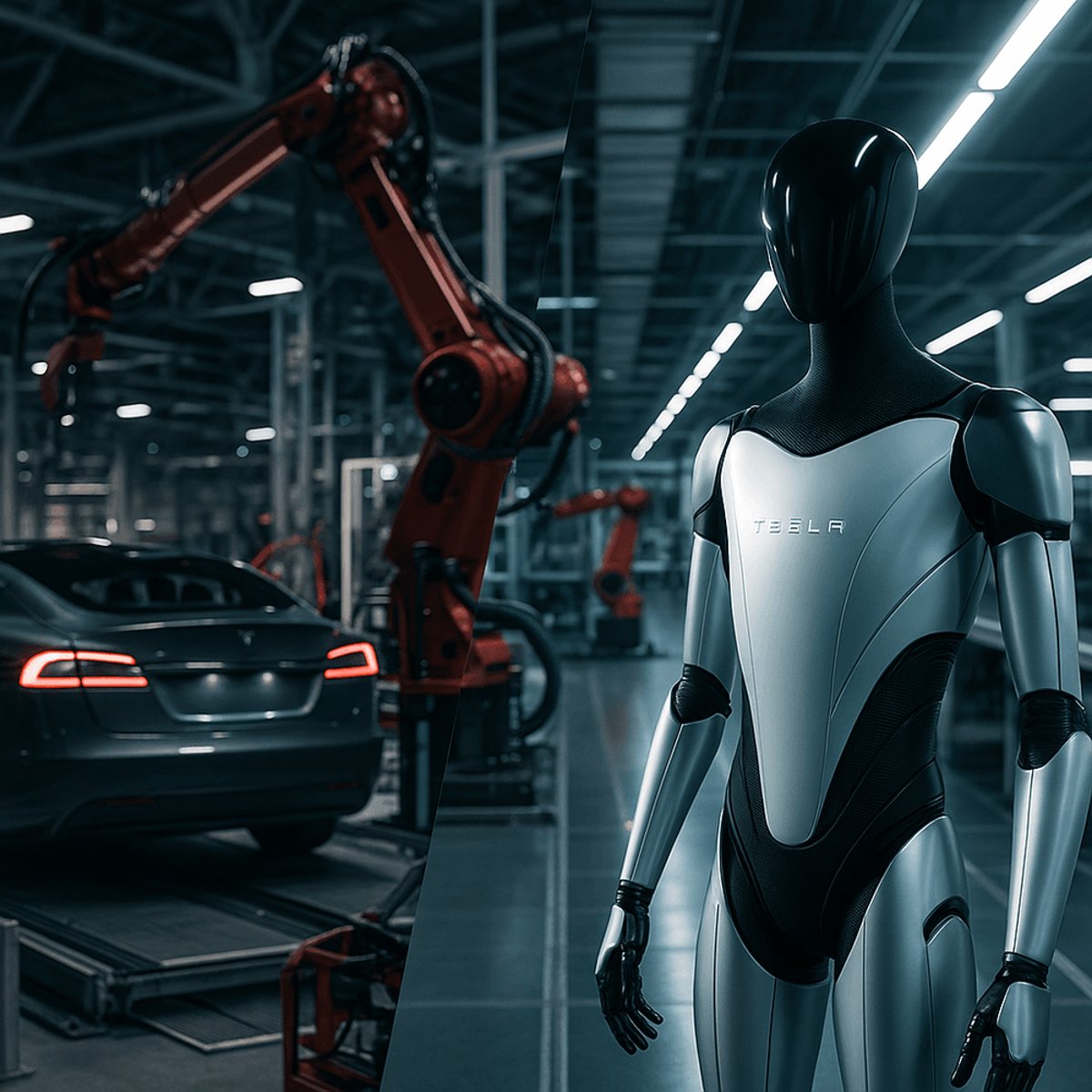
Tesla just made its boldest - and riskiest - strategic pivot yet. CEO Elon Musk announced Wednesday that the company is killing off its Model S and X vehicles and converting the entire Fremont production line to manufacture Optimus humanoid robots at a target rate of 1 million units per year. The bombshell came during Tesla's Q4 earnings call, where the company reported its first-ever annual revenue decline. Musk is essentially betting Tesla's oldest factory on a product that doesn't yet exist commercially, abandoning the premium EVs that helped build the brand's luxury credentials.
Tesla is pulling the plug on the vehicles that started it all. During Wednesday's fourth-quarter earnings call, Elon Musk announced the company is ending production of the Model S sedan and Model X SUV - giving the legacy vehicles what he called "an honorable discharge" - and repurposing their Fremont, California production lines to build Optimus humanoid robots instead.
"If you're interested in buying a Model S and X, now would be the time to order it," Musk told investors, according to the earnings call transcript. The comment sent shockwaves through the auto industry, marking the end of the two models that established Tesla as a serious luxury automaker over a decade ago.
The timing is jarring. Tesla just reported its first annual revenue decline on record, with sales falling in three of the past four quarters. Rather than doubling down on EVs, Musk is pivoting hard into robotics - a market where Tesla has exactly zero commercial presence. The company plans to unveil Optimus Gen 3 this quarter, calling it the "first design meant for mass production" in Wednesday's earnings release.
The numbers tell the story of why Model S and X are getting axed. The two vehicles accounted for just 3% of Tesla's 1.59 million deliveries last year, with the Model 3 and Y dominating at 97%. Tesla has been slashing prices on S and X as global EV competition intensified, eroding whatever premium margins these flagship models once commanded. The Model S launched in 2012, the X in 2015 - ancient by automotive standards.
But killing these models isn't just about poor sales. It's about supply chain economics. "Because it is a completely new supply chain, there's really nothing from the existing supply chain that exists in Optimus," Musk explained on the call. Translation: Tesla needs dedicated manufacturing capacity for robots, and it's not interested in running parallel production systems. The Fremont factory, Tesla's first major production facility, is getting a complete overhaul to support what Musk claims will be a 1-million-unit-per-year Optimus production line.
The bet is enormous. Tesla is developing Optimus as a bipedal humanoid robot capable of tasks ranging from factory work to household assistance. The company has shown off prototypes at various events, but the robot remains far from commercial viability. Competitors like Boston Dynamics and Figure AI are racing toward similar goals, while Tesla still struggles to deliver on its Full Self-Driving promises for actual cars.
The auto industry is watching this move with a mix of fascination and skepticism. Legacy automakers spent decades building brand equity in the premium sedan and SUV segments - exactly what Tesla is now abandoning. The Model S pioneered the long-range luxury EV category and regularly outsold comparable models from BMW, Mercedes-Benz, and Audi in key markets. The Model X brought falcon-wing doors and three-row electric SUV capability to wealthy families.
Wall Street analysts have been increasingly vocal about Tesla's valuation disconnect. The company trades at multiples that assume massive future growth in non-automotive businesses like energy storage, autonomous driving, and now robotics. Wednesday's announcement is Musk putting his money where his mouth is - literally retooling factories to match the narrative. Whether Optimus can generate anything close to the revenue that Model S and X produced remains the trillion-dollar question.
Musk has been telegraphing this shift for months, repeatedly telling investors that Tesla should be valued as an AI and robotics company rather than an automaker. The Fremont conversion is the most concrete evidence yet that he means it. The facility will need extensive reconfiguration, new tooling, and entirely different workforce training to build humanoid robots instead of luxury EVs.
The move also frees up capital and engineering resources. Model S and X have been a drain on development budgets, requiring continuous updates to remain competitive while never achieving the scale of Model 3 and Y. By consolidating around fewer vehicle platforms and betting on Optimus, Tesla is making a clear choice about its future identity.
Tesla is burning the boats. By retiring Model S and X and converting Fremont to robot production, Musk is forcing the company - and investors - to embrace his vision of Tesla as an AI robotics firm rather than a car company. It's a high-stakes gamble that abandons proven revenue streams for a product that exists only in prototype form. If Optimus succeeds, Tesla could dominate an entirely new industry worth hundreds of billions. If it stumbles, the company will have sacrificed its premium automotive credentials for nothing. The next few quarters will reveal whether Musk is a visionary or just reckless.