Tesla just posted its worst profit performance in years, with earnings plunging 46% to $3.8 billion across 2025 as the electric vehicle giant's core car business continues to sputter. The company shipped 1.63 million vehicles globally, marking a second consecutive year of declining sales despite CEO Elon Musk's longstanding promise of 50% annual growth. But investors sent shares higher after-hours Wednesday, betting on Tesla's pivot to what it calls a "physical AI company" - including a surprise $2 billion investment in Musk's AI startup xAI.
Tesla is no longer just an electric vehicle company struggling with falling car sales - it's betting the farm on becoming an AI and robotics powerhouse. The numbers released Wednesday paint a stark picture of an automotive business in decline, even as the company's stock defied gravity on promises of a high-tech future.
The EV maker reported just $3.8 billion in profit for all of 2025, down a staggering 46% from the prior year, according to its shareholder letter. Revenue from car sales fell 11% year-over-year, and the company's 1.63 million vehicle deliveries mark the second consecutive year of sales contraction. It's a brutal reversal for a company whose CEO spent years promising investors average annual growth of 50%.
But Wall Street isn't panicking. Shares climbed in after-hours trading as Tesla beat earnings and revenue estimates, powered by surging growth in everything except its core business. The company's energy storage and solar divisions grew revenue 25% compared to 2024, while its services segment - including Full Self-Driving software subscriptions, insurance, parts, and Supercharging fees - jumped 18%.
The real headline buried in the earnings release: Tesla just invested $2 billion in xAI, Elon Musk's artificial intelligence startup. The investment came as part of xAI's recent Series E funding round, creating yet another layer of financial entanglement between Musk's sprawling business empire and Tesla's shareholder capital.
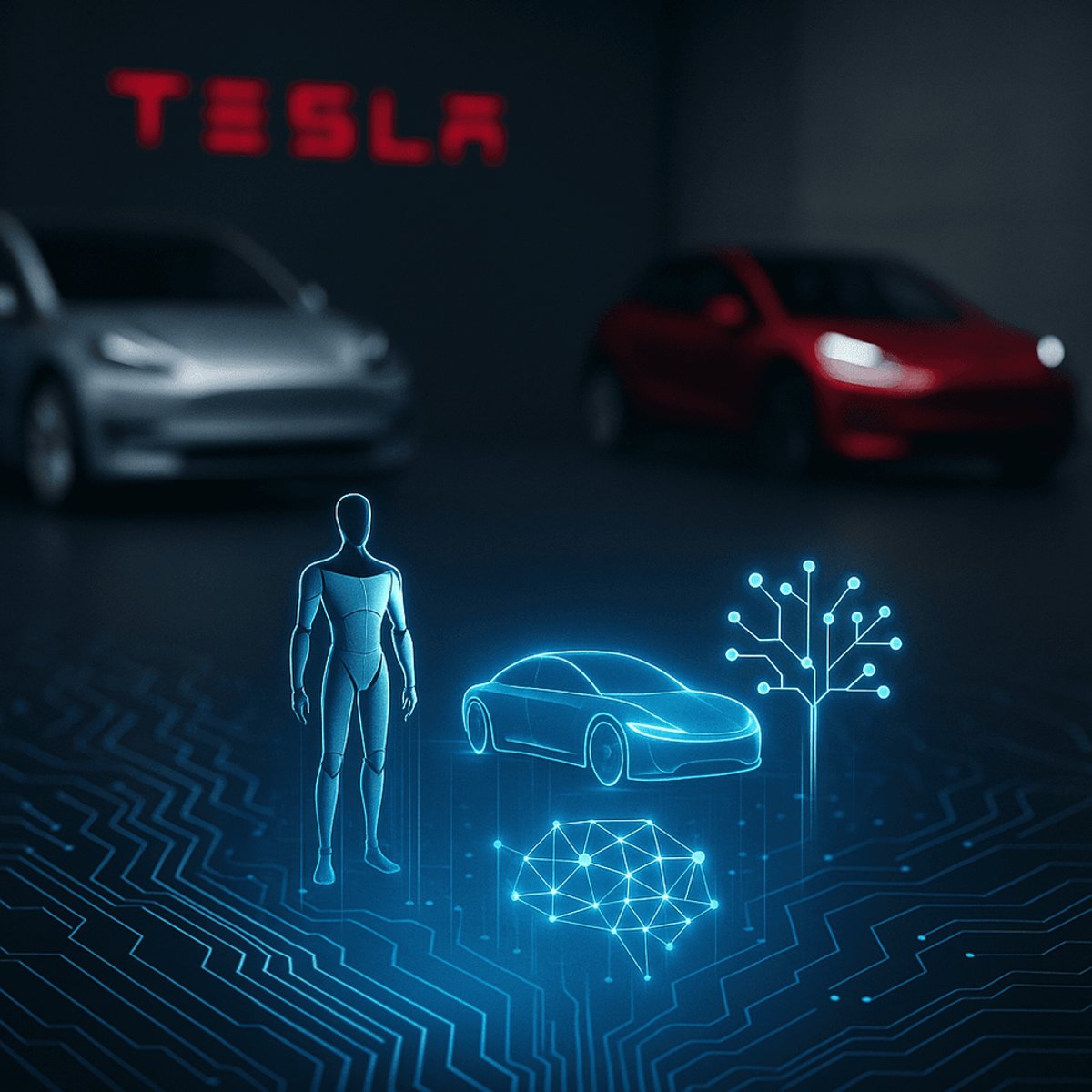
"2025 marked a critical year for Tesla as we further expanded our mission and continued our transition from a hardware-centric business to a physical AI company," the company wrote in its shareholder letter. It's corporate-speak for a fundamental strategic pivot away from the car business that built the company.
The timing couldn't be more fraught. Musk's assumption of a role in the Trump administration coincided with Congress killing federal EV subsidies, creating a perfect storm that hammered Tesla's sales. The political distraction and policy headwinds show up clearly in the delivery numbers - the kind of consecutive annual declines that would typically trigger alarm bells for any growth stock.
But Tesla is asking investors to look beyond the struggling automotive division to a future filled with robotaxis, humanoid robots, and AI infrastructure. Long-delayed projects are supposedly nearing reality. The Tesla Semi, first unveiled way back in 2017, and the Cybercab robotaxi, which debuted in 2024 after years of teasing, are both slated to enter production in the first half of 2026.
The company is throwing resources at an almost dizzying array of moonshot projects. Tesla started pilot production at its lithium refinery in Texas. It's developing proprietary inference chips for autonomy and robotics programs. The third-generation Optimus humanoid robot is set for reveal in Q1 2026. Each represents a bet that Tesla's future lies in cutting-edge technology rather than selling electric sedans and SUVs.
Investors seem willing to give Musk the benefit of the doubt, at least for now. The company even managed to expand gross margins compared to prior quarters, suggesting improved operational efficiency despite lower volumes. Energy storage deployments are booming as utilities and businesses race to add battery capacity to support grid stability and renewable integration.
The question is whether Tesla can execute on its AI and robotics vision before the automotive business deteriorates further. The company is essentially asking shareholders to accept short-term pain in car sales in exchange for long-term gains in higher-margin businesses like software, energy, and eventually autonomous transportation.
Competition in EVs has intensified dramatically. Legacy automakers and Chinese rivals are flooding the market with new models, many priced below Tesla's offerings. The company's aging product lineup - the Model 3 and Model Y still account for the vast majority of sales - hasn't seen major refreshes in years. Price cuts throughout 2025 helped move inventory but squeezed margins.
Musk's political activities and public persona have also become a wildcard. His visibility in the Trump administration and controversial statements on social media have alienated some potential buyers, particularly in progressive markets where EV adoption is highest. It's a dynamic that doesn't show up in financial statements but influences purchase decisions.
The $2 billion xAI investment raises its own questions about capital allocation. Shareholders might wonder whether that money could have been better spent on new vehicle development, manufacturing capacity, or the Supercharger network. Instead, it's flowing to another Musk venture with unclear returns to Tesla's core business.
Still, the after-hours stock pop suggests the market is buying what Tesla is selling - literally and figuratively. Energy revenue growth of 25% demonstrates real momentum in a business with potentially better economics than car manufacturing. Services revenue climbing 18% shows Tesla is building recurring revenue streams that could smooth out the volatility of vehicle sales cycles.
The company's transformation into what it calls a "physical AI company" is underway whether skeptics like it or not. The question for 2026 is whether Tesla can stabilize its automotive business while scaling up these newer ventures fast enough to justify its premium valuation.
Tesla's 2025 earnings tell two different stories. The automotive business that built the company is in undeniable decline, with sales falling for a second straight year and profit cut nearly in half. But the company's bet on AI, robotics, and energy is starting to pay off in ways that have investors looking past the car sales slump. The $2 billion xAI investment signals Musk is all-in on this transformation, even if it means diverting capital from the core business. Whether this pivot rescues Tesla's growth story or becomes an expensive distraction will define 2026. For now, Wall Street is giving Musk the benefit of the doubt - but consecutive years of automotive decline can't continue indefinitely without consequences.