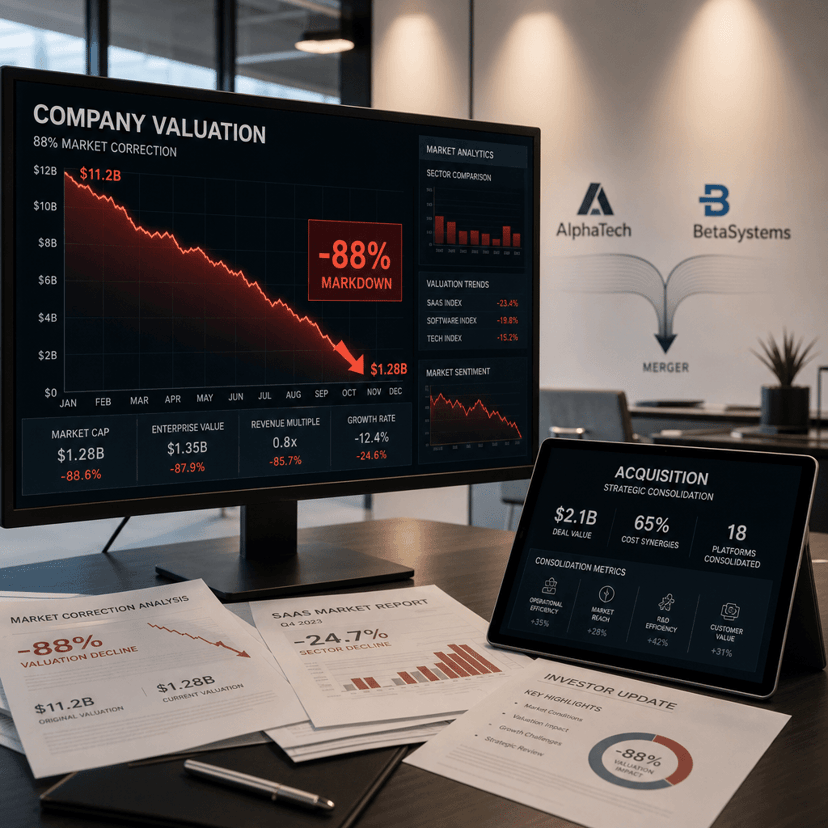
Workday shares tumbled in after-hours trading Tuesday after the enterprise software giant delivered weaker-than-expected revenue guidance for the coming quarters. The disappointing forecast comes just weeks after the company announced CEO Carl Eschenbach is stepping down, with co-founder Aneel Bhusri returning to the helm. The dual blow of soft numbers and leadership uncertainty is rattling investors who've counted on Workday as a steady player in the cloud software wars.
Workday just gave investors a reality check on the enterprise software market. The company's Q4 earnings report, released Tuesday evening, showed revenue guidance that fell short of Wall Street expectations, sending shares sliding in extended trading. According to the CNBC report, the cloud software provider is facing headwinds that go beyond typical quarterly fluctuations.
The timing couldn't be worse. Just weeks ago, Workday announced that CEO Carl Eschenbach would be stepping down after less than three years at the helm. Co-founder Aneel Bhusri, who previously served as CEO before handing the reins to Eschenbach in 2024, is making a comeback to steady the ship. The leadership shuffle already had analysts nervous, and now the soft guidance is amplifying those concerns.
Workday built its reputation on human capital management and financial planning software that enterprises depend on for core operations. But the market's getting crowded. Microsoft has been aggressively pushing Dynamics 365 with AI capabilities baked in, while SAP continues to defend its turf in the ERP space. The pressure's showing up in Workday's numbers.
What's particularly striking is the disconnect between enterprise software demand and Workday's performance. Most analysts expected robust cloud spending to continue, especially as companies invest in digital transformation and AI-powered tools. Yet Workday's guidance suggests something's not clicking, whether it's elongated sales cycles, pricing pressure, or customers hitting pause on big implementations.
Bhusri's return as CEO adds another layer to this story. He co-founded Workday back in 2005 and led it through its IPO and early growth years. His decision to step back in suggests the board believes only a founder can navigate whatever's happening internally. But comeback stories in tech are tricky - just ask Intel, which brought back Pat Gelsinger to mixed results so far.
The enterprise software market has changed dramatically since Bhusri first ran the company. AI isn't just a buzzword anymore - it's table stakes. Salesforce is embedding Einstein GPT across its platform, Oracle is pitching AI-powered databases, and ServiceNow is automating workflows with machine learning. Workday's been talking about AI capabilities, but investors clearly want to see those translate into revenue growth that justifies the company's premium valuation.
There's also the macro picture. Enterprise software spending has been resilient, but CFOs are scrutinizing every contract renewal. Workday's subscription model means customers are constantly evaluating whether they're getting value. If implementations are taking longer or adoption is slower than expected, that shows up quickly in retention and expansion metrics.
The stock reaction tells you everything about investor sentiment right now. Any sign of weakness in high-multiple software companies triggers immediate selling. Workday's been trading at a premium because investors believed in consistent, predictable growth. When that narrative cracks, multiples compress fast. After-hours trading showed investors weren't waiting around to hear management's explanation.
Bhusri faces a tough task ahead. He needs to articulate a clear vision for how Workday competes in an AI-first world while also addressing whatever operational issues led to this guidance miss. The next earnings call will be critical - analysts will grill him on customer sentiment, deal pipeline, and whether this is a temporary blip or a sign of deeper challenges.
For the broader enterprise software sector, Workday's stumble raises questions about the sustainability of growth rates that investors have come to expect. If a well-established player like Workday is struggling to meet numbers, that could signal tougher conditions across the board. Competitors will be watching closely, looking for opportunities to poach customers or talent during this uncertain period.
Workday's earnings miss and leadership transition mark a pivotal moment for one of enterprise software's most respected names. The combination of weak revenue guidance and a CEO change creates uncertainty that Wall Street hates, especially in a sector where predictability commands premium valuations. Bhusri's return might bring the founder's vision back to the forefront, but he inherits a more competitive landscape than when he last held the CEO title. The next few quarters will reveal whether this is just a rough patch or the start of a longer struggle to maintain relevance in an AI-driven enterprise software world. For now, investors are voting with their feet, and the message is clear: show us the path back to growth.