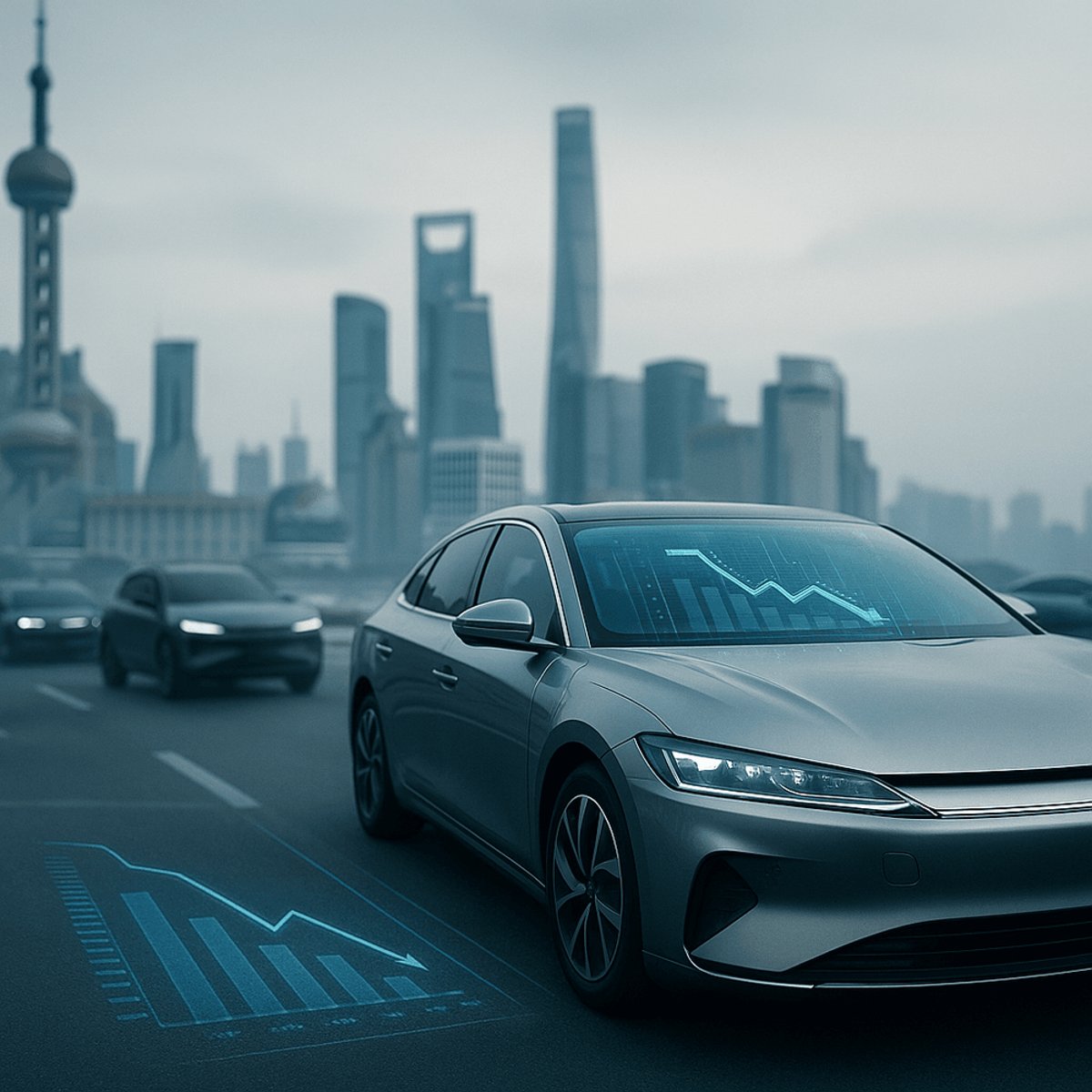
China's electric vehicle champion is stumbling. BYD, the world's largest EV maker, lost significant ground to domestic competitors during the first two months of 2026 as demand across China's electric vehicle market slowed dramatically. The sales plunge marks a troubling reversal for the company that dethroned Tesla just months ago, raising questions about whether the Chinese EV boom has finally hit its ceiling.
BYD just hit a speed bump in what's been an otherwise meteoric rise. The Chinese electric vehicle powerhouse saw sales plunge during the first two months of 2026, losing market share to a pack of hungry domestic rivals as China's once-booming EV market shows signs of cooling.
The sales decline comes at an awkward moment for BYD, which only recently celebrated overtaking Tesla as the world's top-selling electric vehicle manufacturer. That victory lap now feels premature as competitors like Nio, Li Auto, and Geely capitalize on BYD's stumble.
China's EV market has been the engine driving global electric vehicle adoption, but cracks are starting to show. The January-February period is traditionally slow due to the Lunar New Year holiday, when factories shut down and consumer spending shifts away from big-ticket purchases. But industry watchers say this year's downturn appears more pronounced than typical seasonal patterns would explain.
The broader context reveals a market in transition. Chinese EV makers have been locked in a brutal price war for over a year, slashing margins to capture market share. BYD itself triggered several rounds of price cuts in 2025, forcing competitors to follow suit or risk being priced out. That strategy worked for a while, but it may be reaching its limits as consumers grow fatigued and wait for the next round of discounts.
Government policy shifts are adding pressure too. Beijing has been gradually reducing EV subsidies as the industry matures, forcing automakers to compete on actual product merit rather than incentive-fueled demand. The transition is exposing which companies built sustainable businesses versus those riding the subsidy wave.
BYD's competitors aren't sitting idle. Nio has been pushing its battery-swap technology as a differentiator, while Li Auto focuses on extended-range electric vehicles that ease range anxiety. Geely, backed by massive manufacturing scale, is flooding multiple market segments with diverse EV offerings. Each is chipping away at BYD's dominance with distinct strategies.
The international dimension matters too. BYD has been aggressively expanding into Europe, Southeast Asia, and Latin America, which may be diverting management attention and resources from the crucial home market. Building global distribution networks and brand recognition requires massive investment, potentially leaving less firepower for the domestic price wars.
Market saturation is becoming a real concern. China's tier-one cities already have high EV penetration rates, and growth is shifting to smaller cities where charging infrastructure lags and consumer preferences differ. BYD and its rivals are all chasing the same customers in an increasingly crowded field.
The technical innovation race is accelerating too. Solid-state batteries, advanced driver assistance systems, and AI-powered features are becoming the new battleground. Companies that can't keep pace with technology development risk falling behind, regardless of their current market position. BYD's vertically integrated model - the company manufactures its own batteries and semiconductors - has been an advantage, but maintaining that edge requires constant R&D investment.
Investors are watching closely. BYD's stock has been volatile as traders try to separate temporary setbacks from structural problems. The company's valuation depends heavily on maintaining growth momentum, and any sign of sustained market share loss could trigger reassessments.
What happens in China's EV market reverberates globally. The country accounts for roughly 60% of worldwide electric vehicle sales, making it the critical battleground for automakers' electrification strategies. If demand is genuinely softening rather than just experiencing seasonal weakness, it has implications for battery suppliers, charging infrastructure companies, and the entire EV ecosystem.
BYD's early 2026 sales slump serves as a reality check for China's electric vehicle industry. The combination of intensifying competition, fading government subsidies, potential market saturation, and seasonal headwinds is creating a more challenging environment than the growth-at-any-cost era that defined recent years. Whether this represents a temporary blip or the beginning of a more fundamental market shift will become clearer in the coming months. For now, the race to dominate the world's largest EV market just got significantly more competitive, and even giants like BYD aren't immune to stumbling.