**Update: 01/26/2026 Google advises that this issue has now been fully resolved. **
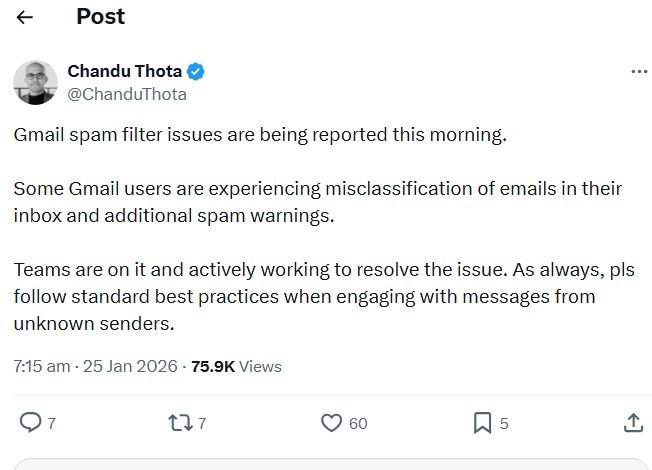
Gmail's spam filtering system suffered a major breakdown early Saturday morning, leaving millions of users drowning in promotional emails and spam while legitimate messages were flagged as suspicious. The disruption, which began around 5am Pacific time, has turned the world's largest email service into what users are calling a "complete mess" - with spam flooding primary inboxes and trusted senders suddenly tagged with warnings. Google confirmed the issue and said it's actively working on a fix, but offered no timeline for restoration.
Gmail users woke up Saturday to chaos in their inboxes as the service's normally reliable spam filtering system went haywire. What started as confusion quickly turned to frustration as users realized that Google's email categorization had essentially stopped working.
The problems began around 5am Pacific time, according to the official Google Workspace status dashboard. The incident report describes two primary issues: "misclassification of emails in their inbox and additional spam warnings." But that dry description doesn't capture the full extent of the disruption hitting the service's 1.8 billion users.
In practice, the breakdown means Gmail's sophisticated categorization system - which normally sorts messages into Primary, Promotions, Social, and Updates tabs - has essentially given up. Promotional emails that would typically be filtered away are now dumping directly into primary inboxes. At the same time, the spam detection system has become paranoid, slapping warning labels on messages from known, trusted senders.
TechCrunch reporter Anthony Ha noted that his Primary inbox was "filled with messages that would normally appear in the Promotions, Social, or Updates inboxes," while spam warnings appeared on emails from senders he regularly corresponds with. It's a double hit - too much noise and too many false alarms.
The outcry on social media reflects just how dependent users have become on Gmail's filtering. "All the spam is going directly to my inbox," complained one user on X. Another described Gmail's filters as "suddenly completely busted" on Bluesky. When a system that processes hundreds of billions of emails annually stops working correctly, people notice immediately.
This isn't just an annoyance for individual users. Gmail powers countless businesses through Google Workspace, and email misclassification can mean missed client communications, lost sales opportunities, or important messages buried under promotional spam. The timing on a Saturday morning may have minimized business impact, but it's still a significant reliability black eye for a service that's become critical infrastructure.
Google acknowledged the problem with a brief statement posted to its status dashboard: "We are actively working to resolve the issue. As always, we encourage users to follow standard best practices when engaging with messages from unknown senders." That last bit of advice feels almost comical given that the system is now flagging known senders as suspicious.
What's notably absent is any explanation of what went wrong or when normal service will resume. For a company that prides itself on engineering excellence and system reliability, the silence is conspicuous. Did a machine learning model go rogue? Was there a bad code deploy? A database corruption issue? Google isn't saying.
The incident highlights how much modern email depends on increasingly complex AI-powered filtering systems. Gmail's spam detection uses machine learning models trained on massive datasets to distinguish legitimate email from junk. When those systems break, there's no easy manual fallback - users are suddenly exposed to the full firehose of incoming messages that would normally be filtered automatically.
For context, Gmail blocks more than 100 million phishing emails every day and has a spam filtering accuracy rate that typically exceeds 99.9%. When that system fails, even briefly, the impact is immediately visible to users who've grown accustomed to clean, organized inboxes.
The breakdown also raises questions about centralization risk in email infrastructure. With Gmail commanding such dominant market share, a filtering failure affects a substantial portion of global email communications. There's no easy workaround when the service itself is the problem.
Google hasn't responded to requests for additional comment beyond the status dashboard update. The company's engineering teams are presumably scrambling to diagnose and fix whatever went wrong with the filtering algorithms. But until then, Gmail users are left manually sorting through the mess - a reminder that even the most sophisticated cloud services can break in spectacular fashion.
Gmail's spam filter meltdown serves as a stark reminder that even the most reliable cloud services can fail without warning. While Google works to restore normal filtering, millions of users are getting an unwelcome glimpse of what email looked like before sophisticated AI-powered sorting - and it's not pretty. The incident underscores both how dependent we've become on automated filtering and how little transparency big tech companies provide when their systems break. Until Google provides more details about what went wrong and when it'll be fixed, Gmail users are stuck doing manually what algorithms normally handle invisibly.