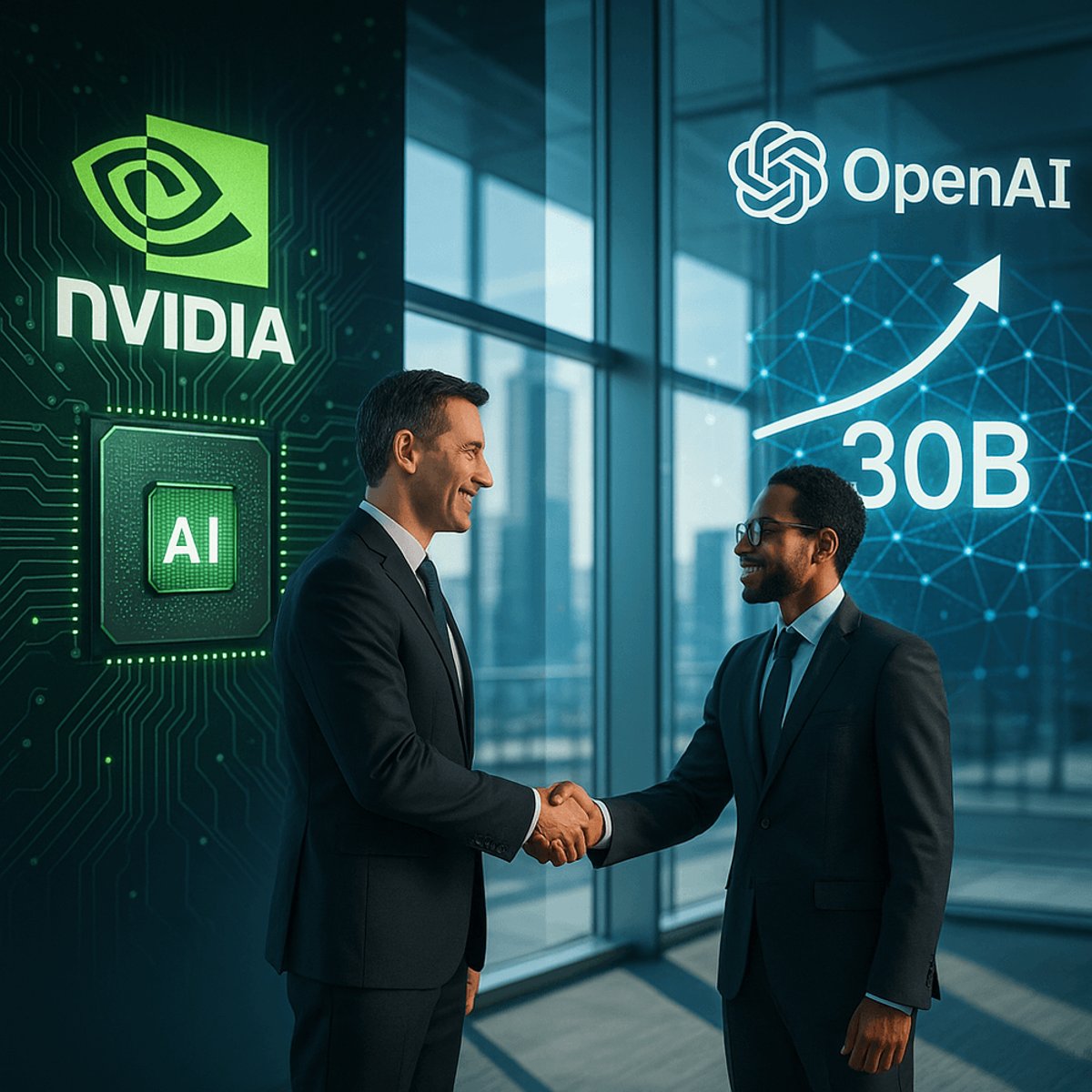
Nvidia is in talks to invest up to $30 billion in OpenAI, marking one of the largest single-company investments in AI history, according to a source familiar with the matter. The deal, reported by CNBC, would be entirely separate from the $100 billion infrastructure agreement the two companies announced last September. If completed, this investment would dramatically deepen the already tight partnership between the world's leading AI chipmaker and the company behind ChatGPT, reshaping the competitive dynamics of the enterprise AI market.
Nvidia is pushing beyond its role as the picks-and-shovels provider of the AI gold rush. The chipmaker's reported negotiations to invest up to $30 billion in OpenAI would mark a strategic shift from arms dealer to stakeholder, cementing one of the most consequential partnerships in tech.
The deal under discussion is distinct from the massive infrastructure partnership the companies unveiled last fall. That $100 billion agreement focused on building out the computational backbone for OpenAI's future models. This new investment represents something different - direct equity ownership in the company reshaping how businesses think about artificial intelligence.
For Nvidia, the move makes strategic sense. The company has watched its valuation soar past $3 trillion on the back of AI demand, with OpenAI serving as both showcase customer and demand driver. Every breakthrough from GPT-4 to the latest o-series models runs on Nvidia's H100 and upcoming B200 chips. But as competition intensifies from AMD, custom silicon efforts at Google and Amazon, and emerging AI chip startups, owning a piece of the most prominent AI company offers a hedge.
The timing coincides with OpenAI's ongoing transformation from nonprofit research lab to commercial powerhouse. The company is reportedly pursuing a complex restructuring that would give CEO Sam Altman equity for the first time while maintaining some nonprofit oversight. That reorganization has attracted interest from sovereign wealth funds, tech giants, and now apparently its most critical hardware partner.
Industry watchers note the deal could reshape competitive dynamics across the AI landscape. Microsoft, which has invested over $13 billion in OpenAI and holds an exclusive cloud partnership, may view Nvidia's deepening involvement with concern. The chipmaker supplies compute to Microsoft's rivals, including Google, Meta, and Amazon, all of whom are building competing AI products.
But Nvidia CEO Jensen Huang has consistently argued the AI market is big enough for everyone. The company's strategy has been to enable all players while remaining platform-agnostic. A major equity stake in OpenAI, however, might test that neutrality, particularly as enterprise customers increasingly choose between OpenAI's models and alternatives from Anthropic, Google, and open-source options.
The $30 billion figure, if accurate, would value OpenAI at well over $150 billion, assuming Nvidia isn't taking a majority position. That valuation would place it among the most valuable private companies globally and underscore the premium investors place on leadership in generative AI. Previous funding rounds have valued OpenAI at around $80-100 billion, suggesting significant appreciation in just months.
For OpenAI, the capital infusion would provide ammunition for what CEO Sam Altman has called the company's most ambitious technical roadmap yet. Training frontier models like GPT-5 and beyond requires unprecedented compute resources. Having Nvidia as both infrastructure partner and major investor could guarantee priority access to the latest chips during shortages and align incentives around pushing the boundaries of what's technically possible.
The structure of any deal remains unclear. Nvidia could be participating in a broader funding round, taking a direct stake through a bilateral agreement, or structuring the investment as convertible debt. The company's balance sheet, flush with AI-driven profits, can easily support a $30 billion deployment. Nvidia generated over $60 billion in revenue last year and is projecting even stronger growth ahead.
Competitors are watching closely. AMD has been positioning its MI300 chips as alternatives to Nvidia's H100, winning some cloud deployments and custom deals. Nvidia's ownership stake in the industry's most visible AI company could make those sales pitches harder, particularly if customers worry about strategic alignment between OpenAI and Nvidia disadvantaging alternative hardware.
The deal talks come as regulatory scrutiny of AI partnerships intensifies. The FTC has been examining Microsoft's OpenAI investment and Amazon's stake in Anthropic, questioning whether these arrangements effectively function as acquisitions designed to sidestep merger reviews. A $30 billion Nvidia investment would likely trigger similar examination, particularly given Nvidia's dominance in AI chips.
Neither company has commented on the reported negotiations. Talks at this stage can evolve or collapse entirely, and deal structures often shift during final negotiations. But the mere possibility signals how quickly the AI industry is consolidating around a few key players and strategic partnerships.
If completed, Nvidia's $30 billion investment in OpenAI would represent more than financial maneuvering. It signals the AI industry entering a new phase where hardware makers aren't content selling infrastructure - they want ownership of the applications layer too. For enterprises building AI strategies, this consolidation matters. The lines between chipmaker, model provider, and platform are blurring, potentially affecting everything from procurement negotiations to long-term vendor lock-in. Watch how Microsoft responds, whether regulatory scrutiny materializes, and if this sparks similar vertical integration moves from AMD, Intel, or cloud providers looking to secure their positions in the AI stack.