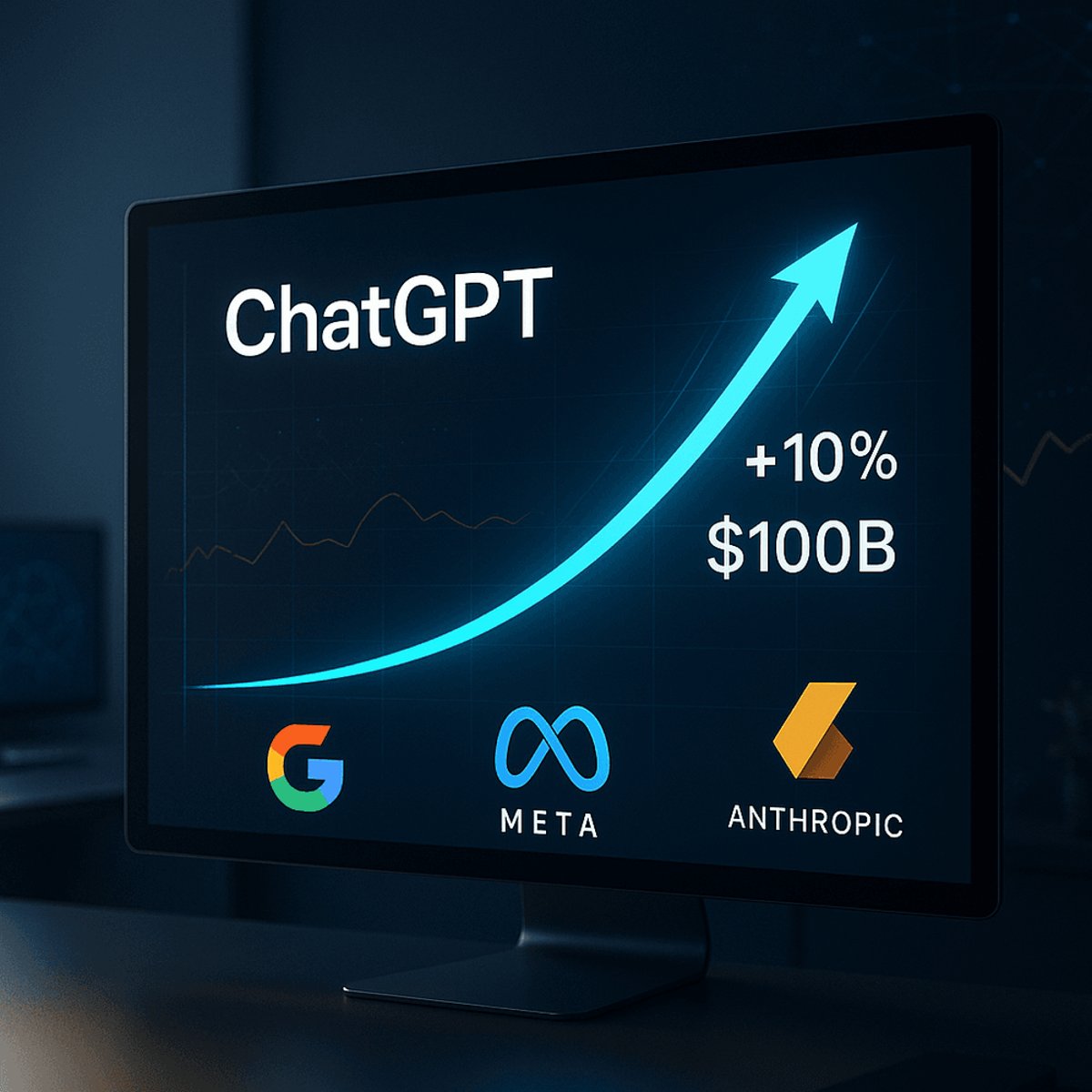
OpenAI CEO Sam Altman just delivered a bullish update to employees: ChatGPT's monthly growth has climbed back above 10%, reversing what many feared was a cooling trajectory for the AI chatbot. The timing couldn't be more strategic - the revelation comes as OpenAI closes in on a massive funding round that would value the company at nearly $100 billion, cementing its position as the most valuable private AI startup even as competition from Google, Meta, and Anthropic intensifies.
OpenAI CEO Sam Altman is rallying the troops with fresh growth numbers that suggest ChatGPT isn't slowing down. In an internal communication to employees, Altman revealed that the AI chatbot's monthly growth rate has climbed back above 10%, a significant acceleration that comes at a pivotal moment for the company, according to CNBC.
The disclosure arrives as OpenAI barrels toward a funding round that would value the San Francisco-based company at approximately $100 billion, a staggering figure that would cement its status as the most valuable private artificial intelligence company in the world. For context, that valuation would put OpenAI in the same league as established tech giants and far ahead of AI competitors like Anthropic, which raised funding at a $18 billion valuation last year.
Altman's message to staff appears designed to counter any internal concerns about ChatGPT's momentum. The AI industry has been watching OpenAI's growth closely, especially as competitors roll out increasingly capable alternatives. Google has been aggressively pushing its Gemini models across search and productivity tools, while Meta has open-sourced its Llama family of models, enabling developers worldwide to build competing applications without paying OpenAI's API fees.
The reacceleration is particularly noteworthy given the natural maturation curve most consumer applications face. ChatGPT exploded onto the scene in late 2022, becoming the fastest-growing consumer application in history by hitting 100 million users in just two months. Maintaining double-digit monthly growth at that scale is exceptionally difficult - even Meta's Instagram and Google's YouTube took years to achieve comparable user bases.
But OpenAI isn't just competing on user growth anymore. The company has been rapidly expanding its enterprise offerings, rolling out ChatGPT Enterprise and forging partnerships with major corporations. Microsoft, which has invested over $13 billion in OpenAI, has integrated the technology across its Office suite and Azure cloud platform, creating multiple revenue streams beyond direct consumer subscriptions.
The competitive landscape has intensified dramatically over the past year. Anthropic's Claude has gained traction among developers who prize its longer context windows and safety features. Google's Gemini integration into Search represents an existential threat to ChatGPT's position as the go-to AI assistant. Meanwhile, Meta is betting that open-source models will eventually commoditize the technology, undercutting OpenAI's ability to charge premium prices.
Yet Altman's growth figures suggest OpenAI is holding its ground. The company has been shipping updates at a blistering pace, including ChatGPT's new voice mode, improved image generation, and enhanced reasoning capabilities. These features appear to be resonating with users who are willing to pay $20 monthly for ChatGPT Plus, contributing to what analysts estimate could be over $2 billion in annual revenue.
The $100 billion valuation question looms large for investors. At that price, OpenAI would be valued at roughly 50 times its estimated annual revenue - a premium multiple that reflects both the transformative potential of AI and the enormous capital requirements to train cutting-edge models. Training runs for frontier AI models now cost hundreds of millions of dollars, and OpenAI is reportedly planning even larger investments in compute infrastructure.
Timing matters here. The funding round comes as the broader AI market shows signs of consolidation. Smaller AI startups are struggling to compete with the computational resources and talent that companies like OpenAI, Google, and Anthropic can marshal. Investors are increasingly betting on a few dominant platforms rather than spreading capital across dozens of hopefuls.
Altman's internal messaging also serves a retention purpose. OpenAI employees hold equity that could become extraordinarily valuable if the company maintains its trajectory toward an eventual public offering or acquisition. Keeping the team motivated and confident in the company's competitive position is critical when rivals are aggressively recruiting AI talent with lucrative compensation packages.
The reacceleration narrative will be tested in the coming months. Sustaining 10%+ monthly growth means adding millions of new users or significantly increasing revenue per user through enterprise contracts and API usage. With Google embedding AI across its ecosystem of billions of users and Meta doing the same, OpenAI's ability to maintain its lead is far from guaranteed.
OpenAI's ability to reaccelerate ChatGPT growth above 10% monthly while approaching a $100 billion valuation signals the company isn't ceding ground to Google, Meta, or Anthropic despite intensifying competition. But sustaining that momentum will require more than product updates - it demands continuing to justify premium pricing in a market where open-source alternatives are proliferating and tech giants are embedding AI across billions of existing users. The funding round will provide the capital to compete in the compute arms race, but the real test is whether ChatGPT can maintain its position as the default AI assistant when every major tech platform is building competing experiences. Investors betting $100 billion are wagering that OpenAI's head start and execution velocity will prove insurmountable, even as the competitive moat narrows with each passing quarter.