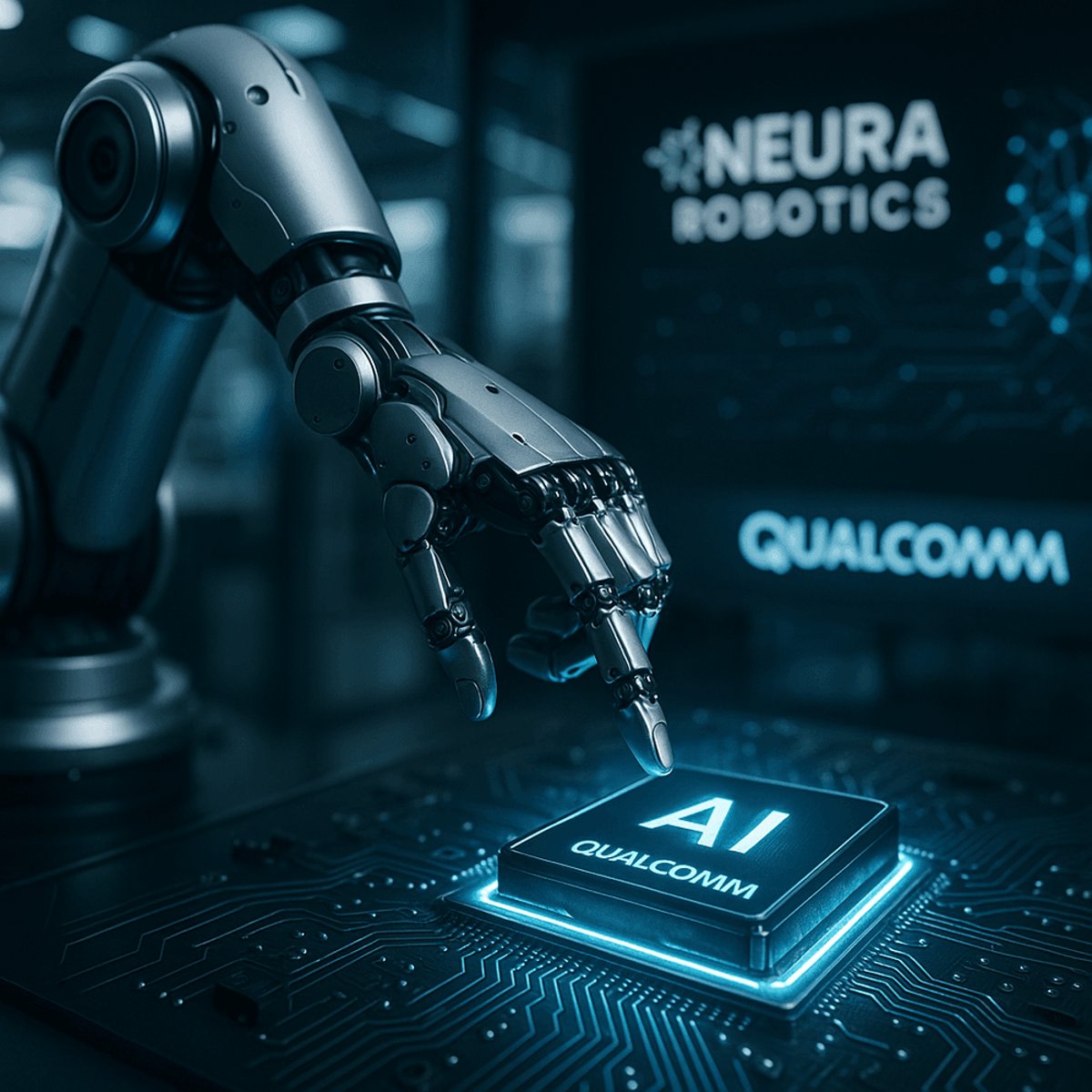
Qualcomm is making a serious play for the AI robotics market. The chip giant just locked in a partnership with Neura Robotics to power the company's next generation of robots with its new IQ10 processors, unveiled at CES earlier this year. The move signals Qualcomm's ambition to challenge NVIDIA's grip on AI hardware and carve out a dominant position in the emerging humanoid robotics space, where computing power meets physical automation.
Qualcomm isn't content just powering smartphones anymore. The San Diego-based chip giant is aggressively pushing into AI robotics, and its new partnership with Neura Robotics marks a major escalation in that strategy.
Neura Robotics, a German startup that's been turning heads with its cognitive automation technology, will integrate Qualcomm's IQ10 processors into its upcoming robot lineup. The IQ10 platform, which Qualcomm unveiled at CES 2026, is purpose-built for edge AI workloads - exactly the kind of real-time processing that humanoid robots need to navigate environments, recognize objects, and make split-second decisions without relying on cloud connectivity.
The timing couldn't be more strategic. The robotics industry is hitting an inflection point as companies race to deploy AI-powered humanoids in warehouses, factories, and eventually homes. But there's a hardware bottleneck - most current robots either rely on cloud processing, which introduces latency issues, or use power-hungry GPUs that weren't designed for mobile autonomous systems.
That's where Qualcomm sees its opening. The company spent decades optimizing chips for mobile devices, mastering the art of balancing performance with power efficiency. Now it's applying that expertise to robotics, where battery life and thermal management are just as critical as raw computing power.
"The IQ10 represents a fundamental shift in how we think about robot intelligence," according to Qualcomm's announcement materials. The processor family includes dedicated neural processing units capable of running large language models and computer vision algorithms locally, eliminating the need for constant cloud connections that plague current-generation robots.
Neura Robotics isn't exactly a household name yet, but the company has been quietly building sophisticated humanoid platforms that combine advanced AI with dexterous manipulation capabilities. Their robots are designed for industrial applications where they need to work alongside humans, adapting to dynamic environments rather than following pre-programmed routines.
But this partnership isn't just about one robotics company. The title of TechCrunch's report says it all - this is just the beginning. Qualcomm is clearly positioning the IQ10 as a platform play, hoping to become the go-to processor for the entire robotics industry.
That puts them in direct competition with NVIDIA, which has dominated AI hardware for years thanks to its GPU architecture and CUDA software ecosystem. NVIDIA has been aggressively courting robotics companies with its Jetson platform and recently announced partnerships with multiple humanoid robot manufacturers. The battle for robotics silicon supremacy is heating up fast.
The competitive dynamics are fascinating. NVIDIA has the AI software ecosystem and developer mindshare. Qualcomm has mobile power efficiency and decades of experience shipping billions of chips that work reliably in constrained environments. Both companies are betting billions that robotics will be the next massive computing platform after smartphones.
For Neura Robotics, the partnership gives them access to cutting-edge silicon without having to design custom chips themselves - a massive advantage for a startup competing against better-funded rivals. It also signals to potential customers and investors that they're building on a solid, scalable hardware foundation.
The broader implication is that robotics is finally moving beyond the experimental phase into industrialization. When major semiconductor companies start forming strategic partnerships and designing specialized chips, it's a sign that the market is maturing and real commercial deployment is imminent.
Qualcomm's move also reflects a larger industry trend: diversification away from the smartphone market, which has matured and stagnated. The company has been pushing into automotive chips, IoT devices, and now robotics, trying to replicate its mobile dominance in new categories before competitors can establish themselves.
What remains to be seen is whether Qualcomm's processor architecture can actually deliver the performance robotics companies need. Running AI models locally sounds great in theory, but humanoid robots require massive amounts of simultaneous processing - sensor fusion, path planning, object recognition, natural language processing, and motor control, all happening in real-time. That's an enormous computational challenge.
The other wildcard is software. NVIDIA's strength isn't just its hardware - it's the entire CUDA ecosystem that makes it relatively easy for developers to write AI applications. Qualcomm will need to build similar tooling and developer support if it wants to compete seriously in this space.
Qualcomm's partnership with Neura Robotics is a clear declaration that the company intends to own a piece of the AI robotics revolution. By designing processors specifically for autonomous systems and locking in early partnerships with promising robotics companies, Qualcomm is positioning itself as a viable alternative to NVIDIA's dominance. Whether the IQ10 platform can actually deliver the performance and developer ecosystem needed to power the next generation of humanoid robots remains to be proven, but one thing is certain - the race to become the Intel of robotics is officially underway, and Qualcomm just put itself in the running.